Stock Analysis · POET Technologies Inc (POET)
Overview
POET Technologies Inc is a small semiconductor company focused on optical interconnect products. In simple terms, it develops technology that helps move very large amounts of data using light instead of only electrical signals. Its core platform, called the POET Optical Interposer, is designed to combine electronic and photonic components in a compact package. The main end markets are data centers, artificial intelligence networking, telecom, and other high-speed communications applications where faster and more power-efficient data transfer is becoming more important.
The business is still in a commercialization phase rather than a mature production phase. That matters for long-term analysis: the company has developed a technology platform and signed partnerships, but its financial profile still looks more like an early-stage industrial technology company than an established chip supplier.
Based on recent annual disclosures and company updates, revenue has been limited and not yet diversified at scale. The available public filings indicate that reported revenue has come primarily from product and design-related commercial activities, with some contribution from development arrangements and engineering services tied to customer programs. A precise breakdown is not consistently detailed enough to present reliable percentages for a recent full year, especially because total revenue remains very small and can move sharply from one contract timing to another.
- Optical engines and modules: products intended for data-center and AI connectivity, including transmit and receive engines and related packaging solutions.
- Development and design services: customer-specific engineering work, qualification programs, and product customization tied to commercialization efforts.
- Technology-related arrangements: collaboration and licensing-type activities, where applicable, though these have not yet created a large recurring revenue base.
The broad financial picture is easy to summarize: spending is concentrated in research and development and operating build-out, while revenue is still at an early stage. Over the last several years, operating expenses have risen much faster than sales, which is typical for a company trying to prove its platform in a demanding hardware market.
The long-term pattern is clear: revenue has remained very small while research, development, and administrative costs have steadily increased. That shows management is investing to reach commercial scale, but it also means the company still depends on future order growth rather than current operating profits.
Key Figures
| Metric | Value | Sector ⓘ |
|---|---|---|
| Date | Sep 12, 2026 | |
| Context | ||
| Sector | Technology | |
| Industry | Semiconductors | |
| Market Cap ⓘ | $1.32B | |
| Beta ⓘ | 0.84 | |
Value (Cheapness) | ||
| P/E Ratio ⓘ | N/A | 29.51 |
| FCF Yield ⓘ | -3.07% | 4.25% |
| EBIT / EV ⓘ | -14.17% | 2.85% |
| PEG ⓘ | N/A | |
Growth (Business expansion) | ||
| Revenue Growth ⓘ | 112.30% | 15.40% |
| RPS Growth (5Y CAGR) ⓘ | 17.50% | 8.56% |
| EPS Growth (5Y CAGR) ⓘ | -4.98% | -11.88% |
| Margin Growth (5Y Trend) ⓘ | N/A | 0.46% |
| FCF Growth (5Y CAGR) ⓘ | N/A | 9.80% |
Quality (Business durability) | ||
| ROIC (Latest) ⓘ | -16.78% | 9.44% |
| ROIC (5Y Median) ⓘ | -89.75% | 8.30% |
| Net Debt / EBIT (Latest) ⓘ | N/A | 0.54 |
| Net Debt / EBIT (5Y Median) ⓘ | N/A | 0.44 |
| Operating Margin (Latest) ⓘ | -4930.04% | 9.58% |
| Operating Margin (5Y Median) ⓘ | -5844.38% | 8.25% |
| Debt to Equity (Latest) ⓘ | 0.92% | 33.33% |
| Profit Margin (Latest) ⓘ | N/A | 7.14% |
| Free Cash Flow (Latest) ⓘ | -$40.43M | |
Momentum (Price trend) | ||
| 3Y Return ⓘ | +125.21% | +45.48% |
| 12M Return (excl. last month) ⓘ | +73.92% | +23.48% |
| 6M Return ⓘ | +6.85% | +20.93% |
| Price vs. 200-Day MA ⓘ | -3.13% | +7.43% |
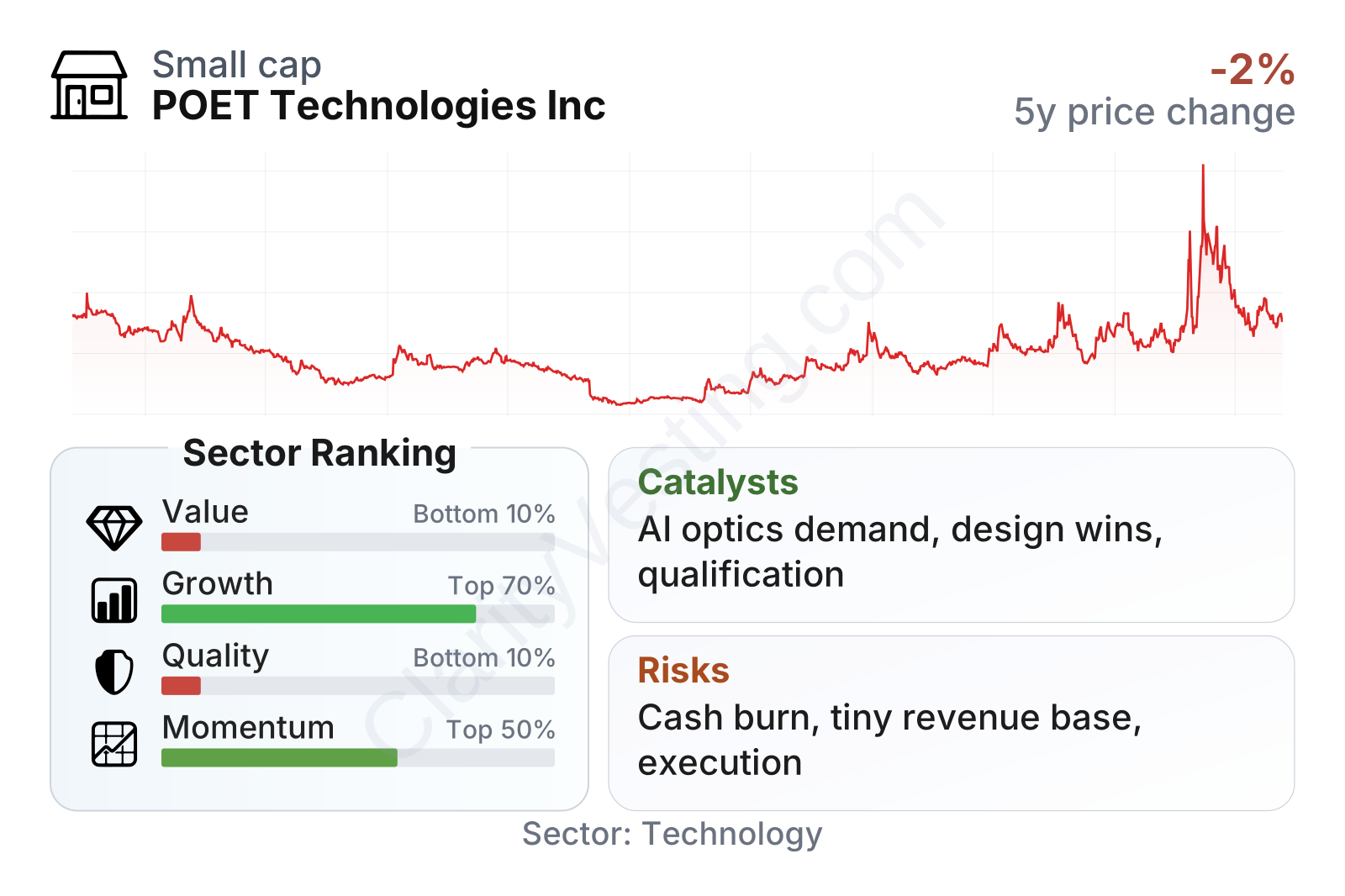
The stock has been highly volatile, with a long decline followed by a sharp rebound into 2026. In the factor snapshot, growth and market momentum look better than average for the semiconductor group, but value and quality rank near the bottom of the sector. That combination usually describes a company with promising revenue acceleration but weak current profitability and limited financial proof so far.
POET remains a relatively small company in market value terms compared with major semiconductor peers. Its beta is below 1, but the actual share-price path shows that company-specific news has mattered far more than any broad-market label would suggest.
Growth
POET operates in a part of the semiconductor industry that has attractive long-term demand drivers. AI clusters, cloud data centers, and high-speed networking all need faster optical links to move data between processors, switches, and memory systems. That trend is real and growing, and it supports the company’s strategic focus on optical engines, co-packaged style integration, and advanced photonics packaging.
The strategy also has an internal logic. Rather than competing directly as a giant full-stack chipmaker, POET is trying to solve a specific bottleneck: how to package optical and electronic functions more efficiently and at lower power and cost. If that platform works at scale, it could fit into a meaningful niche in AI and data communications infrastructure.
Revenue growth has become much stronger after a very uneven period. The recent year-over-year numbers show sharp acceleration, well above the semiconductor sector median, but the swings are so large that they should be read carefully. When a company starts from a very small revenue base, even a few customer shipments can produce extremely large growth percentages. The important point is not the headline percentage alone, but whether it marks the start of repeat orders and broader customer adoption.
Recent company announcements have pointed to design wins, product qualification progress, and partnerships in optical modules and AI-related connectivity. Those developments matter because small photonics companies often need external manufacturing, packaging, and module partners to reach volume production. If qualification turns into recurring shipments, the addressable opportunity could become much larger than the current income statement suggests.
Cash generation remains the weak side of the growth case. Free cash flow has stayed deeply negative and has worsened materially over the last few years, indicating that commercialization still requires meaningful funding. In practice, this means future growth needs to be judged not only by demand potential but by how quickly the company can convert engineering progress into revenue that supports operations.
Risks
This article is for informational purposes only and does not constitute financial advice. Some content is AI-generated. See Disclaimer


