Stock Analysis · Plexus Corp (PLXS)
Overview
Plexus Corp is a manufacturing services company that helps other businesses design, build, and support complex electronic products. In simple terms, it is a behind-the-scenes partner for companies that need sophisticated hardware but do not want to do all the engineering, supply chain management, production, and after-market service themselves. Plexus focuses on markets where products are difficult to make, highly regulated, or mission-critical, which tends to create longer customer relationships than in basic commodity electronics assembly.
The company operates through a global manufacturing footprint and serves customers in areas such as medical devices, industrial equipment, aerospace and defense systems, and communications products. Its model is not centered on selling a branded consumer product. Instead, revenue comes from providing services and manufacturing capacity to other companies, often across the full product life cycle from development to mass production and repair.
Based on the company’s reporting structure, revenue is mainly generated from these end markets, roughly ordered from largest to smallest in recent filings:
- Industrial – typically the largest contributor, including industrial automation, energy-related equipment, and other complex industrial electronics.
- Healthcare / Life Sciences – a major business line tied to medical devices and other regulated healthcare equipment.
- Aerospace / Defense – a smaller but strategically important segment that can support higher-value, longer-cycle programs.
- Communications – generally the smallest of the four, tied to networking and communications infrastructure customers.
Exact percentages can shift meaningfully from year to year depending on customer launches and end-market demand, but Industrial and Healthcare have recently represented the clear majority of sales, while Aerospace/Defense and Communications make up the balance. That mix matters because it gives Plexus exposure to steadier and more specialized markets than low-end consumer electronics.
The business flow also shows a familiar pattern for contract manufacturers: a very large share of revenue is consumed by materials and production costs, leaving relatively thin margins. Even so, the recent progression suggests better conversion from revenue into operating profit and net income than in the weaker period of 2024, helped by lower interest expense and a rebound in earnings.
Key Figures
| Metric | Value | Sector ⓘ |
|---|---|---|
| Date | Jul 18, 2026 | |
| Context | ||
| Sector | Technology | |
| Industry | Electronic Components | |
| Market Cap ⓘ | $6.71B | |
| Beta ⓘ | 0.88 | |
Value (Cheapness) | ||
| P/E Ratio ⓘ | 36.75 | 31.76 |
| FCF Yield ⓘ | 1.13% | 4.18% |
| EBIT / EV ⓘ | 3.32% | 2.56% |
| PEG ⓘ | 2.09 | |
Growth (Business expansion) | ||
| Revenue Growth ⓘ | 18.70% | 13.50% |
| RPS Growth (5Y CAGR) ⓘ | 6.04% | 8.57% |
| EPS Growth (5Y CAGR) ⓘ | -6.56% | -21.87% |
| Margin Growth (5Y Trend) ⓘ | -0.23% | 0.41% |
| FCF Growth (5Y CAGR) ⓘ | 15.85% | 9.76% |
Quality (Business durability) | ||
| ROIC (Latest) ⓘ | 12.13% | 8.54% |
| ROIC (5Y Median) ⓘ | 10.71% | 8.12% |
| Net Debt / EBIT (Latest) ⓘ | -0.16 | 0.38 |
| Net Debt / EBIT (5Y Median) ⓘ | 0.12 | 0.38 |
| Operating Margin (Latest) ⓘ | 5.10% | 9.58% |
| Operating Margin (5Y Median) ⓘ | 4.57% | 8.25% |
| Debt to Equity (Latest) ⓘ | 17.97% | 33.52% |
| Profit Margin (Latest) ⓘ | 4.35% | 6.96% |
| Free Cash Flow (Latest) ⓘ | $75.79M | |
Momentum (Price trend) | ||
| 3Y Return ⓘ | +143.45% | +30.91% |
| 12M Return (excl. last month) ⓘ | +124.72% | +28.90% |
| 6M Return ⓘ | +39.45% | +5.38% |
| Price vs. 200-Day MA ⓘ | +23.87% | +7.61% |
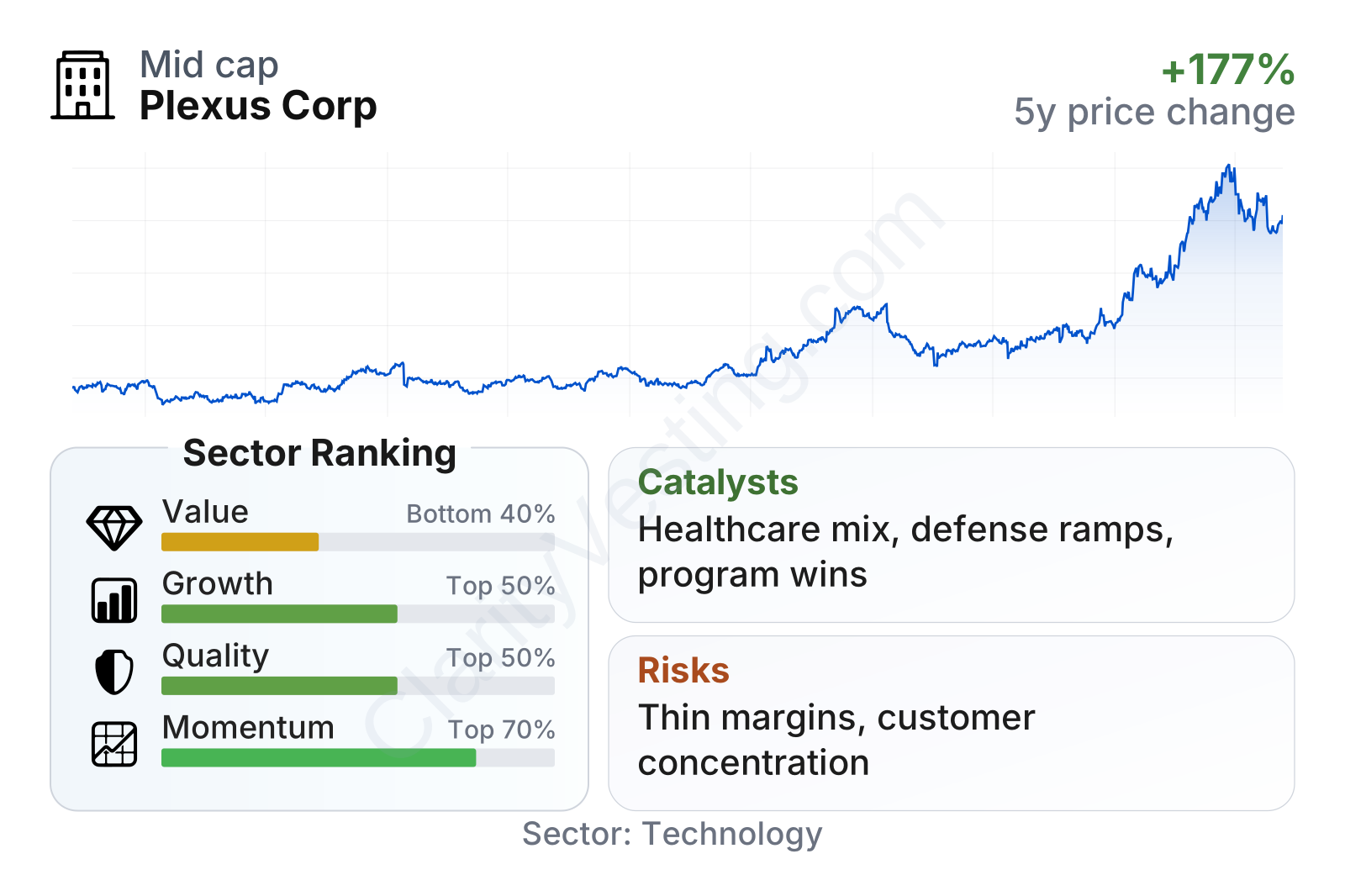
Plexus stands out for balance-sheet strength and decent operating quality, but not for cheapness. The company’s market value is around $8 billion, placing it well above small-cap territory, while its beta sits slightly below 1, suggesting share-price swings that are not unusually extreme for the market. Relative to its sector, quality and growth rank around the middle-to-better half, supported by return on invested capital above the median and very low leverage. The weaker point is valuation: earnings and free-cash-flow measures indicate the stock is not in the inexpensive part of the sector, especially after a strong price run.
The stock chart also helps explain why valuation looks fuller today. Shares have climbed sharply over the last two years, with especially strong momentum from late 2024 into early 2026. That move reflects improving business conditions, but it also means a larger portion of future progress may already be reflected in the share price.
Growth
Plexus operates in a part of the technology and industrial ecosystem that should remain relevant for years: outsourced design, engineering, and manufacturing of complex electronics. This is a favorable niche because many original equipment manufacturers increasingly want partners that can manage supply chains, regulatory requirements, product complexity, and global production without forcing them to own all that infrastructure themselves. Demand is especially durable in healthcare, industrial automation, and aerospace/defense, where reliability and compliance matter more than simply finding the lowest-cost producer.
The company’s strategy appears logically aligned with that environment. Plexus has consistently emphasized higher-complexity programs rather than chasing the highest-volume, lowest-margin consumer electronics work. That tends to reduce direct exposure to the most brutal price competition in contract manufacturing. It also supports customer stickiness, because once a product is designed into a regulated or technically demanding manufacturing process, switching providers can be costly and disruptive.
Recent revenue trends point to renewed momentum after a choppy period. Growth accelerated again into the latest trailing period, and the current year-over-year pace is above the sector median. That said, the longer history shows how cyclical the business can be: strong surges in 2022 and early 2023 were followed by a slowdown and contraction before growth turned positive again. For long-term readers, that pattern suggests Plexus can grow, but not in a straight line.
Cash generation tells a similar story. Free cash flow has improved significantly from the negative levels seen a few years ago, and the five-year trend remains favorable. However, the latest trailing figure is well below the unusually strong level reached in the prior year, which suggests working capital swings and customer timing still have a major influence on short-term cash output. In other words, the direction is better, but volatility remains part of the profile.
A meaningful catalyst is the company’s positioning in healthcare and aerospace/defense. These markets tend to value quality, documentation, and manufacturing discipline, which can reward specialized providers. Continued reshoring, supply-chain diversification, and demand for resilient production networks could also support companies like Plexus, particularly when customers want manufacturing partners outside a single geography. Another possible growth driver is the broader buildout of automation, connected devices, and smart industrial equipment, all of which increase the need for sophisticated electronic assemblies.
Recent company communications and filings have also pointed to improving demand conditions in key programs and stronger earnings expectations relative to the softer period that came before. That matters because Plexus is not being judged purely on distant potential; part of the opportunity comes from evidence that execution and end-market conditions have recently improved.
Risks
The main risk is that Plexus operates in a structurally low-margin business. Even when execution is solid, a contract manufacturer usually keeps only a small share of each sales dollar after paying for materials, labor, and overhead. That makes profits sensitive to customer mix, utilization rates, input costs, and operational hiccups. A company can post higher revenue without seeing the same degree of benefit in earnings if margins come under pressure.
One important mitigating factor is the balance sheet. Debt relative to equity has come down sharply from elevated levels in 2022 and 2023 and now sits comfortably below the sector median. Net debt relative to EBIT is actually negative on the latest reading, which indicates a net cash position rather than a heavily leveraged structure. This does not remove business risk, but it gives Plexus more flexibility if demand softens or customers delay orders.
Profitability remains the softer area. Net margin has recovered from the lows seen in 2024, but it is still below the sector median. Operating margin shows a similar picture. That means Plexus appears operationally competent, but it does not enjoy the kind of margin advantage that would signal a dominant economic moat. Its competitive edge is more about specialization, execution, customer relationships, regulatory know-how, and global manufacturing capabilities than about unusually high profitability.
Competition is intense. Plexus faces larger electronics manufacturing services players such as Jabil, Flex, and Sanmina, as well as other specialized manufacturing and engineering providers depending on the end market. Compared with those larger rivals, Plexus is not the scale leader. Its position is better described as a focused specialist in complex, lower-volume, higher-reliability programs. That can be attractive, but it also means the company must keep proving it can win and retain niche business without the sheer purchasing power or breadth of the biggest competitors.
Customer concentration is another recurring risk in this industry. Even without extreme dependence on a single customer, the loss, delay, or redesign of a few important programs can materially affect revenue and factory utilization. Exposure to regulated and mission-critical industries can stabilize relationships, but it can also lengthen sales cycles and make program ramps harder to predict.
There does not appear to be any widely visible recent scandal or governance event that overshadows the business. The more relevant near-term risk is execution risk: if the recent rebound in growth and earnings cools, the stock could face pressure because expectations have risen along with the share price.
Valuation
Plexus currently trades at a valuation that looks fuller than its own history and somewhat demanding relative to the sector on earnings multiples. The latest P/E is in the mid-40s in the summary metrics, while the broader historical range has often been lower. Even the separate historical series shows that the stock spent long stretches in the high teens to 20s before rerating upward. That rerating has been supported by momentum and improved operating conditions, but it still raises the hurdle for future returns in a purely analytical sense.
Looking across valuation measures, the picture is mixed but leans toward expensive rather than discounted. Free-cash-flow yield is low compared with the sector median, which suggests the market is assigning a healthy premium to the business. EBIT relative to enterprise value is somewhat better, indicating the stock is not extreme on every measure, but the overall value profile still ranks in the lower part of the sector. The PEG ratio around 2 also suggests the valuation already assumes a decent amount of continued progress.
The current price can be understood if the market is rewarding three things at once: a strong balance sheet, better-than-median returns on capital, and renewed top-line momentum after a weaker patch. The challenge is that Plexus still operates with modest margins and a cyclical demand profile. That combination makes the valuation harder to call conservative. In short, the market seems to be pricing Plexus as a well-run specialist with improving prospects, not as an overlooked manufacturer.
Conclusion
Plexus looks like a disciplined, higher-quality operator inside a difficult industry. Its appeal comes from specializing in complex products, serving relatively durable end markets such as healthcare and industrial electronics, and maintaining a much cleaner balance sheet than many peers. Recent revenue and earnings momentum also suggest the business is moving through a healthier phase, which helps explain the stock’s strong performance.
At the same time, the company is still constrained by the basic economics of contract manufacturing. Margins remain modest, profitability trails the sector median, and growth has historically been uneven rather than smooth. Plexus appears stronger than a generic electronics assembler, but it does not clearly look like a dominant industry leader with wide margin protection.
The overall picture is favorable on business quality and strategic positioning, yet more demanding on valuation. That leaves Plexus looking like a credible long-term compounder candidate within specialized manufacturing, but one whose current market pricing already reflects a meaningful share of that improving outlook.
Sources:
- Plexus Corp — Annual Report on Form 10-K for fiscal year 2025
- Plexus Corp — Quarterly Report on Form 10-Q for quarter ended March 28, 2026
- SEC EDGAR — Plexus Corp filings
- Plexus Corp Investor Relations — earnings releases and investor presentation materials
- Plexus Corp Investor Relations — company overview and end-market descriptions
- Wikipedia — Plexus Corp
This article is for informational purposes only and does not constitute financial advice. Some content is AI-generated. See Disclaimer


