Stock Analysis · Palantir Technologies Inc (PLTR)
Overview
Palantir Technologies builds software that helps organizations collect, organize, and analyze large amounts of information so they can make faster decisions. Its platforms are used by government agencies, militaries, intelligence services, and commercial customers in industries such as healthcare, manufacturing, energy, insurance, and logistics. The company’s core products are Gotham for government missions, Foundry for business operations, and AIP, its artificial intelligence platform, which is designed to connect large language models and AI tools to real-world enterprise data and workflows.
Palantir makes most of its money from software subscriptions and related services tied to long-term customer deployments. Based on recent company reporting, revenue is mainly split between government and commercial customers, with the commercial side becoming a larger growth engine. The main sources of revenue can be summarized as follows:
- U.S. commercial: approximately 35% to 40% of revenue. This includes private-sector customers using Foundry and AIP for operations, supply chains, manufacturing, healthcare, and financial use cases.
- U.S. government: approximately 30% to 35% of revenue. This includes defense, intelligence, and other federal agency contracts, where Gotham remains especially important.
- International government: approximately 15% to 20% of revenue. This covers non-U.S. public-sector customers, including allied governments and defense-related organizations.
- International commercial: approximately 10% to 15% of revenue. This includes overseas private-sector customers adopting Foundry and AIP.
The business model has become more attractive over time because revenue has scaled faster than many major operating costs. Gross profit has remained very high, while the company has moved from losses to strong operating profit and net income. That combination matters because it suggests Palantir is no longer only promising future scale; it is increasingly showing it.
One visible trend is the sharp rise in revenue and gross profit since 2021, combined with a major improvement in operating income and net income. Selling and administrative costs have grown much more slowly than revenue, which helps explain why profitability has expanded so quickly.
Key Figures
| Metric | Value | Sector ⓘ |
|---|---|---|
| Date | Sep 12, 2026 | |
| Context | ||
| Sector | Technology | |
| Industry | Software - Infrastructure | |
| Market Cap ⓘ | $401.86B | |
| Beta ⓘ | 1.62 | |
Value (Cheapness) | ||
| P/E Ratio ⓘ | 141.72 | 29.51 |
| FCF Yield ⓘ | 0.84% | 4.25% |
| EBIT / EV ⓘ | 0.79% | 2.85% |
| PEG ⓘ | 1.60 | |
Growth (Business expansion) | ||
| Revenue Growth ⓘ | 92.80% | 15.40% |
| RPS Growth (5Y CAGR) ⓘ | 21.46% | 8.56% |
| EPS Growth (5Y CAGR) ⓘ | 105.15% | -11.88% |
| Margin Growth (5Y Trend) ⓘ | 68.48% | 0.46% |
| FCF Growth (5Y CAGR) ⓘ | 59.91% | 9.80% |
Quality (Business durability) | ||
| ROIC (Latest) ⓘ | 37.61% | 9.44% |
| ROIC (5Y Median) ⓘ | 7.30% | 8.30% |
| Net Debt / EBIT (Latest) ⓘ | -0.59 | 0.54 |
| Net Debt / EBIT (5Y Median) ⓘ | -2.50 | 0.44 |
| Operating Margin (Latest) ⓘ | 49.90% | 9.58% |
| Operating Margin (5Y Median) ⓘ | 10.81% | 8.25% |
| Debt to Equity (Latest) ⓘ | 2.16% | 33.33% |
| Profit Margin (Latest) ⓘ | 49.01% | 7.14% |
| Free Cash Flow (Latest) ⓘ | $3.36B | |
Momentum (Price trend) | ||
| 3Y Return ⓘ | +972.67% | +45.48% |
| 12M Return (excl. last month) ⓘ | -8.52% | +23.48% |
| 6M Return ⓘ | +8.94% | +20.93% |
| Price vs. 200-Day MA ⓘ | +10.37% | +7.43% |
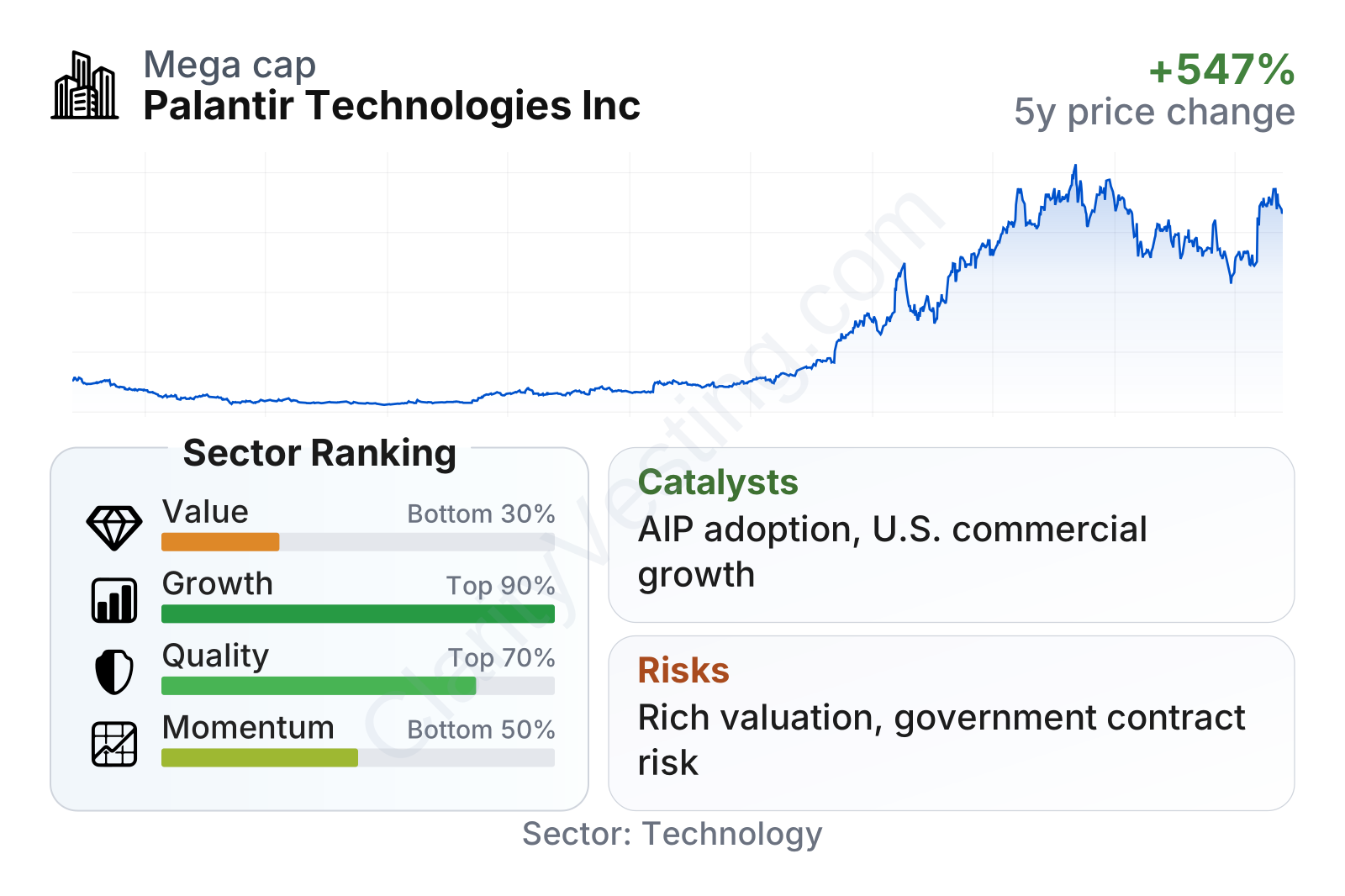
Palantir is now a very large software company by market value, but its profile is unusual even within technology. Growth ranks near the top of the sector, quality is solid, and balance-sheet strength is notably better than average because debt is very low and cash generation is strong. The weak point is valuation: earnings and cash-flow multiples remain far above typical software peers, which means the market is already assuming unusually strong future execution.
The share price history also shows how sentiment can swing sharply. After a deep decline in 2022, the stock rebounded dramatically through 2024 and 2025 before becoming more volatile again in 2026. That pattern reflects a company that has moved from skepticism about profitability to enthusiasm about AI and government demand.
Growth
Palantir operates in one of the most important areas of software spending: turning complex data into usable decisions and, more recently, embedding artificial intelligence into day-to-day operations. That is a favorable market. Governments want software that can support defense, intelligence, and mission planning, while corporations want tools that can connect data across departments and automate decisions. In both cases, the need is structural rather than temporary.
The company’s strategy also makes sense for future expansion. Palantir is not only selling access to AI models; it is selling the software layer that helps customers use AI inside messy, real-world systems. That distinction is important. Many enterprises already have data, but much of it is fragmented, sensitive, or difficult to integrate. Palantir’s value proposition is that it can connect those systems and make AI useful in a secure, operational setting.
Revenue growth accelerated meaningfully after slowing in 2022 and early 2023. The latest pace is far above the broader software sector, showing that Palantir is benefiting from both stronger product adoption and a much more favorable demand backdrop than it had a few years ago.
Cash generation has strengthened at the same time. Free cash flow has risen from a few hundred million dollars to well above $2 billion on a trailing basis in just a few years. That matters because it shows the business is not just growing accounting earnings; it is also converting its expansion into real cash.
A major catalyst is the company’s Artificial Intelligence Platform. Management has emphasized growing demand for AIP bootcamps and production deployments, especially among U.S. commercial customers. That can be significant because it shortens the path from product demonstration to revenue-generating contracts. Another catalyst is defense and national security spending, where Palantir’s software is aligned with growing interest in software-defined military systems, battlefield decision tools, and autonomous operations.
Recent company updates have also pointed to continued momentum in the U.S. commercial segment and expanding participation in government programs. The broader AI spending cycle remains supportive, but Palantir’s specific opportunity is stronger than a generic AI label suggests: it sits at the point where data integration, security, workflow automation, and AI adoption meet.
Risks
This article is for informational purposes only and does not constitute financial advice. Some content is AI-generated. See Disclaimer


