Stock Analysis · Douglas Dynamics Inc (PLOW)
Overview
Douglas Dynamics is a specialty manufacturer focused on equipment used for snow and ice control and, to a smaller extent, work-truck upfitting. Its products are mainly sold under well-known brands such as WESTERN, FISHER, SNOWEX, HENDERSON, DEJANA, and HENKE. In simple terms, the company makes snowplows, salt spreaders, dump bodies, storage systems, municipal snow-removal equipment, and truck modifications that help commercial, municipal, and fleet customers keep roads and properties open in winter or prepare trucks for specialized work.
The business is organized in two main segments, and the revenue mix is usually heavily tilted toward snow and ice equipment. Based on recent company reporting, the approximate breakdown is:
- Work Truck Attachments – about 70% to 75%: snowplows, ice control spreaders, municipal snow-removal equipment, and related parts and accessories. This is the company’s core business and includes both original equipment sales and recurring aftermarket demand.
- Work Truck Solutions – about 25% to 30%: truck upfitting, including service bodies, dump bodies, crane bodies, van interiors, storage solutions, and other modifications for commercial fleets.
Within those segments, parts and accessories matter because they can provide repeat business even when new equipment demand is uneven. The company’s customer base includes independent contractors, municipalities, dealers, and commercial fleets, which gives it exposure to both seasonal weather patterns and longer-term work-truck demand.
Over the last several years, the income flow has shown a business that can swing with volume, but also one that has improved profitability meaningfully when pricing, product mix, and operating execution align. Revenue moved from roughly the low-$500 million range in 2021 to the mid-$600 million range in 2025, while gross profit and operating income improved faster than sales over that span, indicating better margin capture.
The revenue and profit flow also highlights an important feature of Douglas Dynamics: manufacturing costs remain the largest expense by far, while selling and administrative spending is material but relatively stable compared with revenue. That means earnings can improve quickly when volume and pricing are favorable, but they can also be pressured when demand softens or winter conditions reduce equipment purchases.
Key Figures
| Metric | Value | Sector ⓘ |
|---|---|---|
| Date | Sep 12, 2026 | |
| Context | ||
| Sector | Consumer Cyclical | |
| Industry | Auto Parts | |
| Market Cap ⓘ | $1.02B | |
| Beta ⓘ | 1.22 | |
Value (Cheapness) | ||
| P/E Ratio ⓘ | 20.44 | 17.10 |
| FCF Yield ⓘ | 4.78% | 8.53% |
| EBIT / EV ⓘ | 6.61% | 6.46% |
| PEG ⓘ | 0.98 | |
Growth (Business expansion) | ||
| Revenue Growth ⓘ | 10.50% | 5.75% |
| RPS Growth (5Y CAGR) ⓘ | 4.23% | 9.14% |
| EPS Growth (5Y CAGR) ⓘ | -6.81% | -18.21% |
| Margin Growth (5Y Trend) ⓘ | 2.65% | -0.23% |
| FCF Growth (5Y CAGR) ⓘ | 6.54% | 4.91% |
Quality (Business durability) | ||
| ROIC (Latest) ⓘ | 13.36% | 12.61% |
| ROIC (5Y Median) ⓘ | 13.26% | 10.72% |
| Net Debt / EBIT (Latest) ⓘ | -61.39 | 2.10 |
| Net Debt / EBIT (5Y Median) ⓘ | 3.51 | 2.32 |
| Operating Margin (Latest) ⓘ | 11.89% | 9.25% |
| Operating Margin (5Y Median) ⓘ | 9.51% | 9.64% |
| Debt to Equity (Latest) ⓘ | 96.84% | 75.78% |
| Profit Margin (Latest) ⓘ | 7.52% | 5.33% |
| Free Cash Flow (Latest) ⓘ | $48.91M | |
Momentum (Price trend) | ||
| 3Y Return ⓘ | +57.41% | +14.53% |
| 12M Return (excl. last month) ⓘ | +45.03% | +3.08% |
| 6M Return ⓘ | +13.91% | +0.55% |
| Price vs. 200-Day MA ⓘ | +10.10% | -0.54% |
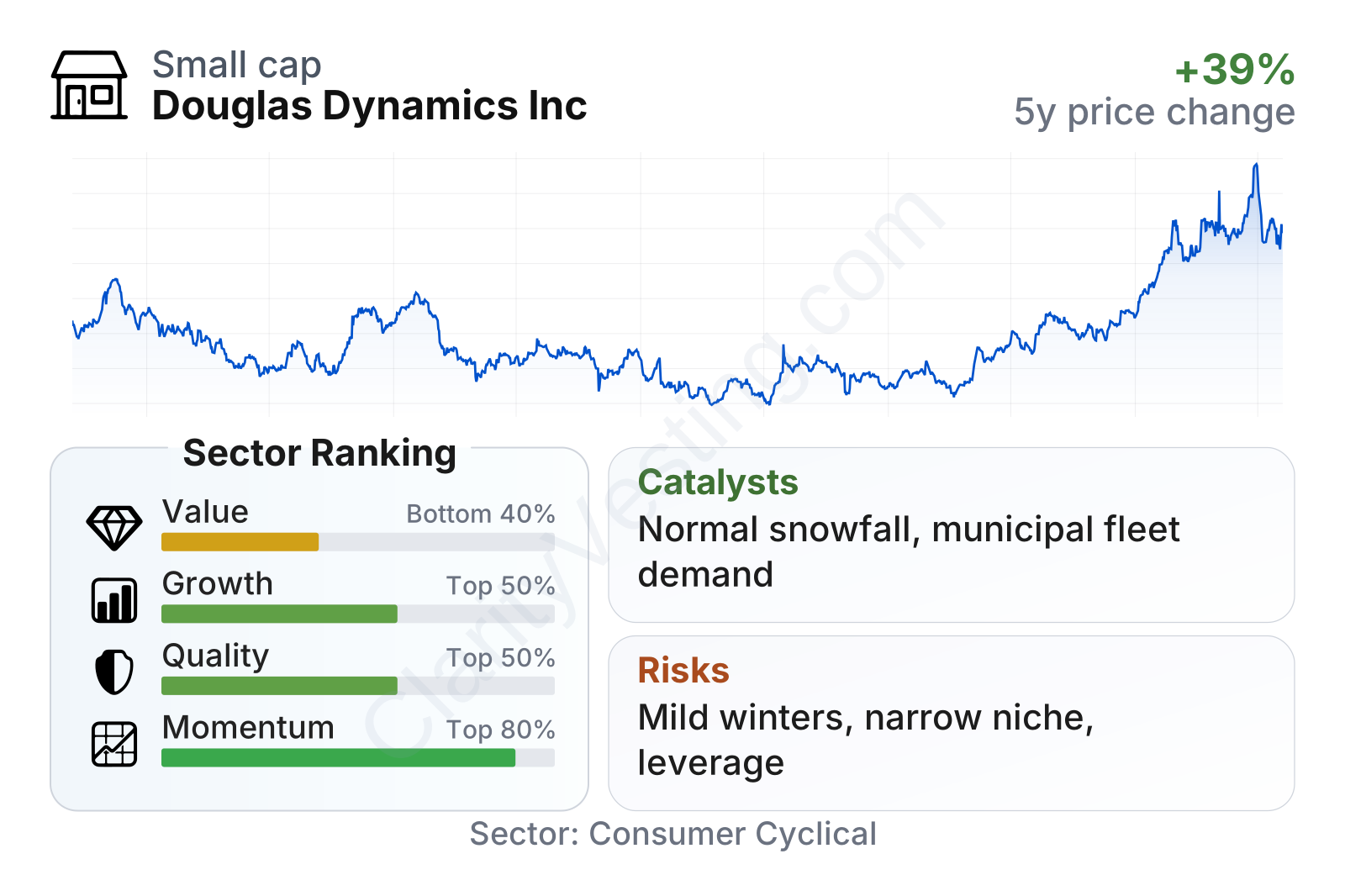
Douglas Dynamics is a small-cap industrial company with a market value around $1 billion, so it is large enough to have established brands and national reach, but still small enough for results to be noticeably affected by weather, dealer ordering patterns, and municipal budgets. The stock has been strong over the last one, three, and even six-month periods, clearly outperforming the broader sector median over those horizons.
The quality profile is better than it may look at first glance. Recent operating margin is around 12%, above the sector median, profit margin is also ahead of peers, and return on invested capital is in the low teens, again better than the typical company in its sector. Growth metrics are mixed but respectable: recent year-over-year revenue growth is around 10%, above the sector median, while five-year revenue-per-share growth has been slower. Free cash flow has also improved over time, supporting the idea that the recent earnings recovery is not purely accounting-driven.
On valuation factors, the picture is less favorable. The earnings multiple is somewhat above the sector median, and free cash flow yield is below the sector median, which suggests the market is already assigning value to the company’s better margins, stronger recent momentum, and improved business conditions.
Growth
Douglas Dynamics operates in a niche rather than a broad secular boom market, so the growth case is more specialized than explosive. Snow and ice control is a necessary activity in many North American regions, and work-truck upfitting remains essential for contractors, utilities, municipalities, and service fleets. That creates durable demand, but not the kind of rapid structural expansion seen in software or semiconductors. The company’s opportunity comes more from replacement cycles, share retention, pricing, product innovation, aftermarket sales, and selective acquisitions than from a fast-growing end market.
The company’s strategy still makes practical sense for long-term expansion. It has built a portfolio of recognized brands, a dealer network, and a business mix that combines seasonal equipment with fleet-oriented truck solutions. That combination can reduce dependence on any single product line. It also gives Douglas Dynamics a chance to sell both initial equipment and follow-on parts, service, and upgrades. For a company in a mature industrial niche, that is a rational growth model.
Recent revenue growth has been uneven quarter to quarter, which is normal for this type of business, but the latest trend is clearly stronger than the sector median. The more encouraging point is not just that sales have rebounded, but that the company has been able to translate that rebound into healthier margins than it produced several years ago.
Cash generation has improved materially from negative territory a few years ago to solidly positive levels more recently. That matters because free cash flow supports debt management, dividends, product development, acquisitions, and resilience through weaker periods. When a seasonal manufacturer converts earnings into cash more consistently, the business becomes easier to evaluate and financially sturdier.
One meaningful catalyst is weather normalization after periods of weaker snowfall in key regions. A severe or even simply normal winter can lift demand for replacement plows, spreaders, and parts. Another catalyst is municipal and infrastructure-related spending, which can support purchases of larger truck equipment and snow-control solutions. In addition, the company has continued to discuss operational initiatives, pricing discipline, and product refreshes in its public communications, all of which can support growth without needing dramatic market expansion.
Recent company updates have also pointed to continued order activity and margin focus rather than signs of retrenchment. For a business like Douglas Dynamics, that is important: the near-term upside often comes less from a new disruptive product and more from efficient execution across manufacturing, pricing, supply chain management, and dealer fulfillment.
Risks
This article is for informational purposes only and does not constitute financial advice. Some content is AI-generated. See Disclaimer


