Stock Analysis · Planet Fitness Inc (PLNT)
Stock Analysis · Planet Fitness Inc (PLNT)

Overview

Planet Fitness is a gym operator and franchisor built around a simple idea: make fitness affordable and unintimidating for casual users. The brand is known for low monthly prices, a broad national presence, and a “Judgement Free Zone” message aimed at first-time gym members and people who do not identify as serious fitness enthusiasts. That positioning has helped the company scale across the United States and internationally through a largely franchise-based model.

The business makes money from several streams, with franchise-related revenue carrying a particularly important role because it tends to be asset-light and high margin. Based on recent company filings, the main revenue sources can be summarized as follows:

  • Franchise segment revenue: roughly half of total revenue, mainly franchise royalties, fees, and related income tied to franchisee sales and club openings.
  • Corporate-owned stores: roughly one-third of revenue, generated directly from memberships and in-club activity at locations operated by the company itself.
  • Equipment segment: roughly one-sixth to one-fifth of revenue, largely tied to the sale of fitness equipment to franchisee-owned clubs.

This mix matters because it gives Planet Fitness exposure to gym membership growth without requiring the company to own every location itself. As the system expands, royalty income can rise faster than operating costs, which helps explain why profitability has improved meaningfully over time.

The business also benefits from recurring membership-related demand. Even though gym usage can fluctuate, subscriptions and franchise royalties create a steadier base than many other consumer discretionary businesses. Over the last several years, revenue, operating income, and net income have all moved higher, while interest expense remains a meaningful but manageable drag on earnings.

The long-term pattern shows a company that has expanded sales materially since the pandemic recovery while turning a larger share of revenue into operating profit. That is one of the clearest signs of how scalable the franchise-heavy model can be when club growth and member counts keep moving in the right direction.

Key Figures

MetricValueSector
DateJul 18, 2026
Context
SectorConsumer Cyclical
IndustryLeisure
Market Cap $4.20B
Beta 1.04
Value
(Cheapness)
P/E Ratio 19.0918.58
FCF Yield 6.36%7.99%
EBIT / EV 6.59%5.91%
PEG 0.92
Growth
(Business expansion)
Revenue Growth 19.70%5.50%
RPS Growth (5Y CAGR) 22.61%9.20%
EPS Growth (5Y CAGR) -23.39%-26.43%
Margin Growth (5Y Trend) 8.61%-0.18%
FCF Growth (5Y CAGR) 17.57%5.02%
Quality
(Business durability)
ROIC (Latest) 15.76%12.03%
ROIC (5Y Median) 11.78%10.82%
Net Debt / EBIT (Latest) 5.782.12
Net Debt / EBIT (5Y Median) 7.102.25
Operating Margin (Latest) 31.38%9.28%
Operating Margin (5Y Median) 27.45%9.64%
Debt to Equity (Latest) -597.79%75.23%
Profit Margin (Latest) 17.77%5.28%
Free Cash Flow (Latest) $267.38M
Momentum
(Price trend)
3Y Return -23.85%+10.68%
12M Return (excl. last month) -51.10%+5.26%
6M Return -47.16%-2.41%
Price vs. 200-Day MA -35.82%+1.55%
Better than sector median
Slightly worse than sector median
More than 20% worse than sector median

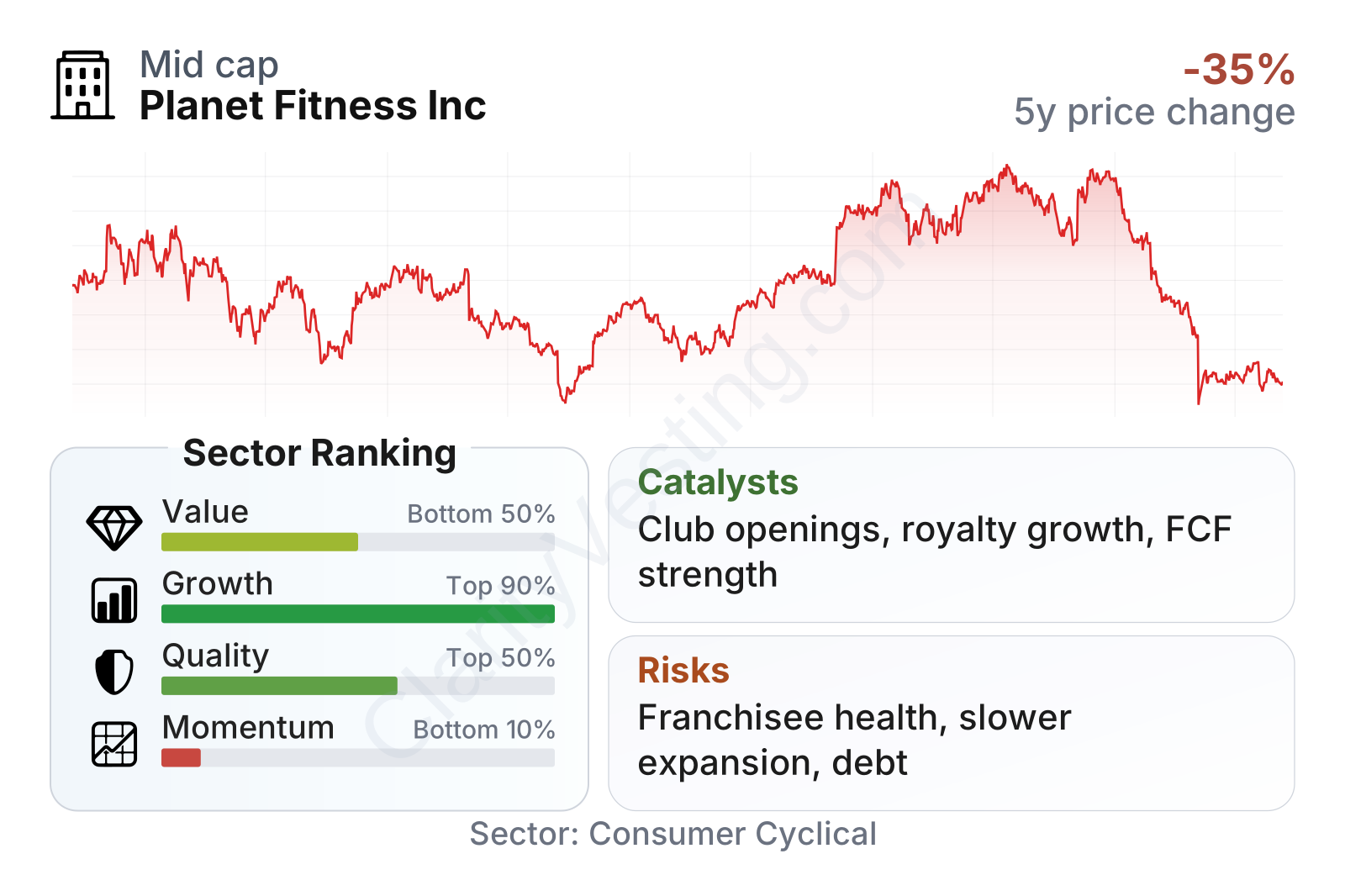
Planet Fitness currently sits around a mid-cap size, with share-price volatility close to the broader market rather than at an extreme level. The most striking feature in the latest profile is the contrast between strong operating fundamentals and weak recent market momentum. Growth ranks well above much of the sector, profitability is strong, and return on invested capital is solid, while recent stock performance has been notably weaker than peers.

The company’s value profile looks close to the sector average on earnings, not deeply discounted but no longer carrying the very high multiples seen in earlier years. Free cash flow generation is meaningful, though leverage remains elevated, which is the key balance-sheet issue to keep in mind when interpreting the rest of the metrics.

Growth

The fitness industry has attractive long-term characteristics. Health awareness has increased, strength training has become more mainstream, and low-cost gym memberships remain one of the most accessible consumer wellness services. Within that landscape, Planet Fitness is positioned in a mass-market category rather than a premium niche, which widens its potential customer base. That matters in a slower economy, because a low monthly price point can remain more resilient than higher-end fitness concepts.

The company’s strategy is also coherent for future expansion. Its model combines new club openings, same-store sales support from member growth, franchise royalties, and equipment placements tied to system development. Because franchisees fund much of the unit expansion, Planet Fitness can grow with less capital intensity than a fully company-owned chain. Recent financial trends support that logic: revenue growth has remained clearly positive and has accelerated again recently after a more moderate phase.

The recent revenue pattern suggests that demand is still expanding at a healthy pace. Year-over-year growth is well above the broader sector median, and the five-year revenue-per-share trend is also strong. That indicates the company is not just recovering from earlier disruptions; it has continued to build scale over a longer period.

Free cash flow has also moved steadily upward over the last several years. That is important because it shows that accounting profits are being converted into real cash that can support debt service, buybacks, reinvestment, and strategic flexibility. For a franchise-led consumer brand, rising cash generation is one of the most encouraging signs that the model is maturing well rather than relying only on headline expansion.

A notable catalyst is the continued runway for new club development. Planet Fitness has often described its white-space opportunity in North America and abroad, and the economics for franchisees remain central to that opportunity. Another growth lever is the Black Card membership tier, which carries a higher monthly fee and includes added perks, supporting average revenue per member. The company has also continued to invest in national marketing, digital member engagement, and brand partnerships that can help keep the funnel of new members active.

Recent company updates have pointed to ongoing club openings, member growth, and operational initiatives designed to improve franchisee returns and strengthen the brand’s appeal. None of that guarantees a straight line upward, but it does suggest Planet Fitness still has expansion tools beyond simply raising prices.

Risks

The biggest financial risk is leverage. Planet Fitness has generated strong margins and cash flow, but net debt remains high relative to operating earnings. Its debt-to-equity figure is distorted by negative book equity, which can happen after large share repurchases and balance-sheet structure effects, so that ratio is less useful here than debt relative to earnings. On that basis, leverage is clearly above sector norms.

The balance-sheet structure means the company has less room for error if growth slows, interest costs rise, or franchisee economics weaken. Interest expense already absorbs a meaningful portion of operating income, so debt remains an important part of the investment case rather than a side issue.

Another risk is that consumer spending on gym memberships is discretionary. Planet Fitness has a lower price point than many competitors, which helps, but cancellations can still increase during economic stress. There is also execution risk tied to franchisees: if franchise operators face higher labor, rent, or equipment costs, club openings may slow and weaker franchisees may underperform.

Profitability is a major strength, but it can also set a high bar. Planet Fitness operates with margins well above the sector median, which reflects the power of the franchise model. The risk is that any prolonged softness in new members, store openings, or franchise sales could draw more attention because the market is used to seeing this business operate efficiently.

Competitive pressure is real, though Planet Fitness has meaningful advantages. Its main edge is brand clarity: it dominates the low-cost, beginner-friendly gym category at national scale in the United States. That is hard to replicate because it combines pricing, marketing, operating systems, and a very large installed base of clubs. Competitors include low-price chains such as Crunch Fitness, value-focused regional gyms, traditional operators like LA Fitness, premium concepts such as Life Time, and alternative fitness options including boutique studios, home workout apps, and connected fitness platforms. Compared with those rivals, Planet Fitness appears strongest in affordability, national reach, and franchise scalability rather than premium pricing or specialized training.

Recent years have also shown that the stock can react sharply when growth expectations are reset. Weak momentum over the last year indicates that the market has become more sensitive to execution, valuation, and macro concerns. There has not been a major public scandal defining the company recently, but leadership execution and franchise health remain worth monitoring because the model depends heavily on both.

Valuation

Planet Fitness looks very different today than it did when the market assigned it much richer earnings multiples. Historically, the shares often traded at a large premium to the sector because the company was seen as a high-quality compounder with a long runway. That premium has narrowed substantially.

The current earnings multiple sits roughly around the sector median, a notable shift from the elevated levels seen in prior years. On one hand, that suggests the market is no longer pricing the company as aggressively as before, even though revenue growth, free cash flow growth, and margins remain relatively strong. On the other hand, the stock is not obviously cheap in a simplistic sense because leverage is still high and recent price momentum has been weak.

In practical terms, the valuation appears more balanced than stretched. The market seems to be recognizing the company’s attractive economics and growth profile while also applying a discount for debt and execution sensitivity. A PEG ratio below 1 and an earnings multiple near the sector average point to a setup where the current price looks more grounded in fundamentals than it was during earlier peak-multiple periods. Whether that remains justified will depend largely on continued club expansion, franchisee health, and the company’s ability to keep turning revenue growth into cash flow.

Conclusion

Planet Fitness stands out as a scaled consumer brand with an unusually efficient business model for the gym industry. Its low-cost positioning, broad appeal, and franchise-led expansion have produced strong revenue growth, high operating margins, and steadily rising free cash flow. Those are attractive features for a long-term business assessment, especially in a sector where many operators struggle to earn consistent returns.

The main complication is not demand strength or brand relevance, but leverage. Debt remains elevated enough to matter, and it reduces flexibility if expansion slows or the consumer backdrop weakens. That risk helps explain why the market has become less enthusiastic than it once was, even as the underlying business continues to perform reasonably well.

Overall, Planet Fitness appears to be a company with durable category leadership and solid long-term operating qualities, but it no longer gets automatic credit from the market for those strengths. The current setup looks more like a disciplined test of execution and balance-sheet management than a pure growth narrative, which makes the business compelling but not carefree.

Sources:

  • Planet Fitness, Inc. — Annual Report on Form 10-K for fiscal year 2025
  • Planet Fitness, Inc. — Quarterly Report on Form 10-Q for quarter ended March 31, 2026
  • Planet Fitness Investor Relations — Earnings Release for first quarter 2026
  • SEC EDGAR — Planet Fitness, Inc. filings database
  • Planet Fitness Investor Relations — Investor presentations and company overview materials
  • Wikipedia — Planet Fitness

This article is for informational purposes only and does not constitute financial advice. Some content is AI-generated. See Disclaimer


Sign up for exclusive research and insights.

Unsubscribe anytime.
