Stock Analysis · Photronics Inc (PLAB)
Overview
Photronics is a semiconductor supply-chain company that makes photomasks, which are highly precise quartz or glass plates used to transfer circuit patterns onto semiconductor wafers and flat-panel displays. In simple terms, photomasks act like master templates in chip and display manufacturing. Without them, chipmakers and display producers cannot print the tiny features required for modern electronics.
The business is narrower and more specialized than many well-known semiconductor names. Photronics does not design chips and it does not manufacture finished semiconductors. Instead, it serves as an essential supplier to customers that produce memory chips, logic chips, image sensors, and display panels. This puts the company inside a critical manufacturing step, but also means demand depends heavily on customer production cycles and capital spending.
Based on the company’s latest annual filing, revenue comes mainly from two operating segments:
- Integrated Circuit, or IC, photomasks: about 82% of revenue. This includes masks used for semiconductors across mainstream and advanced process nodes, serving applications such as mobile, automotive, industrial, AI-related compute, and other electronics.
- Flat Panel Display, or FPD, photomasks: about 18% of revenue. This includes masks used in display manufacturing for products such as smartphones, televisions, monitors, and other screens.
Geographically, Photronics has a meaningful presence in Asia, where much of global chip and display production takes place. That footprint matters because mask production often requires close customer relationships, technical coordination, and reliable local service.
One notable financial pattern in recent years is that revenue rose strongly from 2021 through 2023, then leveled off in 2024 and 2025, while profitability remained solid. In other words, the company has recently shown that it can protect earnings even without rapid top-line expansion.
The operating profile has improved materially since 2021. Revenue and gross profit both expanded over that period, and operating income increased faster than operating expenses, showing stronger efficiency. More recently, sales have eased from the 2023 peak, but margins have remained well above earlier levels.
Key Figures
| Metric | Value | Sector ⓘ |
|---|---|---|
| Date | Sep 12, 2026 | |
| Context | ||
| Sector | Technology | |
| Industry | Semiconductor Equipment & Materials | |
| Market Cap ⓘ | $1.71B | |
| Beta ⓘ | 1.35 | |
Value (Cheapness) | ||
| P/E Ratio ⓘ | 10.32 | 29.51 |
| FCF Yield ⓘ | 6.46% | 4.25% |
| EBIT / EV ⓘ | 25.81% | 2.85% |
| PEG ⓘ | 2.64 | |
Growth (Business expansion) | ||
| Revenue Growth ⓘ | 2.70% | 15.40% |
| RPS Growth (5Y CAGR) ⓘ | 7.27% | 8.56% |
| EPS Growth (5Y CAGR) ⓘ | -6.65% | -11.88% |
| Margin Growth (5Y Trend) ⓘ | 10.50% | 0.46% |
| FCF Growth (5Y CAGR) ⓘ | 9.50% | 9.80% |
Quality (Business durability) | ||
| ROIC (Latest) ⓘ | 18.42% | 9.44% |
| ROIC (5Y Median) ⓘ | 17.36% | 8.30% |
| Net Debt / EBIT (Latest) ⓘ | -2.10 | 0.54 |
| Net Debt / EBIT (5Y Median) ⓘ | -1.75 | 0.44 |
| Operating Margin (Latest) ⓘ | 29.91% | 9.58% |
| Operating Margin (5Y Median) ⓘ | 28.58% | 8.25% |
| Debt to Equity (Latest) ⓘ | 0.30% | 33.33% |
| Profit Margin (Latest) ⓘ | 19.05% | 7.14% |
| Free Cash Flow (Latest) ⓘ | $110.38M | |
Momentum (Price trend) | ||
| 3Y Return ⓘ | +45.02% | +45.48% |
| 12M Return (excl. last month) ⓘ | +58.12% | +23.48% |
| 6M Return ⓘ | -12.23% | +20.93% |
| Price vs. 200-Day MA ⓘ | -18.82% | +7.43% |
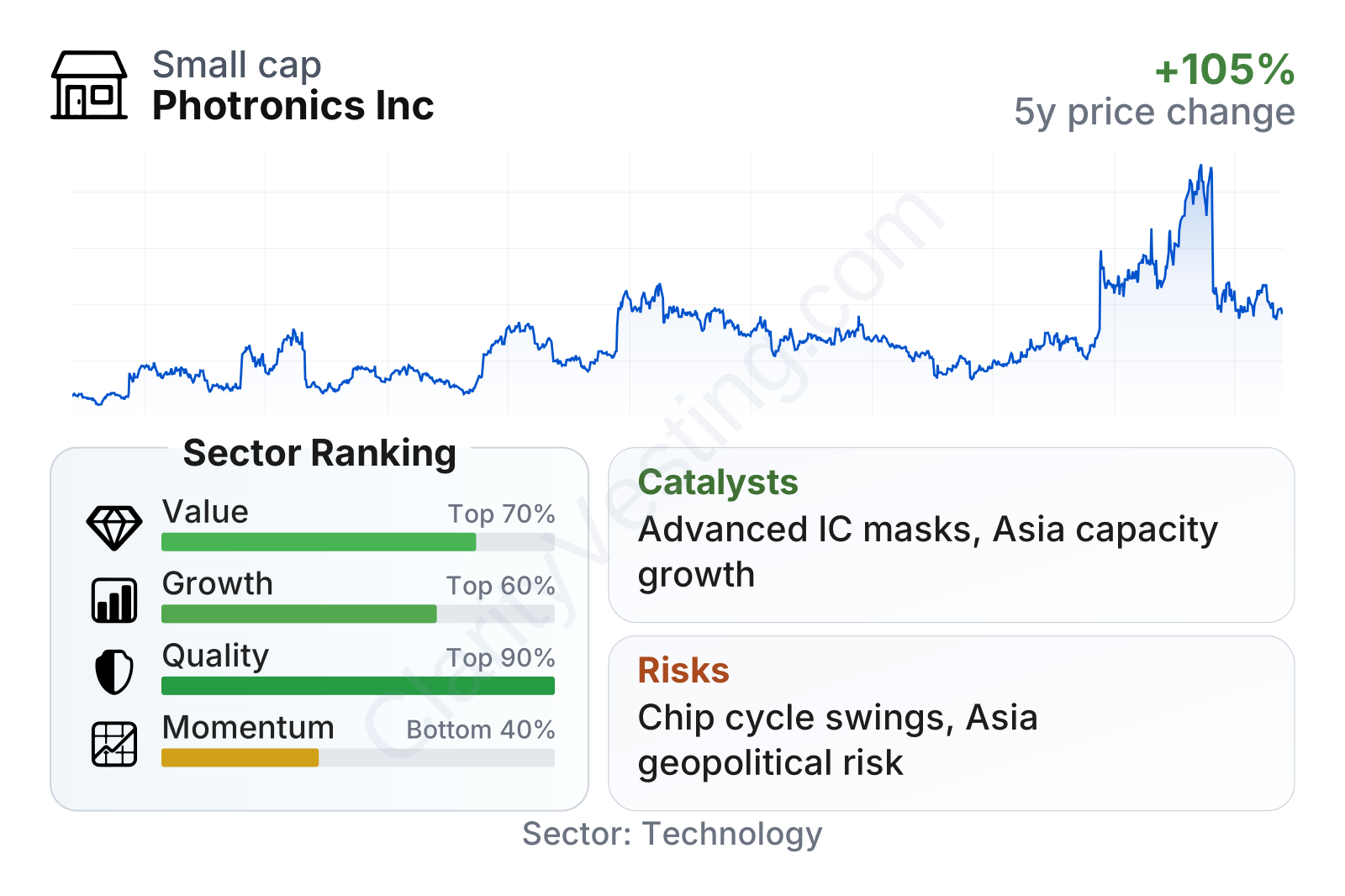
Photronics is a small-to-mid-sized technology company with a stock that has been more volatile than the overall market, which is normal for a cyclical semiconductor supplier. The metrics table stands out most on quality: returns on invested capital, operating margin, profit margin, and balance-sheet strength are all well above the sector median. Value also looks favorable, with a low earnings multiple and stronger cash-flow yield than many peers. By contrast, growth is more mixed, reflecting recent slower revenue expansion, and momentum has weakened after a strong earlier run in the share price.
Growth
Photronics operates in a sector that still has favorable long-term demand drivers. The world continues to need more semiconductors for artificial intelligence infrastructure, automotive electronics, industrial automation, smartphones, cloud data centers, and connected devices. Even when chip cycles slow, the long-term direction of semiconductor content per device remains upward. That broad industry backdrop supports continued need for photomasks.
The company’s strategy is also understandable for long-term readers: invest in higher-end IC mask capability, stay close to Asian manufacturing hubs, and serve both advanced and mainstream chip production. Photronics does not need to dominate the entire semiconductor industry to grow; it needs to remain relevant in the mask layers customers actually outsource and in regions where demand is expanding.
Recent growth has been uneven rather than linear. Revenue growth was very strong in 2021 and 2022, slowed sharply in 2023, turned slightly negative across parts of 2024 and 2025, and then returned to low positive growth in the most recent period. That pattern fits a cyclical manufacturing business more than a steady software-like model. It suggests that the long-term opportunity remains intact, but quarterly and annual comparisons can swing with customer utilization and product mix.
Cash generation has also shown this cyclical character. Free cash flow climbed substantially through 2024 and remained strong into 2025 before dropping in the latest trailing period. That decline deserves attention, but it does not erase the broader picture: Photronics has demonstrated an ability to convert a meaningful share of earnings into cash over time, which gives it flexibility to fund capacity, technology upgrades, and regional expansion without depending heavily on debt.
As a recent opportunity indicator, company communications in the latest fiscal year continued to emphasize demand linked to high-end IC photomasks and advanced packaging-related needs, while Asian manufacturing remains central to customer investment. If leading-edge and specialty-node capacity additions continue across Asia, Photronics is positioned to benefit as a specialized enabling supplier rather than as a direct chip-cycle headline name.
Risks
This article is for informational purposes only and does not constitute financial advice. Some content is AI-generated. See Disclaimer


