Stock Analysis · Packaging Corp of America (PKG)
Overview
Packaging Corporation of America is a large North American paper and packaging company. Its core business is making corrugated packaging products used to ship, protect, and display goods. That includes the brown boxes and containerboard materials widely used in e-commerce, food, industrial distribution, agriculture, and consumer products. The company also operates a smaller paper business that produces communication papers and specialty papers, and it sells some related services such as design, logistics support, and recycling.
The business is centered on two operating segments, with revenue heavily concentrated in packaging. Based on recent company reporting, the mix is approximately:
- Packaging: about 92% to 94% of revenue. This segment includes containerboard, corrugated products, and related packaging activities. It is the economic engine of the company.
- Paper: about 6% to 8% of revenue. This includes office papers and specialty papers, a smaller business that has less strategic weight than packaging.
That revenue mix matters because it makes PKG far more tied to box demand, industrial production, and shipping activity than to the structurally slower paper market. It also means the company’s long-term outlook depends mainly on the health of corrugated packaging rather than traditional printing paper.
The broad financial flow also shows a business with substantial manufacturing costs but still solid operating earnings. Revenue rebounded after the 2023 dip and reached a new high in 2025, while operating income recovered but net income did not fully keep pace, suggesting that financing costs and other below-the-line items became a bigger drag than they were in earlier years.
Key Figures
| Metric | Value | Sector ⓘ |
|---|---|---|
| Date | Sep 12, 2026 | |
| Context | ||
| Sector | Consumer Cyclical | |
| Industry | Packaging & Containers | |
| Market Cap ⓘ | $20.88B | |
| Beta ⓘ | 0.80 | |
Value (Cheapness) | ||
| P/E Ratio ⓘ | 30.48 | 17.10 |
| FCF Yield ⓘ | 3.55% | 8.53% |
| EBIT / EV ⓘ | 4.39% | 6.46% |
| PEG ⓘ | 1.49 | |
Growth (Business expansion) | ||
| Revenue Growth ⓘ | 14.70% | 5.75% |
| RPS Growth (5Y CAGR) ⓘ | 5.24% | 9.14% |
| EPS Growth (5Y CAGR) ⓘ | -21.62% | -18.21% |
| Margin Growth (5Y Trend) ⓘ | -4.00% | -0.23% |
| FCF Growth (5Y CAGR) ⓘ | 10.48% | 4.91% |
Quality (Business durability) | ||
| ROIC (Latest) ⓘ | 9.40% | 12.61% |
| ROIC (5Y Median) ⓘ | 12.38% | 10.72% |
| Net Debt / EBIT (Latest) ⓘ | 3.68 | 2.10 |
| Net Debt / EBIT (5Y Median) ⓘ | 1.89 | 2.32 |
| Operating Margin (Latest) ⓘ | 11.28% | 9.25% |
| Operating Margin (5Y Median) ⓘ | 13.68% | 9.64% |
| Debt to Equity (Latest) ⓘ | 94.47% | 75.78% |
| Profit Margin (Latest) ⓘ | 7.26% | 5.33% |
| Free Cash Flow (Latest) ⓘ | $742.40M | |
Momentum (Price trend) | ||
| 3Y Return ⓘ | +72.50% | +14.53% |
| 12M Return (excl. last month) ⓘ | +32.01% | +3.08% |
| 6M Return ⓘ | +10.88% | +0.55% |
| Price vs. 200-Day MA ⓘ | +5.40% | -0.54% |
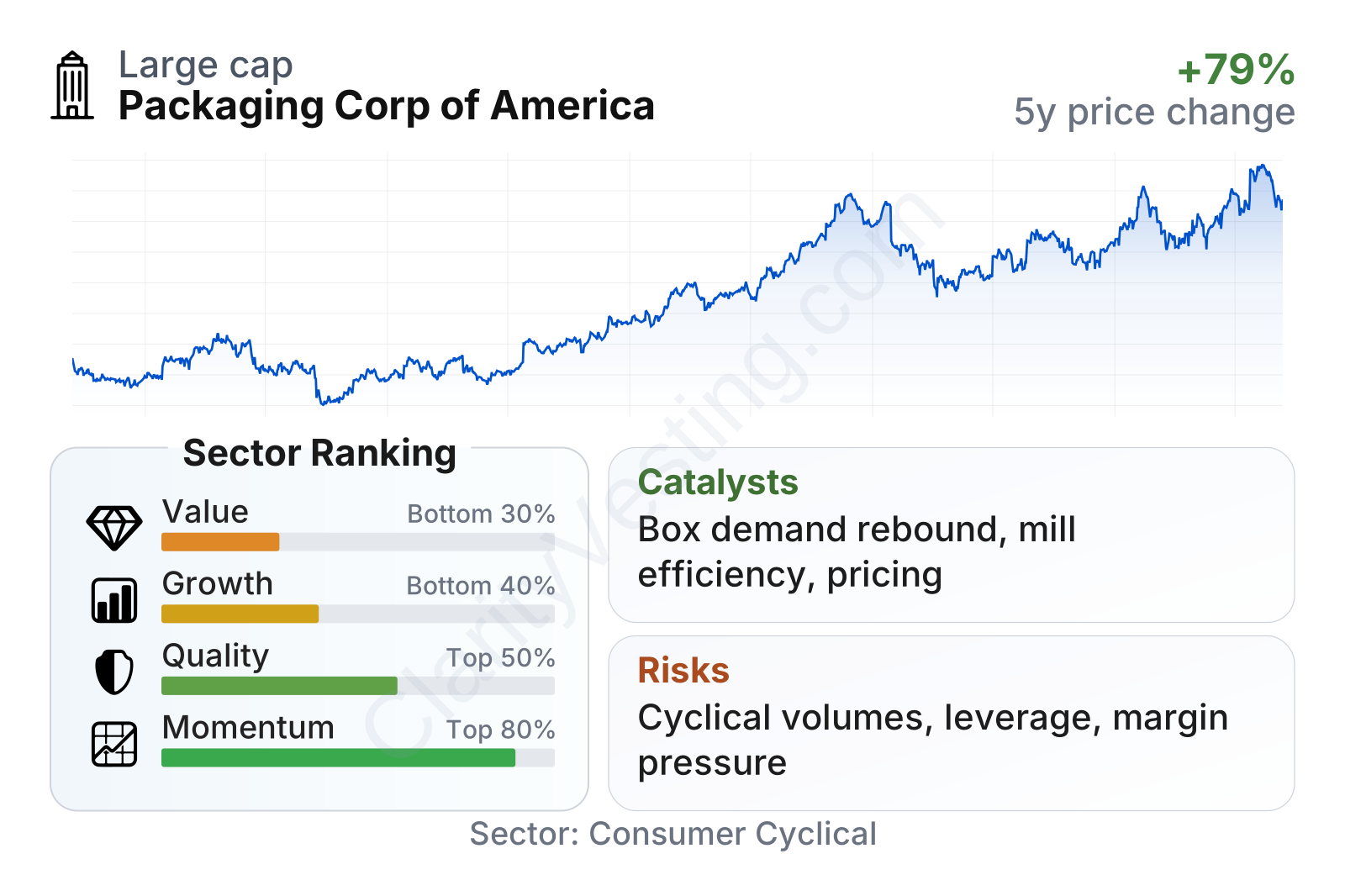
PKG is a large-cap packaging company with relatively low share-price volatility, as shown by a beta below 1. On operating quality, the picture is respectable: margins remain above the sector median, and long-term returns on invested capital have been solid. Growth is more mixed. Recent revenue growth has been stronger than the sector median, but the longer five-year growth profile is less impressive. The weakest area is valuation, where the stock trades at noticeably richer earnings and cash-flow multiples than much of the sector.
The share price trend has been strong over the last three years, clearly outperforming many peers. That strength signals market confidence in the business model and earnings resilience, but it also raises the bar for future execution because expectations embedded in the stock are now higher than they were a few years ago.
Growth
PKG operates in a sector that benefits from long-term demand for shipping boxes, supply-chain packaging, and retail-ready transport materials. That does not make packaging a fast-growing industry in the way software or semiconductors can be, but it is a durable and essential one. As more goods move through distribution networks, packaging remains necessary even when end markets shift. This gives the company a practical kind of growth exposure: less explosive, but rooted in recurring industrial demand.
The company’s strategy makes sense for that environment. PKG focuses on containerboard integration, mill operations, converting plants, and customer service for corrugated packaging. In simple terms, it controls more of the process from paper production to finished boxes, which can help with cost discipline and delivery reliability. Public company materials have also emphasized productivity projects, product mix, and customer service as levers for growth rather than relying only on broad economic expansion.
Revenue growth has been uneven across the cycle. After a strong period in 2021 and 2022, sales declined during 2023, then recovered through 2024, 2025, and into 2026. The recent pace, around the mid-teens year over year, is clearly stronger than the sector median and points to improving demand, pricing, volume, or a combination of the three. That said, the five-year revenue-per-share growth rate is only around 5%, which suggests PKG is still more of a steady industrial compounder than a high-growth name.
Cash generation remains an important support for the growth profile. Free cash flow has been volatile, which is normal for a capital-intensive manufacturer, but the broader trend over five years is positive and stronger than the sector median. The latest trailing twelve-month figure, a little above $700 million, indicates the company is still generating meaningful internal funds even after capital spending. That matters because packaging growth often depends on mill upgrades, plant efficiency projects, and selective expansion, all of which require cash.
A visible catalyst in recent periods has been the rebound in revenue after the 2023 slowdown. Another is the company’s scale in corrugated packaging, where operational improvements and tighter industry supply can support pricing and margins. Any continued normalization in box volumes, e-commerce shipping demand, and industrial activity would likely matter more to PKG than developments in the smaller paper segment.
Risks
This article is for informational purposes only and does not constitute financial advice. Some content is AI-generated. See Disclaimer


