Stock Analysis · Polaris Industries Inc (PII)
Stock Analysis · Polaris Industries Inc (PII)

Overview

Polaris Industries is a powersports manufacturer best known for off-road vehicles, snowmobiles, motorcycles, and marine products. Its brands include Polaris, RZR, Ranger, Sportsman, Indian Motorcycle, Slingshot, and Bennington, among others. In simple terms, the company sells recreational and utility vehicles used for leisure, work, and outdoor activities, along with replacement parts, accessories, and apparel.

The business is diversified across several product categories, but off-road vehicles remain the center of the company. Polaris also has a meaningful aftermarket business through parts, garments, and accessories, which tends to be more resilient than new vehicle sales because owners continue to maintain and customize products even in weaker demand periods.

Based on recent annual reporting, Polaris revenue is roughly concentrated in the following areas:

  • Off Road — about 65% to 70% of revenue. This includes side-by-sides, all-terrain vehicles, and related utility products.
  • Marine — about 15% to 20%. This mainly includes pontoon and deck boats.
  • On Road — about 10% to 15%. This segment includes Indian Motorcycle and Slingshot.
  • Parts, garments, accessories, and service-related sales — embedded across segments and an important profit contributor, though not always disclosed as a fully separate top-line segment.

That revenue mix matters because it shows Polaris is not a one-product company, but it is still heavily tied to consumer discretionary spending. When households and dealers become cautious, big-ticket recreational purchases can slow quickly.

The long-term picture shows a company that expanded strongly through 2022 and 2023, then saw revenue and profitability compress as industry demand cooled and costs stayed elevated. The latest flow of revenue to profit suggests pressure from lower sales, thinner margins, and still-significant operating costs.

Key Figures

MetricValueSector
DateJul 18, 2026
Context
SectorConsumer Cyclical
IndustryRecreational Vehicles
Market Cap $4.16B
Beta 1.26
Value
(Cheapness)
P/E Ratio N/A18.58
FCF Yield 3.86%7.99%
EBIT / EV -6.38%5.91%
PEG 3.34
Growth
(Business expansion)
Revenue Growth 7.50%5.50%
RPS Growth (5Y CAGR) 1.45%9.20%
EPS Growth (5Y CAGR) -71.46%-26.43%
Margin Growth (5Y Trend) -14.53%-0.18%
FCF Growth (5Y CAGR) N/A5.02%
Quality
(Business durability)
ROIC (Latest) -10.98%12.03%
ROIC (5Y Median) 17.55%10.82%
Net Debt / EBIT (Latest) N/A2.12
Net Debt / EBIT (5Y Median) 2.312.25
Operating Margin (Latest) -5.37%9.28%
Operating Margin (5Y Median) 7.84%9.64%
Debt to Equity (Latest) 293.92%75.23%
Profit Margin (Latest) -6.07%5.28%
Free Cash Flow (Latest) $160.60M
Momentum
(Price trend)
3Y Return -37.44%+10.68%
12M Return (excl. last month) +78.88%+5.26%
6M Return +5.59%-2.41%
Price vs. 200-Day MA +15.38%+1.55%
Better than sector median
Slightly worse than sector median
More than 20% worse than sector median

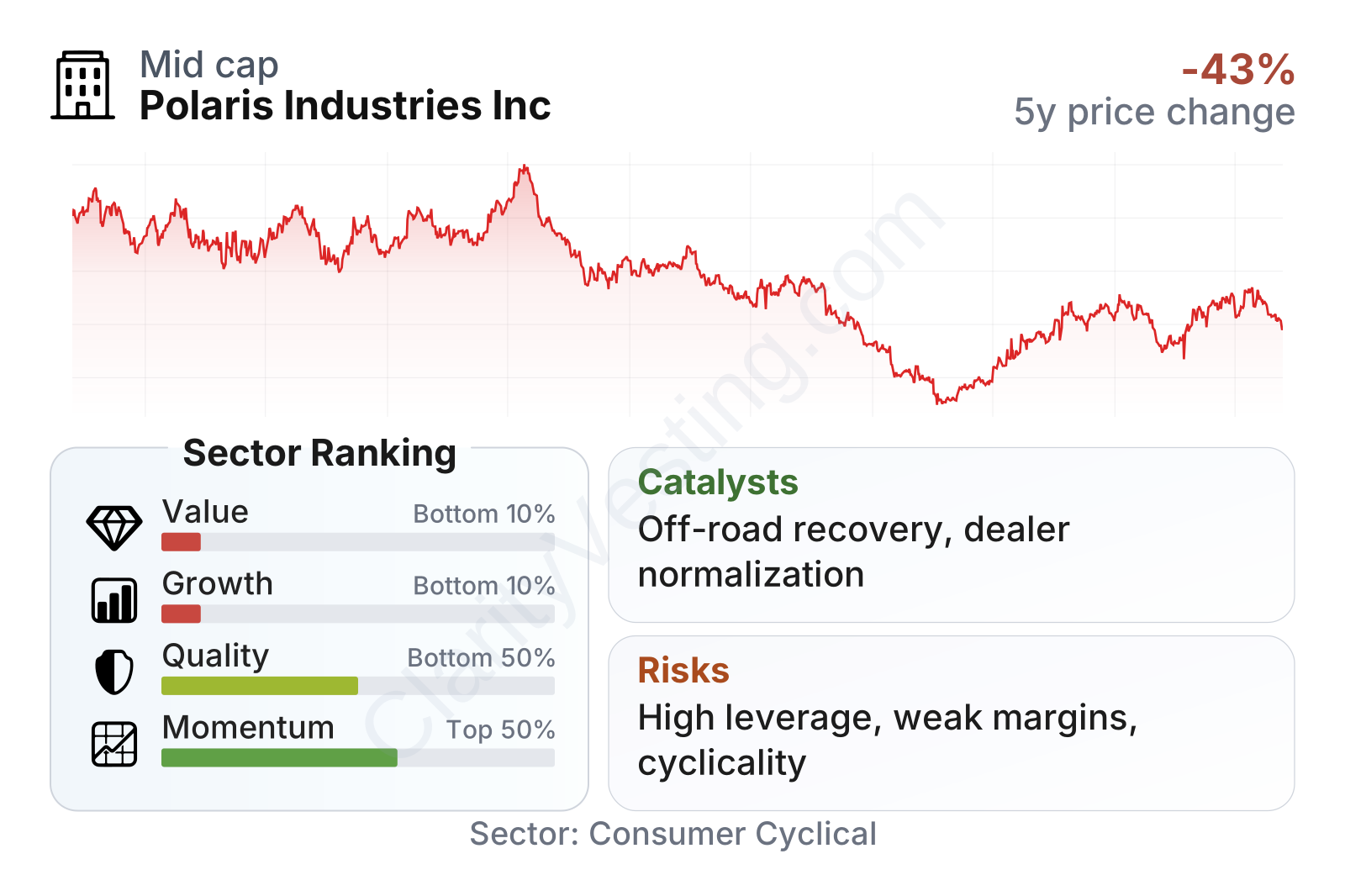
Polaris currently sits in a mixed position. Market value is in the mid-cap range, and the stock has recently recovered from depressed levels, but the underlying fundamentals still look weak relative to much of the broader consumer discretionary universe. Growth and quality indicators are notably challenged, while recent share-price momentum is stronger than the sector. In other words, the market has started to react to stabilization, but the operating profile has not fully recovered yet.

The stock history also reflects this uneven pattern. After trading at much higher levels a few years ago, the shares fell sharply during the downturn in earnings and margins, then rebounded meaningfully before giving back some ground. That kind of volatility is common for cyclical manufacturers whose results depend on dealer inventory, consumer demand, and financing conditions.

Growth

Polaris operates in a sector that can grow over time, but not in a straight line. Powersports and marine recreation benefit from outdoor lifestyle demand, product innovation, and premiumization, yet they are also highly cyclical. Demand often swings with consumer confidence, interest rates, and dealer inventory levels. That means the long-term opportunity is real, but short-term results can be rough.

The company’s strategy still makes industrial sense. Polaris has strong brand recognition in off-road vehicles, a broad dealer network, and a portfolio that spans recreation, utility, and premium products. It also continues to invest in engineering and product development, which is important in a category where performance, durability, and new model refreshes influence demand. Over time, innovation in side-by-sides, connected features, rider safety, and accessories can support better mix and pricing.

Recent sales trends suggest the worst of the contraction may be easing. Revenue growth turned positive again in the most recent periods after a long stretch of declines. That does not yet prove a full recovery, but it does point to a business moving from contraction toward stabilization. For a cyclical manufacturer, that shift can matter a lot because profits usually recover only after volume and dealer inventory begin to normalize.

Cash generation has also remained positive, although well below the stronger levels seen earlier in the cycle. That is an encouraging sign because even during a difficult earnings period, the company is still producing cash rather than consuming it heavily. For a manufacturer in a downturn, preserving cash and managing working capital are important signals of operating discipline.

One practical catalyst is dealer inventory normalization. In recent years, many vehicle makers had to work through excess channel inventory as demand softened. If Polaris gets inventory back to healthier levels and retail demand steadies, shipments and margins could improve together. Another potential growth driver is the company’s premium brand lineup, especially in off-road and motorcycles, where enthusiasts often spend not just on the vehicle but also on accessories, upgrades, and branded gear.

Recent company communications have also emphasized operational actions such as cost control, channel discipline, and product launches. None of these is transformative on its own, but together they support the idea that Polaris is trying to protect profitability while positioning itself for the next upcycle rather than simply waiting for demand to recover.

Risks

The biggest risk is cyclicality. Polaris sells products that are expensive, optional purchases for many households and businesses. When financing costs are high or confidence weakens, customers can delay buying a new off-road vehicle, motorcycle, or boat. That makes revenue and earnings more volatile than in steadier consumer categories.

A second major issue is profitability. The company’s recent margin profile has deteriorated sharply, moving from healthy positive levels a few years ago to negative territory on a trailing basis. That means the current pressure is not only about slower sales; it is also about the ability to convert those sales into profit.

The margin trend is one of the clearest warning signs. Polaris used to operate around or above sector-level profitability at times, but the recent picture shows a steep decline that now sits well below the industry median. Until margins improve, valuation arguments based on normalized earnings remain more speculative than they appear at first glance.

Leverage is another important risk.

Debt relative to equity has climbed to a level far above the sector norm. Some of that reflects weaker equity and earnings rather than only rising borrowings, but the result is the same: the balance sheet has become less comfortable. Higher interest costs further reduce flexibility during a weak part of the cycle. This does not necessarily point to immediate distress, yet it raises the pressure on management to restore profitability and cash generation.

Competition is intense. In off-road vehicles, Polaris is one of the category leaders, competing most directly with BRP, Honda, Yamaha, and privately held players in certain niches. In motorcycles, Indian competes against Harley-Davidson and international brands. In marine, Bennington faces Brunswick, Malibu Boats, and other boat manufacturers. Polaris has real advantages in brand recognition, scale, and dealer relationships, especially in side-by-sides and utility-oriented products, but it does not have an unchallenged position across all categories.

Its competitive strengths are most visible in off-road, where the company has long been one of the most established names and where accessories and rider communities can reinforce customer loyalty. That said, leadership in a cyclical category does not eliminate earnings risk. Even strong brands can struggle when dealers cut orders or consumers pull back.

Another point to watch is operational and reputational risk. Vehicle manufacturers can face recalls, warranty costs, product liability claims, and regulatory scrutiny related to safety or emissions. These are not unusual in the industry, but they can quickly become expensive and distracting if they escalate. For Polaris, that risk deserves attention because product quality and brand trust are central to repeat purchases.

Valuation

Valuation is unusually tricky right now because traditional earnings-based measures are distorted by weak or negative trailing profits. That is why a simple comparison with the sector’s normal price-to-earnings range can be misleading.

The company historically traded at a discount to the broader sector for long stretches, which makes sense for a cyclical manufacturer. More recently, the P/E measure has become less useful because earnings weakened so much that the ratio drops out entirely. In that setting, the market is not valuing Polaris on current earnings power as much as on the possibility of a future recovery.

Other signals also suggest the stock is not obviously cheap on fundamentals alone. The latest factor snapshot places Polaris in the weaker end of the sector on value measures, and free cash flow yield does not stand out as especially compelling relative to peers. So even after a large multi-year decline in the share price, the stock does not automatically screen as a bargain.

The more realistic framing is that the current price appears to reflect a partial rebound scenario: not a return to peak conditions, but some expectation that earnings, margins, and shipments eventually recover from depressed levels. If that recovery proves durable, the valuation can look understandable. If margin pressure and leverage remain elevated for longer, the shares may still look demanding despite being far below prior highs.

Conclusion

Polaris remains a recognizable leader in powersports, with strong brands, a valuable dealer network, and a meaningful position in off-road vehicles that gives the company staying power over a full cycle. The business is not broken at its core: recent revenue trends have improved, cash generation remains positive, and management still has brands and products that matter in enthusiast markets.

At the same time, the current picture is shaped by real strain. Profitability has deteriorated sharply, leverage looks stretched versus the sector, and the company is still working through the aftermath of a cyclical downturn. That leaves Polaris in a transitional phase rather than a clearly restored one.

For long-term analysis, the central question is less about whether Polaris has recognizable assets and more about whether those assets can again produce durable margins closer to past levels. Right now, the company looks more like a cyclical recovery case with credible brand strength than a clean compounding business. That creates interest, but it also keeps the overall profile dependent on execution and on a healthier industry backdrop.

Sources:

  • Polaris Inc. — Annual Report on Form 10-K for fiscal year 2025
  • Polaris Inc. — Quarterly Report on Form 10-Q for quarter ended March 31, 2026
  • SEC EDGAR — Polaris Inc. filings database
  • Polaris Investor Relations — earnings releases and company presentations
  • Wikipedia — Polaris Inc.

This article is for informational purposes only and does not constitute financial advice. Some content is AI-generated. See Disclaimer


Sign up for exclusive research and insights.

Unsubscribe anytime.
