Stock Analysis · Impinj Inc (PI)
Overview
Impinj is a semiconductor and software company focused on item-level connectivity. In simple terms, it helps businesses identify, locate, and track physical objects using RFID technology, mainly the RAIN RFID standard. Its products are used in areas such as retail inventory, supply chain management, logistics, healthcare, and industrial operations. The goal is to make everyday items visible to software systems without needing a battery in every tag.
The company’s business is built around a platform rather than a single chip. Impinj designs endpoint integrated circuits that go into RFID tags attached to items, reader chips and readers that capture the signal from those tags, and software that turns the radio data into usable business information. That positioning is important because it gives the company exposure to both the growth in tag volumes and the broader infrastructure needed to read and analyze those tags.
Based on the company’s reporting structure in recent SEC filings, revenue comes from two main sources.
- Endpoint ICs: approximately 70% to 80% of revenue in recent years. These are the chips embedded in RFID labels or tags attached to products, cases, pallets, and other physical items. This is the largest business and benefits when customers expand item-level tagging programs.
- Systems, Reader ICs, and software/services: approximately 20% to 30% of revenue. This includes readers, gateway products, reader chips, and supporting software used to collect and manage RFID data.
The revenue mix means Impinj is primarily driven by the scale of RFID adoption at the item level, especially in high-volume markets. It also means demand can be uneven because large customers may adjust ordering patterns as they work through inventory or phase in deployments over time.
From a cost structure perspective, the business still spends heavily on research and development, which is typical for a company trying to deepen its technology lead. Revenue has grown meaningfully over the last several years, gross profit has expanded, and free cash flow has turned positive, but profitability remains inconsistent.
The long-term pattern shows a business that has scaled revenue from roughly $190 million in 2021 to just above $360 million by 2025, while keeping gross profit near or above half of sales. Research and development remains a large expense, showing that Impinj is still investing aggressively to widen adoption and strengthen its product platform.
Key Figures
| Metric | Value | Sector ⓘ |
|---|---|---|
| Date | Sep 12, 2026 | |
| Context | ||
| Sector | Technology | |
| Industry | Semiconductors | |
| Market Cap ⓘ | $5.25B | |
| Beta ⓘ | 1.92 | |
Value (Cheapness) | ||
| P/E Ratio ⓘ | N/A | 29.51 |
| FCF Yield ⓘ | 1.20% | 4.25% |
| EBIT / EV ⓘ | -0.47% | 2.85% |
| PEG ⓘ | N/A | |
Growth (Business expansion) | ||
| Revenue Growth ⓘ | 10.70% | 15.40% |
| RPS Growth (5Y CAGR) ⓘ | 11.88% | 8.56% |
| EPS Growth (5Y CAGR) ⓘ | -13.16% | -11.88% |
| Margin Growth (5Y Trend) ⓘ | N/A | 0.46% |
| FCF Growth (5Y CAGR) ⓘ | N/A | 9.80% |
Quality (Business durability) | ||
| ROIC (Latest) ⓘ | -3.38% | 9.44% |
| ROIC (5Y Median) ⓘ | -5.33% | 8.30% |
| Net Debt / EBIT (Latest) ⓘ | N/A | 0.54 |
| Net Debt / EBIT (5Y Median) ⓘ | N/A | 0.44 |
| Operating Margin (Latest) ⓘ | -6.50% | 9.58% |
| Operating Margin (5Y Median) ⓘ | -7.60% | 8.25% |
| Debt to Equity (Latest) ⓘ | 115.14% | 33.33% |
| Profit Margin (Latest) ⓘ | -7.27% | 7.14% |
| Free Cash Flow (Latest) ⓘ | $62.99M | |
Momentum (Price trend) | ||
| 3Y Return ⓘ | +178.85% | +45.48% |
| 12M Return (excl. last month) ⓘ | +10.56% | +23.48% |
| 6M Return ⓘ | +93.58% | +20.93% |
| Price vs. 200-Day MA ⓘ | +24.04% | +7.43% |
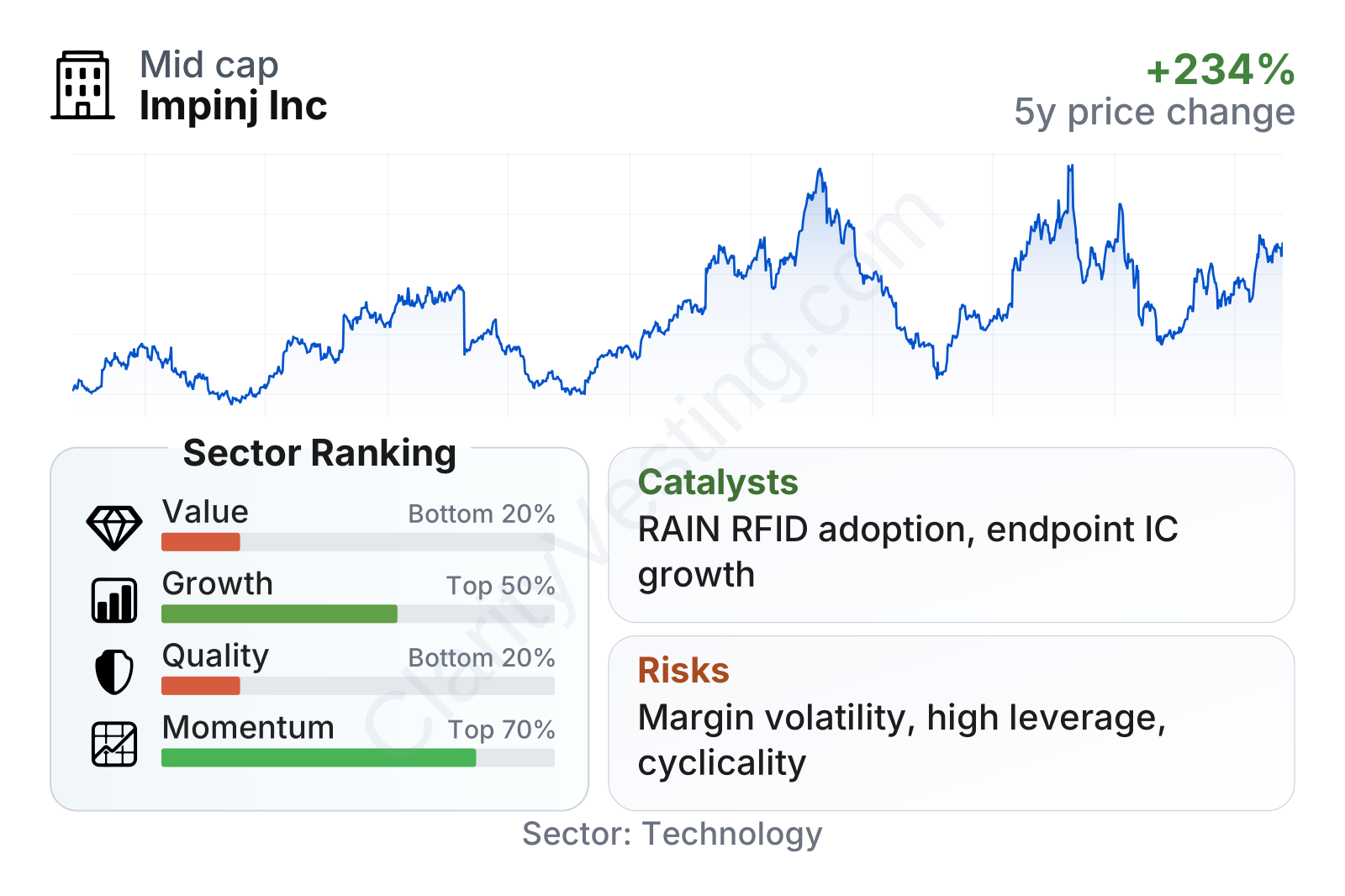
Impinj is a mid-cap semiconductor company with a stock that has been much more volatile than the broader market, reflected in its elevated beta. The scorecard is mixed: growth and share-price momentum are better than much of the sector, but value and quality rank near the lower end. In practice, that usually means the market is giving the company credit for future potential even though current profitability and capital efficiency are still weak compared with many semiconductor peers.
The stock price history also shows sharp swings rather than a smooth upward path. Over the past few years, the shares have moved through large rallies and pullbacks, which fits a company whose results are closely tied to adoption cycles, customer inventory changes, and changing expectations around future margins.
Growth
Impinj operates in a market with a credible long-term growth tailwind. RAIN RFID adoption is expanding because companies want better inventory accuracy, lower labor costs, fewer stockouts, improved loss prevention, and more automated logistics. Retail remains the clearest use case, but the opportunity goes beyond apparel into general merchandise, food, healthcare, travel, and industrial environments. As more businesses want real-time visibility into physical goods, the need for low-cost item identification can expand with them.
The company’s strategy also makes sense for this type of market. Instead of supplying only one component, Impinj participates across the stack: tag chips, reader chips, readers, and software. That can strengthen customer relationships and help the company benefit as deployments become larger and more complex. It also supports an ecosystem effect, because solution providers, device makers, and enterprise users can build around a common platform.
Recent revenue growth has been uneven rather than linear. The company posted very strong expansion in 2021 through 2023, then went through a slower period with some quarters of contraction before returning to modest double-digit year-over-year growth most recently. That pattern suggests the long-term direction is still positive, but near-term demand can fluctuate significantly as customers adjust purchasing timing.
A more encouraging signal is cash generation. Free cash flow has improved from negative territory in 2022 and 2023 to clearly positive levels more recently, reaching roughly $60 million on a trailing basis. That matters because it shows the business has made real progress beyond revenue growth alone, even if accounting profits remain inconsistent.
A meaningful catalyst is broader enterprise adoption of item-level RFID as a standard part of inventory and supply chain systems. Impinj has also continued introducing new endpoint and reader products through company announcements and investor materials, which can support better performance, lower total system cost, and wider deployment. Another important opportunity is that RFID data becomes more valuable when connected to enterprise software and automation tools, making Impinj relevant not only as a chip vendor but as part of the infrastructure for digital operations.
Recent company communications have continued to emphasize expanding endpoint volumes, platform adoption, and product innovation. That does not remove cyclicality, but it does support the view that the addressable market is still developing rather than mature.
Risks
This article is for informational purposes only and does not constitute financial advice. Some content is AI-generated. See Disclaimer


