Stock Analysis · PulteGroup Inc (PHM)
Overview
PulteGroup is one of the largest homebuilders in the United States. The company develops communities, buys and prepares land, builds homes, and sells them to buyers across a wide range of price points. Its brands are aimed at different customer groups, including first-time buyers, move-up buyers, luxury buyers, and active-adult customers through Del Webb. In addition to homebuilding, PulteGroup also provides mortgage-related and title services that support its home sales.
The business is overwhelmingly driven by homebuilding. Based on recent company reporting, revenue is concentrated in a few major sources:
- Home sale revenues: about 98% of total revenue. This includes the sale of newly built single-family homes and attached homes across the company’s branded communities.
- Financial services: about 2% of total revenue. This mainly includes mortgage origination and related title and closing services provided to homebuyers.
- Other revenues: less than 1% of total revenue. This generally includes land sales and other smaller items that are not core to recurring operations.
PulteGroup operates in a cyclical industry, but its scale, broad geographic footprint, and multi-brand approach give it more flexibility than smaller regional builders. The company’s revenue base is also tied to underlying housing demand, affordability conditions, and access to mortgage financing, which means results can move meaningfully as the housing market changes.
The long-term pattern shows a business that expanded revenue and profits strongly through 2024, then gave back part of that margin strength in 2025 as the market became more challenging. Even so, the cost structure still leaves PulteGroup with profitability that remains notably solid for its industry.
Key Figures
| Metric | Value | Sector ⓘ |
|---|---|---|
| Date | Sep 12, 2026 | |
| Context | ||
| Sector | Consumer Cyclical | |
| Industry | Residential Construction | |
| Market Cap ⓘ | $22.53B | |
| Beta ⓘ | 1.20 | |
Value (Cheapness) | ||
| P/E Ratio ⓘ | 12.08 | 17.10 |
| FCF Yield ⓘ | 6.71% | 8.53% |
| EBIT / EV ⓘ | 10.25% | 6.46% |
| PEG ⓘ | 0.97 | |
Growth (Business expansion) | ||
| Revenue Growth ⓘ | -9.60% | 5.75% |
| RPS Growth (5Y CAGR) ⓘ | 12.81% | 9.14% |
| EPS Growth (5Y CAGR) ⓘ | -23.91% | -18.21% |
| Margin Growth (5Y Trend) ⓘ | -2.10% | -0.23% |
| FCF Growth (5Y CAGR) ⓘ | 17.06% | 4.91% |
Quality (Business durability) | ||
| ROIC (Latest) ⓘ | 11.69% | 12.61% |
| ROIC (5Y Median) ⓘ | 22.75% | 10.72% |
| Net Debt / EBIT (Latest) ⓘ | 0.42 | 2.10 |
| Net Debt / EBIT (5Y Median) ⓘ | 0.25 | 2.32 |
| Operating Margin (Latest) ⓘ | 14.11% | 9.25% |
| Operating Margin (5Y Median) ⓘ | 18.92% | 9.64% |
| Debt to Equity (Latest) ⓘ | 17.66% | 75.78% |
| Profit Margin (Latest) ⓘ | 11.62% | 5.33% |
| Free Cash Flow (Latest) ⓘ | $1.51B | |
Momentum (Price trend) | ||
| 3Y Return ⓘ | +54.41% | +14.53% |
| 12M Return (excl. last month) ⓘ | +5.56% | +3.08% |
| 6M Return ⓘ | -1.41% | +0.55% |
| Price vs. 200-Day MA ⓘ | -5.37% | -0.54% |
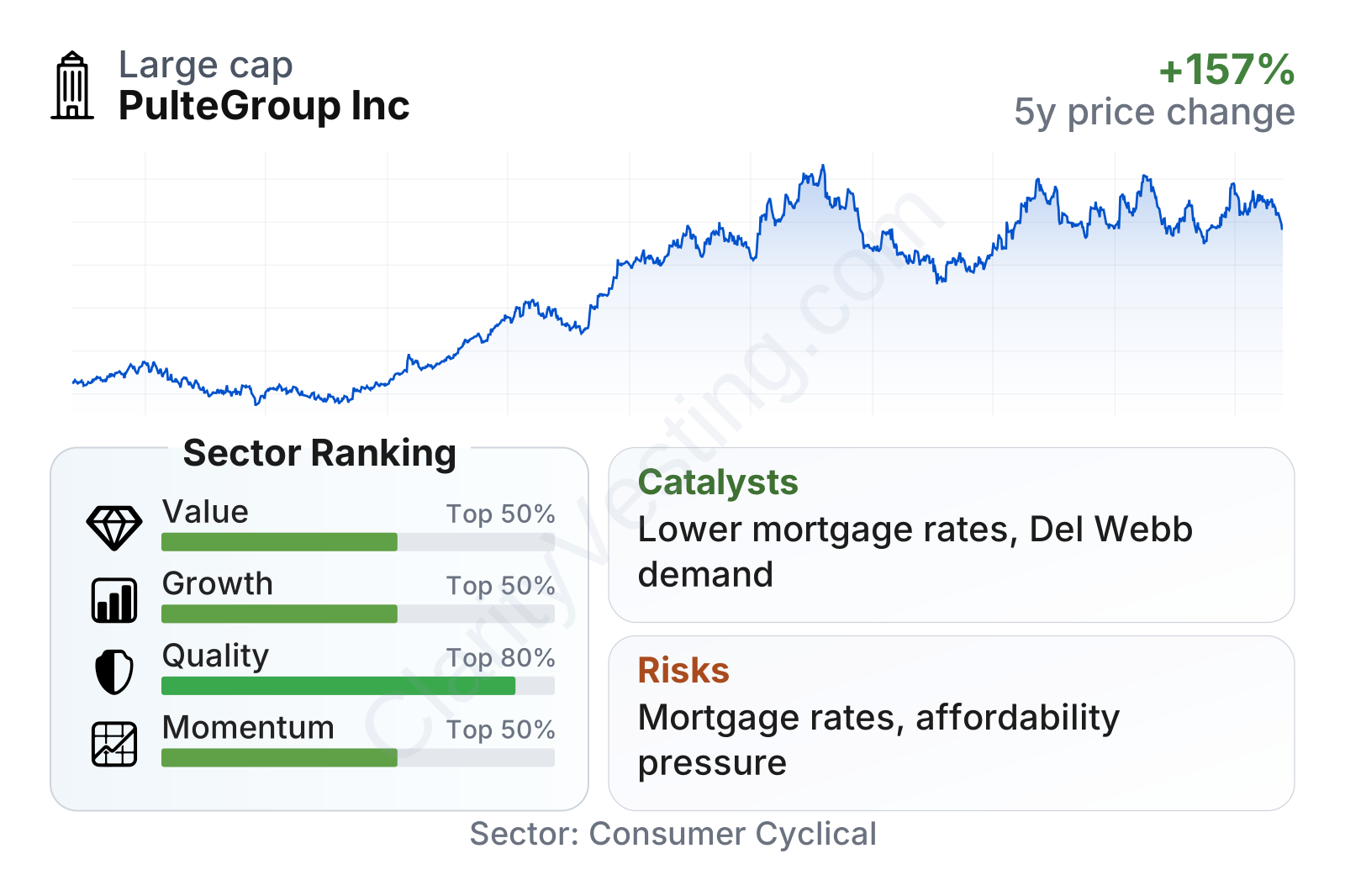
PulteGroup is a large-cap residential construction company with share-price volatility somewhat above the broad market, which is common for homebuilders. In the latest factor snapshot, its overall profile looks balanced rather than extreme: valuation sits in the stronger half of the sector, growth also ranks in the stronger half despite a recent slowdown, and quality remains supported by unusually low leverage and margins that are still well above many peers.
The most striking points are the combination of a low debt load, healthy operating profitability, and a valuation multiple that remains below the sector median. At the same time, recent year-over-year revenue and earnings trends are softer than the company’s longer-term record, which helps explain why the market is not assigning a richer earnings multiple.
Growth
Housing remains an important long-term sector because the United States still faces structural supply constraints in many markets, and household formation continues over time. That does not mean growth is smooth. Homebuilding moves in cycles, and short-term activity depends heavily on mortgage rates, buyer affordability, and consumer confidence. For PulteGroup, the long-term opportunity comes from serving several demand segments rather than relying on a single niche.
The company’s strategy appears coherent for long-term growth. Its brand portfolio lets it reach first-time, move-up, luxury, and active-adult buyers, which helps diversify demand. The active-adult category is especially relevant because aging demographics can support demand for Del Webb communities over many years. PulteGroup also continues to emphasize disciplined land investment rather than simply maximizing volume, which can protect returns when conditions are less favorable.
Recent revenue growth has clearly slowed and turned negative, with the latest reading down about 10% year over year. That matters, but it should be viewed alongside the company’s stronger five-year record, where revenue per share has still compounded at a rate above the sector median. In other words, the near-term picture is weaker, while the longer-term expansion record remains credible.
Cash generation is an important positive. Free cash flow has generally trended upward over the last several years and remains at a strong level, around the high end of its recent range. For a homebuilder, that supports flexibility: buying land, funding development, repurchasing shares, and maintaining balance-sheet resilience during slower periods.
Recent company updates have continued to highlight the use of incentives to support demand in a tougher affordability environment. That can pressure margins, but it also shows the business is adapting rather than standing still. If mortgage rates stabilize or move lower, affordability could improve enough to unlock better order activity, which would be one of the clearest external catalysts for the company.
Risks
This article is for informational purposes only and does not constitute financial advice. Some content is AI-generated. See Disclaimer


