Stock Analysis · PHINIA Inc (PHIN)
Overview
PHINIA Inc is an automotive technology supplier focused on fuel systems, electrical systems, and aftermarket products. The company was separated from BorgWarner in 2023 and now operates as an independent business. Its products are used mainly in internal combustion engine, hybrid, and some alternative-fuel applications across passenger vehicles, commercial vehicles, and industrial equipment. In simple terms, PHINIA makes many of the components that help engines deliver fuel, manage ignition, and meet emissions requirements, and it also sells replacement parts through repair channels.
The business is organized into two main segments. Fuel Systems is the larger operation and serves original equipment manufacturers, while Aftermarket mainly sells replacement parts under established brands. Based on recent annual disclosures, revenue is roughly split as follows:
- Fuel Systems: about 78% to 80% of revenue. This includes gasoline and diesel fuel injection equipment, pumps, injectors, rails, modules, and related engine-management technologies supplied to vehicle and equipment manufacturers.
- Aftermarket: about 20% to 22% of revenue. This includes replacement parts such as ignition products, sensors, fuel-system parts, and service components sold through distributors, repair shops, and retailers.
Geographically, PHINIA is diversified across North America, Europe, and other international markets, which reduces reliance on one single region, but it is still deeply tied to global vehicle production and replacement-parts demand. The business model is relatively straightforward: win long-term supply programs with manufacturers, maintain engineering content in powertrain systems, and use the aftermarket channel to generate steadier sales and cash flow.
The broader financial picture shows a company with revenue around the mid-$3 billion range, gross profit that has stayed fairly resilient, and cash generation that has improved more clearly than reported net income. One notable feature is that high manufacturing costs absorb most of sales, which is typical in auto parts, so margin discipline matters a great deal.
Over the last several years, revenue has moved within a fairly narrow band, while gross profit has remained relatively stable. The more volatile line has been net income, pressured at times by interest expense and other costs. That makes PHINIA look less like a fast-growing technology company and more like an industrial supplier where execution, pricing, and cash conversion are central to the long-term case.
Key Figures
| Metric | Value | Sector ⓘ |
|---|---|---|
| Date | Sep 12, 2026 | |
| Context | ||
| Sector | Consumer Cyclical | |
| Industry | Auto Parts | |
| Market Cap ⓘ | $2.43B | |
| Beta ⓘ | 1.08 | |
Value (Cheapness) | ||
| P/E Ratio ⓘ | 18.93 | 17.10 |
| FCF Yield ⓘ | 12.53% | 8.53% |
| EBIT / EV ⓘ | 8.97% | 6.46% |
| PEG ⓘ | N/A | |
Growth (Business expansion) | ||
| Revenue Growth ⓘ | 5.60% | 5.75% |
| RPS Growth (5Y CAGR) ⓘ | 6.06% | 9.14% |
| EPS Growth (5Y CAGR) ⓘ | 6.28% | -18.21% |
| Margin Growth (5Y Trend) ⓘ | 1.19% | -0.23% |
| FCF Growth (5Y CAGR) ⓘ | 270.29% | 4.91% |
Quality (Business durability) | ||
| ROIC (Latest) ⓘ | 7.49% | 12.61% |
| ROIC (5Y Median) ⓘ | 5.96% | 10.72% |
| Net Debt / EBIT (Latest) ⓘ | 2.48 | 2.10 |
| Net Debt / EBIT (5Y Median) ⓘ | 2.34 | 2.32 |
| Operating Margin (Latest) ⓘ | 7.72% | 9.25% |
| Operating Margin (5Y Median) ⓘ | 8.01% | 9.64% |
| Debt to Equity (Latest) ⓘ | 68.92% | 75.78% |
| Profit Margin (Latest) ⓘ | 3.73% | 5.33% |
| Free Cash Flow (Latest) ⓘ | $304.00M | |
Momentum (Price trend) | ||
| 3Y Return ⓘ | +170.72% | +14.53% |
| 12M Return (excl. last month) ⓘ | +38.05% | +3.08% |
| 6M Return ⓘ | +4.17% | +0.55% |
| Price vs. 200-Day MA ⓘ | -6.65% | -0.54% |
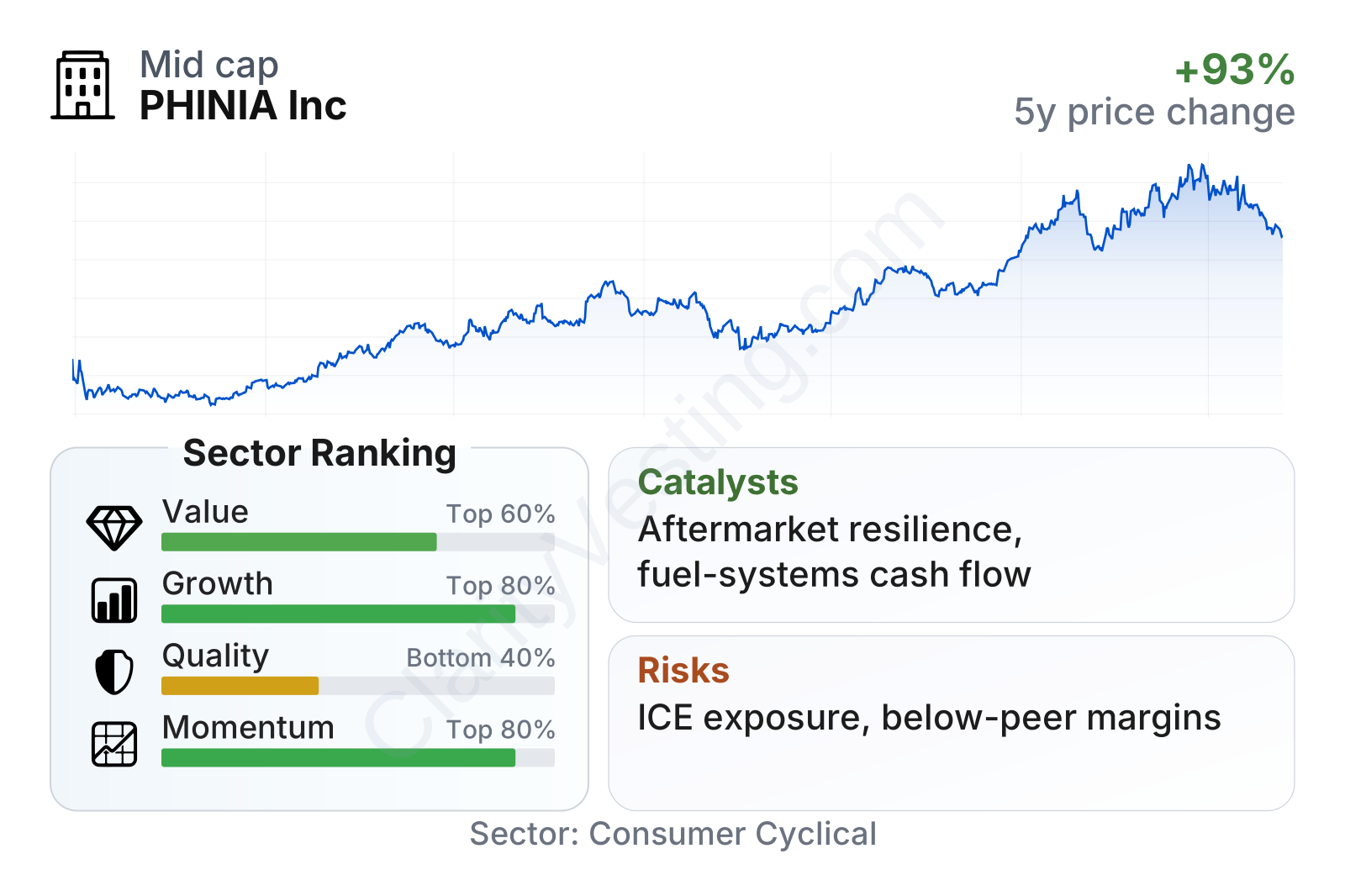
PHINIA is a mid-sized auto-parts company with share-price momentum that has been much stronger than the sector over the last year and over the last three years. On valuation, the earnings multiple sits somewhat above the sector median, but cash-based measures look more favorable, with free-cash-flow yield and EBIT relative to enterprise value stronger than many peers. Growth measures are mixed: recent sales growth has recovered to around the sector median, and earnings and cash flow have improved over time, but returns on invested capital and margins still trail many competitors. Overall, the profile is that of a company with solid cash generation and improving market confidence, but not yet top-tier operating quality.
Growth
PHINIA operates in a sector that is mature rather than rapidly expanding, but that does not mean there is no growth path. Auto parts linked to internal combustion engines face a long-term challenge from electrification, yet the transition is gradual, especially in commercial vehicles, off-highway equipment, and many markets outside the most aggressive EV regions. That gives PHINIA time to keep serving a very large installed base of gasoline and diesel platforms while also supporting hybrid and alternative-fuel applications.
The company’s strategy is logical for this environment. It is not trying to become a pure electric-vehicle champion overnight. Instead, it is focusing on technologies that remain relevant during a long transition period: advanced fuel injection, engine efficiency, emissions-related performance, and replacement parts. That is a practical positioning because hybrids and heavy-duty vehicles still need many of the capabilities PHINIA already supplies.
Recent sales trends suggest the company has moved out of a weaker patch. Revenue growth was negative across several periods in 2024 and early 2025, then turned positive and accelerated, with the latest year-over-year reading in the mid-single digits. That is not explosive expansion, but it does indicate that demand and program execution have improved after a softer period.
Cash generation is one of the more encouraging parts of the picture. Trailing free cash flow has risen sharply over the last two years, reaching a level above $300 million in the latest snapshot. This matters because in an industrial business, steady cash can support debt service, dividends, share repurchases, and investment in new programs even when accounting earnings fluctuate.
A meaningful catalyst is PHINIA’s exposure to commercial vehicles, diesel, and aftermarket demand, areas that usually transition to full electrification more slowly than passenger cars. Another is the company’s focus on improving operational execution as a newly independent company after the spin-off from BorgWarner. Independent companies often spend the first few years simplifying operations, refining capital allocation, and setting clearer priorities, which can create room for better margins and stronger cash flow if management executes well.
Recent company communications have also emphasized capital returns and disciplined use of cash alongside product development in fuel systems and related technologies. That does not create a dramatic headline growth narrative, but it can be significant for long-term business value if the company keeps converting revenue into cash at a healthy rate.
Risks
This article is for informational purposes only and does not constitute financial advice. Some content is AI-generated. See Disclaimer


