Stock Analysis · Penn National Gaming Inc (PENN)
Overview
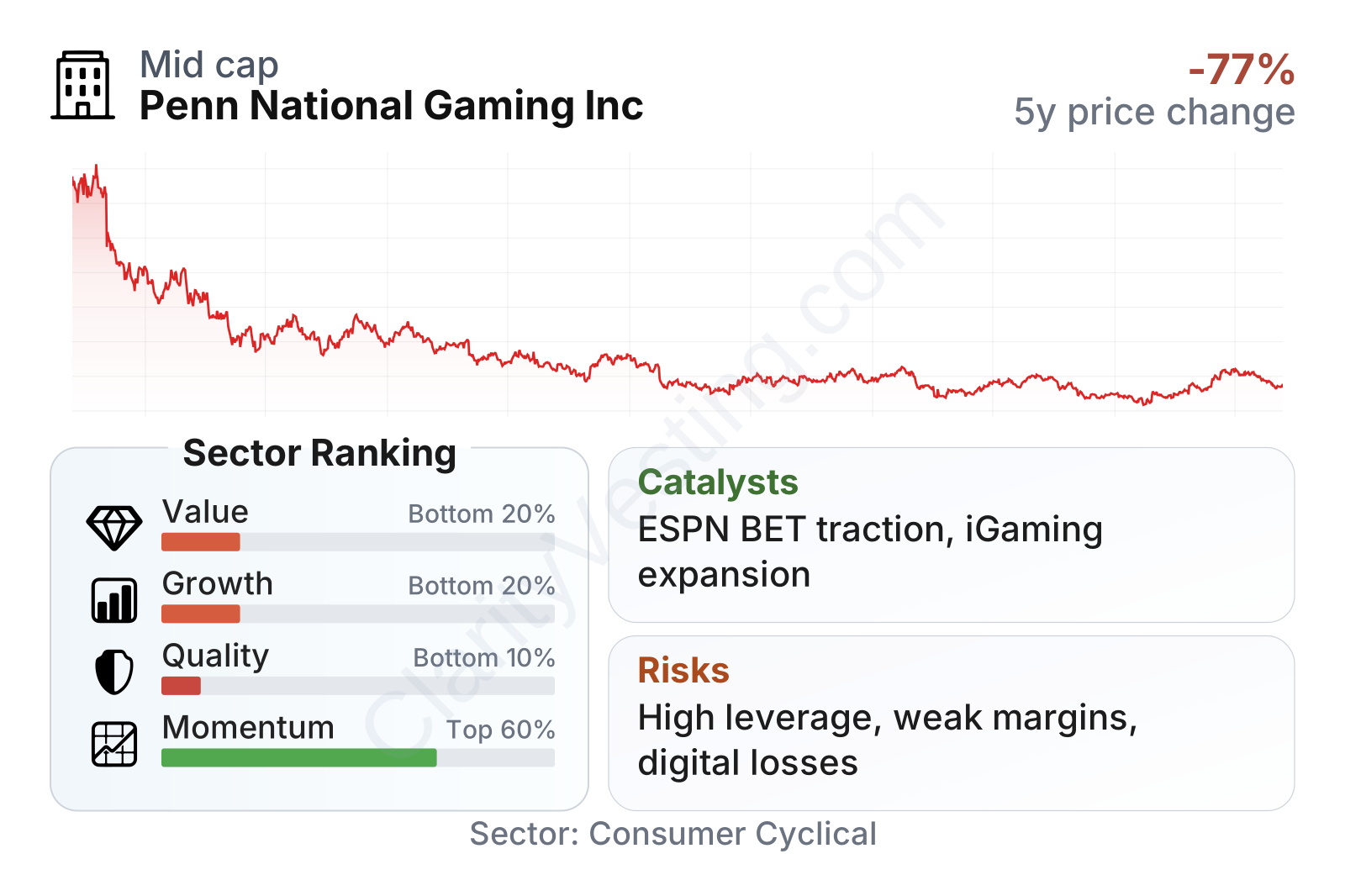
Penn National Gaming Inc., now widely operating under the PENN Entertainment brand, is a U.S. gaming and entertainment company. It owns and operates regional casinos and racetracks, offers online sports betting and iGaming in selected jurisdictions, and also runs a media business tied to sports content and audience engagement. Its model is built around using physical casino properties to generate recurring cash flow while trying to expand into digital betting through branded platforms and media partnerships.
The company’s revenue is still led by its traditional casinos. Based on recent annual reporting, the business mix is approximately as follows:
- Northeast properties: about 30% to 35% — regional casinos and related hotel, food, beverage, and entertainment activity in states such as Pennsylvania and nearby markets.
- South properties: about 25% to 30% — casinos and racetracks across southern states, with revenue from gaming, hospitality, and on-site spending.
- West properties: about 15% to 20% — regional casino operations in western markets.
- Midwest properties: about 15% to 20% — gaming properties serving local and drive-in customers rather than destination tourism.
- Interactive: about 8% to 12% — online sports betting, iCasino where legal, and digital gaming activity, including ESPN BET and theScore Bet related operations.
- Other and corporate-related items: low single-digit share — smaller revenue streams and accounting items not central to property or interactive operations.
This mix matters for long-term analysis because PENN is not a pure online betting company. Most of its economic base still comes from land-based regional gaming, while digital remains the main source of upside potential if execution improves.
The long-term financial picture shows a business that has increased total revenue since 2021, but with weaker conversion of that revenue into profit. Operating costs and cost of revenue have taken a larger share of sales over time, which helps explain why revenue growth has not translated into stable earnings.
Key Figures
| Metric | Value | Sector ⓘ |
|---|---|---|
| Date | Sep 12, 2026 | |
| Context | ||
| Sector | Consumer Cyclical | |
| Industry | Resorts & Casinos | |
| Market Cap ⓘ | $2.30B | |
| Beta ⓘ | 1.38 | |
Value (Cheapness) | ||
| P/E Ratio ⓘ | N/A | 17.10 |
| FCF Yield ⓘ | 3.78% | 8.53% |
| EBIT / EV ⓘ | -4.18% | 6.46% |
| PEG ⓘ | 1.01 | |
Growth (Business expansion) | ||
| Revenue Growth ⓘ | 5.20% | 5.75% |
| RPS Growth (5Y CAGR) ⓘ | 9.37% | 9.14% |
| EPS Growth (5Y CAGR) ⓘ | -30.17% | -18.21% |
| Margin Growth (5Y Trend) ⓘ | -24.62% | -0.23% |
| FCF Growth (5Y CAGR) ⓘ | N/A | 4.91% |
Quality (Business durability) | ||
| ROIC (Latest) ⓘ | -11.32% | 12.61% |
| ROIC (5Y Median) ⓘ | 1.74% | 10.72% |
| Net Debt / EBIT (Latest) ⓘ | N/A | 2.10 |
| Net Debt / EBIT (5Y Median) ⓘ | 12.09 | 2.32 |
| Operating Margin (Latest) ⓘ | -7.28% | 9.25% |
| Operating Margin (5Y Median) ⓘ | 1.96% | 9.64% |
| Debt to Equity (Latest) ⓘ | 366.03% | 75.78% |
| Profit Margin (Latest) ⓘ | -12.66% | 5.33% |
| Free Cash Flow (Latest) ⓘ | $86.90M | |
Momentum (Price trend) | ||
| 3Y Return ⓘ | -18.14% | +14.53% |
| 12M Return (excl. last month) ⓘ | +12.17% | +3.08% |
| 6M Return ⓘ | +22.64% | +0.55% |
| Price vs. 200-Day MA ⓘ | +7.27% | -0.54% |
PENN is a mid-sized company within a very large consumer cyclical universe, and the stock has been much more volatile than the broader market, with a beta above 1.4. The market-based picture has improved recently, with strong six-month performance and the shares trading well above their 200-day average, but the underlying business metrics remain weaker than the sector on value, growth, and especially quality. Free cash flow yield is positive but below the sector median, profitability is currently negative, and leverage remains far above typical peers. In short, the market has recently become more constructive on the shares even though the operating profile is still under pressure.
Growth
PENN operates in a sector with two different growth profiles. Regional casinos are usually a mature business, growing steadily rather than rapidly, while online sports betting and iGaming still have expansion potential as more states legalize digital wagering and as existing markets become more developed. That gives PENN a mixed profile: its core assets provide scale and customer access, while the digital segment offers the possibility of faster future growth.
The company’s strategy broadly makes industrial sense. It already has a large base of customers through its casinos and its loyalty ecosystem, and it is trying to connect that base with digital betting, media reach, and cross-selling. The ESPN BET partnership is central here because it gives PENN access to one of the strongest sports media brands in the United States. TheScore remains important in Canada, where PENN combines media and betting under one ecosystem.
Revenue growth has stabilized after a choppy period. Recent year-over-year growth has been running around the mid-single digits, close to the sector median, which suggests the company is still expanding but not at a pace that by itself resolves profitability concerns. Over the last five years, revenue per share growth has been respectable, but earnings growth has been notably weaker, showing that growth has not been efficient enough.
Cash generation is one of the most important points to watch. Free cash flow was strongly positive a few years ago, then turned negative, and more recently the trailing figure remains modest relative to the size of the company. That pattern suggests PENN is still in a transition period where investment, digital spending, and uneven margins are limiting the amount of cash left after operating and capital needs.
A major catalyst is any evidence that the digital segment can improve its economics rather than only its scale. If ESPN BET gains stronger market share, improves customer acquisition efficiency, or benefits from broader state-level online betting adoption, that could materially change how the market views PENN. Another potential support is the continued resilience of regional gaming demand, especially because PENN’s properties are more exposed to local customers than to luxury destination spending.
Recent company updates have also emphasized product rollouts, market access, and platform improvements in interactive operations. These matter because for PENN, the question is no longer whether it can participate in digital betting, but whether it can do so with margins that justify the investment already made.
Risks
This article is for informational purposes only and does not constitute financial advice. Some content is AI-generated. See Disclaimer