Stock Analysis · Paylocity Holding Corporation (PCTY)
Overview
Paylocity Holding Corporation is a cloud software company focused on human resources and payroll. Its platform helps businesses handle payroll processing, benefits administration, time and labor tracking, talent management, employee communications, and other workforce tasks in one system. The company mainly serves small and midsize organizations in the United States, a part of the market that often wants enterprise-like software without the cost and complexity of the largest corporate systems.
Its business model is largely subscription- and service-based. Customers pay recurring fees to use software modules, and Paylocity also earns money from related services connected to payroll and workforce administration. Based on company filings, revenue is primarily generated from two broad streams.
- Recurring and other revenue: approximately 75% to 85% of total revenue in recent years. This includes fees for payroll, human capital management software modules, time and attendance, benefits, talent tools, scheduling, and other platform-based services.
- Interest income on funds held for clients: approximately 15% to 25% of total revenue in stronger rate environments. Paylocity temporarily holds customer payroll and tax funds before remitting them, and earns interest on those balances. This source can move meaningfully with interest rates and client fund balances.
That mix matters because the first category reflects the core operating franchise, while the second can lift results when short-term rates are elevated. The business also benefits from a wide product set, which gives Paylocity more opportunities to deepen relationships with existing customers instead of relying only on new client wins.
Over the last several years, revenue has expanded from about $853 million in fiscal 2022 to roughly $1.77 billion in fiscal 2026, while operating income and net income also moved steadily higher. Gross profit has remained the dominant portion of revenue, showing the economics typical of scaled software platforms, although Paylocity still spends heavily on product development and sales.
The financial flow shows a business that has been growing while keeping costs under control. Revenue and gross profit have risen each year, and operating income has increased faster than many expense lines, which points to improving scale rather than growth purchased at the expense of profitability.
Key Figures
| Metric | Value | Sector ⓘ |
|---|---|---|
| Date | Sep 12, 2026 | |
| Context | ||
| Sector | Technology | |
| Industry | Software - Application | |
| Market Cap ⓘ | $7.84B | |
| Beta ⓘ | 0.45 | |
Value (Cheapness) | ||
| P/E Ratio ⓘ | 28.85 | 29.51 |
| FCF Yield ⓘ | 5.71% | 4.25% |
| EBIT / EV ⓘ | 5.21% | 2.85% |
| PEG ⓘ | 1.15 | |
Growth (Business expansion) | ||
| Revenue Growth ⓘ | 11.00% | 15.40% |
| RPS Growth (5Y CAGR) ⓘ | 20.96% | 8.56% |
| EPS Growth (5Y CAGR) ⓘ | 24.51% | -11.88% |
| Margin Growth (5Y Trend) ⓘ | 12.00% | 0.46% |
| FCF Growth (5Y CAGR) ⓘ | 48.41% | 9.80% |
Quality (Business durability) | ||
| ROIC (Latest) ⓘ | 21.89% | 9.44% |
| ROIC (5Y Median) ⓘ | 19.49% | 8.30% |
| Net Debt / EBIT (Latest) ⓘ | -0.38 | 0.54 |
| Net Debt / EBIT (5Y Median) ⓘ | -0.74 | 0.44 |
| Operating Margin (Latest) ⓘ | 21.87% | 9.58% |
| Operating Margin (5Y Median) ⓘ | 19.81% | 8.25% |
| Debt to Equity (Latest) ⓘ | 10.11% | 33.33% |
| Profit Margin (Latest) ⓘ | 15.23% | 7.14% |
| Free Cash Flow (Latest) ⓘ | $448.00M | |
Momentum (Price trend) | ||
| 3Y Return ⓘ | -26.62% | +45.48% |
| 12M Return (excl. last month) ⓘ | -14.66% | +23.48% |
| 6M Return ⓘ | +28.18% | +20.93% |
| Price vs. 200-Day MA ⓘ | +13.10% | +7.43% |
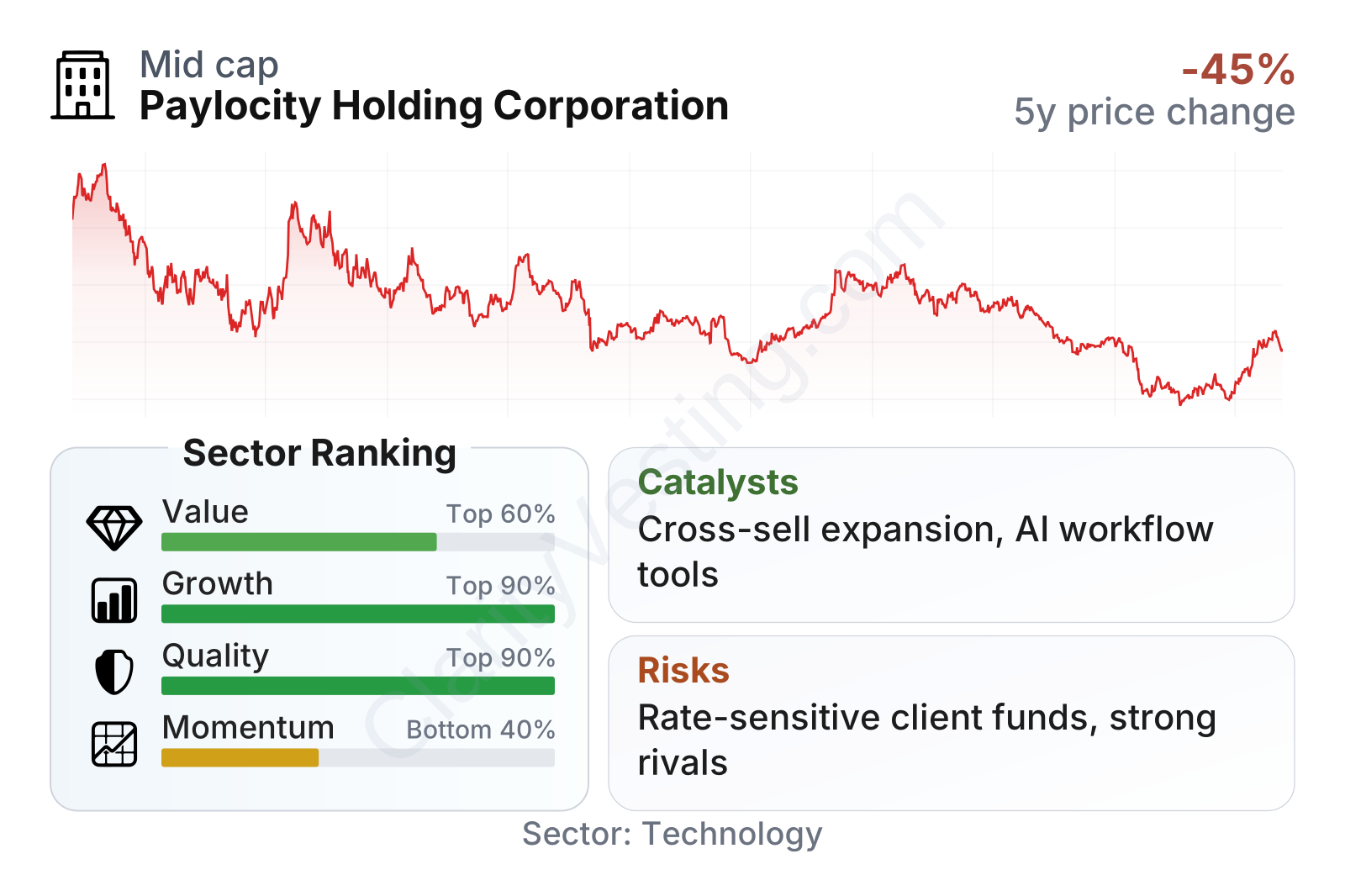
Paylocity sits in the mid-cap range, with relatively low share-price volatility compared with many technology names, reflected in a beta well below 1. On valuation, the earnings multiple is now close to the sector median rather than at the much richer levels seen in prior years. Quality metrics stand out more clearly: operating margin, return on invested capital, profit margin, and balance-sheet strength all compare favorably with much of the software sector. Growth remains strong over a multiyear period, especially in revenue per share, earnings, and free cash flow, even if the latest year-over-year revenue pace is now more moderate than the company’s earlier post-pandemic surge. The weaker area is momentum, as the stock has lagged the broader sector over the last one- and three-year periods.
Growth
Paylocity operates in a favorable long-term market. Human capital management and payroll software continue to benefit from the shift away from manual processes, legacy on-premise systems, and fragmented point solutions. Businesses want integrated platforms that reduce administrative work, improve compliance, and give employees more self-service tools. Those industry trends are durable because payroll and HR are essential functions, not discretionary extras.
The company’s strategy is coherent for this market. It has built a broad suite around payroll, then expanded into adjacent categories such as recruiting, learning, employee engagement, benefits, workforce management, and analytics. This matters because payroll often acts as the anchor product. Once a customer runs payroll on a platform, adding more modules becomes easier, which can raise revenue per client and increase switching costs.
Growth has clearly normalized from the unusually high rates reached in earlier years, but it is still positive and healthy. Recent year-over-year gains have been around 10% to 11%, well below the 30% to 40% range seen several years ago. That slowdown is worth watching, yet it does not automatically signal a weak business. For a company of Paylocity’s larger revenue base, double-digit expansion combined with strong margins can still represent a solid operating profile.
Cash generation is one of the more encouraging parts of the picture. Trailing free cash flow has climbed sharply over the past several years, moving from under $100 million in early 2022 to more than $400 million more recently. That suggests the business is not only growing on paper but also turning more of its scale into actual cash, which gives it flexibility for product investment, acquisitions, and balance-sheet resilience.
A meaningful catalyst remains the cross-sell opportunity within the installed customer base. Paylocity does not need to rely solely on winning brand-new customers; it can also expand wallet share by selling additional modules to current clients. Another support comes from its client funds model. When interest rates are higher, the company earns more from funds held for customers, which can provide a noticeable earnings tailwind even without a major change in core software demand.
Recent company updates have also emphasized product innovation, including AI-related capabilities and workflow improvements across the platform. For a payroll and HR provider, the practical value of AI is less about headline excitement and more about automation, faster answers for employees and managers, and easier administrative work. If these tools improve retention and module adoption, they can become a useful commercial lever rather than just a branding exercise.
Risks
This article is for informational purposes only and does not constitute financial advice. Some content is AI-generated. See Disclaimer