Stock Analysis · Prosperity Bancshares Inc (PB)
Overview
Prosperity Bancshares is a regional bank based in Texas. Through Prosperity Bank, it provides everyday banking services to businesses and consumers, with a footprint centered on Texas and parts of Oklahoma. In simple terms, it gathers deposits from customers, makes loans, invests part of its balance sheet in securities, and earns money from the spread between what it receives on loans and investments and what it pays on deposits and other funding.
Its business is still primarily a traditional banking model, not a fee-heavy financial platform. That matters for long-term analysis because results tend to depend on loan demand, deposit costs, credit quality, local economic conditions, and interest rates more than on capital markets activity.
The main sources of revenue are generally structured as follows, based on the company’s reporting and regional bank economics:
- Net interest income: approximately 80% to 90% of total revenue in recent periods. This is the core banking income from commercial real estate loans, commercial and industrial lending, residential mortgage lending, agricultural lending, consumer loans, securities, and cash balances, after funding costs are deducted.
- Noninterest income: approximately 10% to 20% of total revenue. This usually includes service charges on deposit accounts, mortgage-related income, nonsufficient funds fees, debit card and interchange income, trust and wealth-related fees where applicable, and gains from other banking services.
Over the last several years, revenue has expanded meaningfully, but earnings have been more uneven because higher funding costs and interest expense compressed profitability during the industry’s post-2022 rate adjustment. Even so, the bank has remained solidly profitable, and operating margins have stayed strong for the sector.
The long-term pattern shows a bank that has grown revenue from roughly $1.2 billion to around $1.7 billion over a few years. Profitability dipped in 2023 as funding costs jumped, then improved again in 2024 and 2025, suggesting the pressure was real but manageable rather than destructive to the franchise.
Key Figures
| Metric | Value | Sector ⓘ |
|---|---|---|
| Date | Nov 14, 2026 | |
| Context | ||
| Sector | Financial Services | |
| Industry | Banks - Regional | |
| Market Cap ⓘ | $8.74B | |
| Beta ⓘ | 0.65 | |
Value (Cheapness) | ||
| P/E Ratio ⓘ | 13.32 | 12.38 |
| P/B Ratio ⓘ | 0.89 | 1.54 |
| FCF Yield ⓘ | 8.08% | 8.62% |
| Dividend Yield ⓘ | 3.28% | 2.91% |
| EBIT / EV ⓘ | 9.85% | 8.22% |
| PEG ⓘ | 4.26 | |
Growth (Business expansion) | ||
| Revenue Growth ⓘ | 57.50% | 7.00% |
| RPS Growth (5Y CAGR) ⓘ | 10.28% | 12.30% |
| EPS Growth (5Y CAGR) ⓘ | -4.67% | -0.81% |
| BVPS Growth (5Y CAGR) ⓘ | 3.81% | 4.87% |
| Margin Growth (5Y Trend) ⓘ | -17.37% | -4.00% |
| FCF Growth (5Y CAGR) ⓘ | -6.47% | 4.68% |
| DPS Growth (5Y CAGR) ⓘ | 4.18% | 8.77% |
Quality (Business durability) | ||
| ROIC (Latest) ⓘ | 6.41% | 9.69% |
| ROE (Latest) ⓘ | 6.52% | 14.05% |
| ROA (Latest) ⓘ | 1.22% | 1.58% |
| ROIC (5Y Median) ⓘ | 6.63% | 7.79% |
| ROE (5Y Median) ⓘ | 7.21% | 12.05% |
| ROA (5Y Median) ⓘ | 1.39% | 1.28% |
| Net Debt / EBIT (Latest) ⓘ | 0.35 | 0.97 |
| Net Debt / EBIT (5Y Median) ⓘ | 2.37 | 0.73 |
| Net Debt / EBITDA (Latest) ⓘ | 0.33 | 0.75 |
| Operating Margin (Latest) ⓘ | 44.52% | 23.57% |
| Operating Margin (5Y Median) ⓘ | 39.90% | 24.30% |
| Debt to Equity (Latest) ⓘ | 27.43% | 59.34% |
| Profit Margin (Latest) ⓘ | 36.01% | 26.53% |
| Free Cash Flow (Latest) ⓘ | $705.92M | |
Momentum (Price trend) | ||
| 3Y Return ⓘ | +46.44% | +85.82% |
| 12M Return (excl. last month) ⓘ | +4.50% | +16.88% |
| 6M Return ⓘ | +11.00% | +8.29% |
| Price vs. 200-Day MA ⓘ | +5.17% | +5.17% |
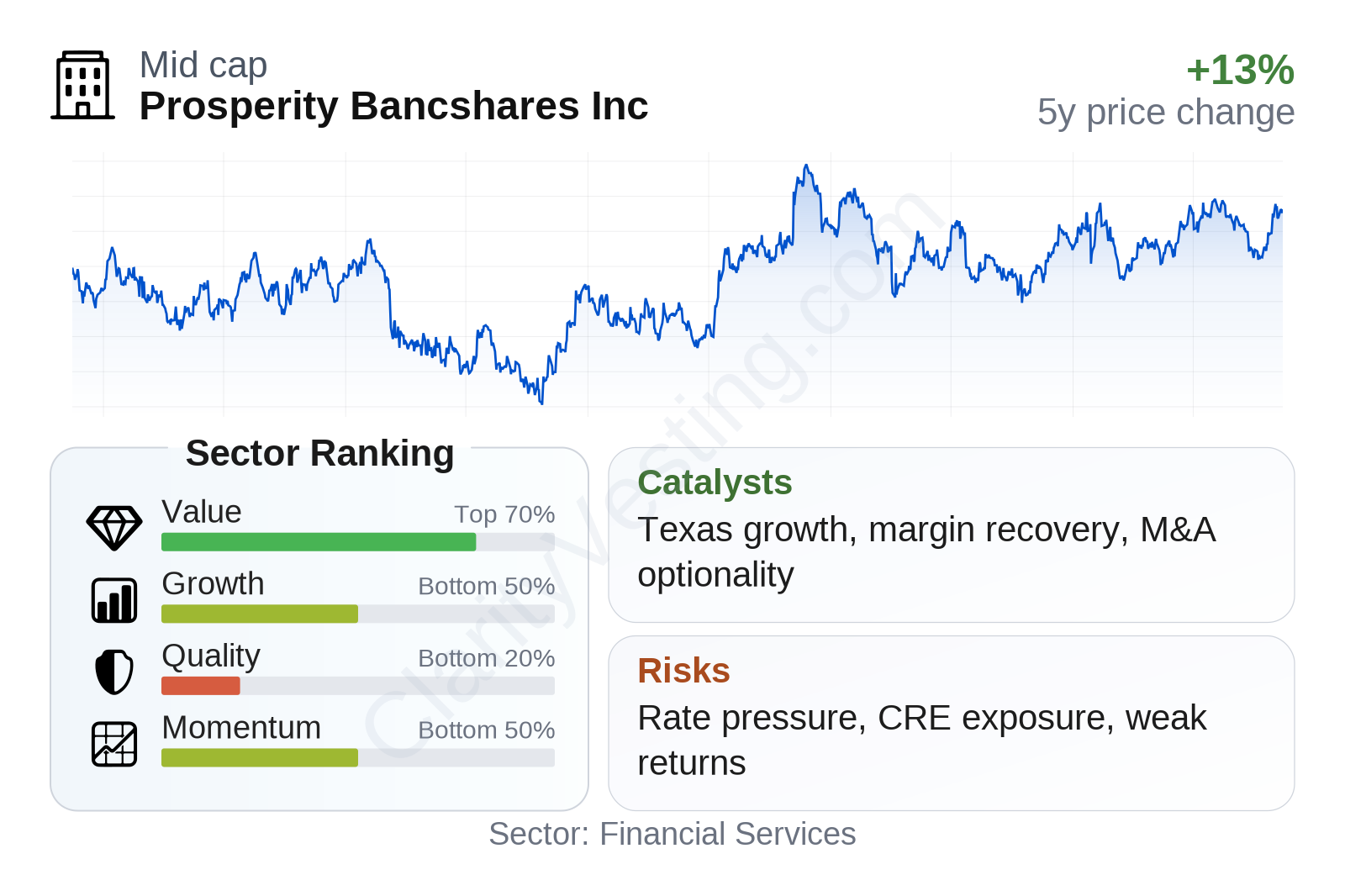
Prosperity Bancshares is a mid-sized regional bank with a market value a little above $8 billion and a below-market beta, which points to lower share-price volatility than many stocks. On valuation, the picture is mixed: its earnings multiple is near the sector median, but its price-to-book ratio is below the regional bank median. Income metrics are respectable, with a dividend yield slightly above the sector median.
The more cautious part of the table is quality and growth ranking. Profitability ratios such as return on equity and return on assets trail the sector median, and growth has been less consistent over five years than some peers. At the same time, the bank’s operating margin and profit margin remain notably strong, and debt-to-equity is lower than the sector median, which supports the view that this is a conservatively run balance-sheet business rather than a high-growth franchise.
Growth
Regional banking is not a fast-growth sector in the way software or semiconductors can be, but it is tied to long-run economic expansion, population growth, business formation, and real estate activity. Prosperity Bancshares operates in Texas, one of the more attractive banking markets in the United States because of its large population, business migration, energy exposure, infrastructure development, and generally above-average economic activity. That market backdrop is an important long-term support for loan and deposit growth.
Its strategy is straightforward and sensible for a bank of its type: expand relationships in attractive local markets, keep credit discipline, protect deposit funding, and use acquisitions selectively. Prosperity has a long history of growing through bank acquisitions, especially in Texas. For a regional bank, that can be a meaningful catalyst because acquired deposits and branches can strengthen market share quickly if integration is handled well.
The earnings trend shows why the business deserves a measured rather than aggressive growth label.
Earnings per share were solid in 2021 and 2022, dropped in 2023 when industry funding pressure intensified, and then recovered in 2024 and 2025. That rebound is encouraging because it suggests the earnings decline was cyclical rather than a sign of a broken business model. Still, the five-year earnings growth record remains modest, so the company’s expansion profile looks more steady than dynamic.
Balance-sheet value has been moving in the right direction.
Book value per share has climbed gradually over time, which is important for bank analysis because book value is a rough indicator of the underlying equity base supporting the franchise. A rising book value usually means the institution has continued to retain profits and build capital, even through a difficult rate environment.
Recent company filings in 2026 show continued attention to deposit costs, loan growth, and margin stability. Those are the main near-term levers for a regional bank. If deposit pricing becomes less competitive and loan demand in Texas remains healthy, Prosperity could have room for further earnings normalization. Another potential catalyst is additional consolidation in regional banking, where strong deposit franchises in desirable states tend to have strategic value.
Risks
This article is for informational purposes only and does not constitute financial advice. Some content is AI-generated. See Disclaimer