Stock Analysis · Paychex Inc (PAYX)
Overview
Paychex is a payroll and human capital management company that mainly serves small and mid-sized businesses in the United States and parts of Europe. In simple terms, it helps employers pay workers, manage tax filings, administer employee benefits, handle retirement plans, track time and attendance, support hiring and HR tasks, and outsource some employer responsibilities through professional employer organization, or PEO, services.
Its business model is built around recurring services rather than one-time software sales. That makes revenue more predictable than in many parts of the technology sector. Paychex also earns interest income on client funds it temporarily holds before payroll taxes and wages are remitted, which can become more meaningful when interest rates are elevated.
Based on recent company reporting, the main revenue sources can be summarized as follows:
- Management Solutions: about 58% to 62% of revenue. This includes payroll processing, HR software and advisory tools, retirement services administration, insurance-related services, and time and attendance products.
- PEO and Insurance Solutions: about 30% to 35% of revenue. This segment includes HR outsourcing and employee benefits administration through the company’s PEO offering, where Paychex supports clients with payroll, compliance, and benefit-related functions.
- Interest on funds held for clients: about 7% to 10% of revenue in the current higher-rate environment. This comes from investing client payroll funds before they are disbursed. The contribution can move up or down materially with interest rates and client fund balances.
Over the last several years, total revenue has climbed from roughly $4.6 billion to about $6.5 billion, while gross profit has expanded even faster. That points to a business with good operating leverage, although some of the recent gains have also been helped by interest income and scale benefits.
Key Figures
| Metric | Value | Sector ⓘ |
|---|---|---|
| Date | Sep 12, 2026 | |
| Context | ||
| Sector | Technology | |
| Industry | Software - Application | |
| Market Cap ⓘ | $41.22B | |
| Beta ⓘ | 0.89 | |
Value (Cheapness) | ||
| P/E Ratio ⓘ | 23.54 | 29.51 |
| FCF Yield ⓘ | 5.63% | 4.25% |
| EBIT / EV ⓘ | 5.79% | 2.85% |
| PEG ⓘ | 2.03 | |
Growth (Business expansion) | ||
| Revenue Growth ⓘ | 12.50% | 15.40% |
| RPS Growth (5Y CAGR) ⓘ | 9.24% | 8.56% |
| EPS Growth (5Y CAGR) ⓘ | 10.02% | -11.88% |
| Margin Growth (5Y Trend) ⓘ | -0.85% | 0.46% |
| FCF Growth (5Y CAGR) ⓘ | 14.04% | 9.80% |
Quality (Business durability) | ||
| ROIC (Latest) ⓘ | 22.40% | 9.44% |
| ROIC (5Y Median) ⓘ | 37.17% | 8.30% |
| Net Debt / EBIT (Latest) ⓘ | 1.35 | 0.54 |
| Net Debt / EBIT (5Y Median) ⓘ | 0.27 | 0.44 |
| Operating Margin (Latest) ⓘ | 39.57% | 9.58% |
| Operating Margin (5Y Median) ⓘ | 40.94% | 8.25% |
| Debt to Equity (Latest) ⓘ | 123.97% | 33.33% |
| Profit Margin (Latest) ⓘ | 26.63% | 7.14% |
| Free Cash Flow (Latest) ⓘ | $2.32B | |
Momentum (Price trend) | ||
| 3Y Return ⓘ | +7.10% | +45.48% |
| 12M Return (excl. last month) ⓘ | -6.90% | +23.48% |
| 6M Return ⓘ | +29.28% | +20.93% |
| Price vs. 200-Day MA ⓘ | +13.19% | +7.43% |
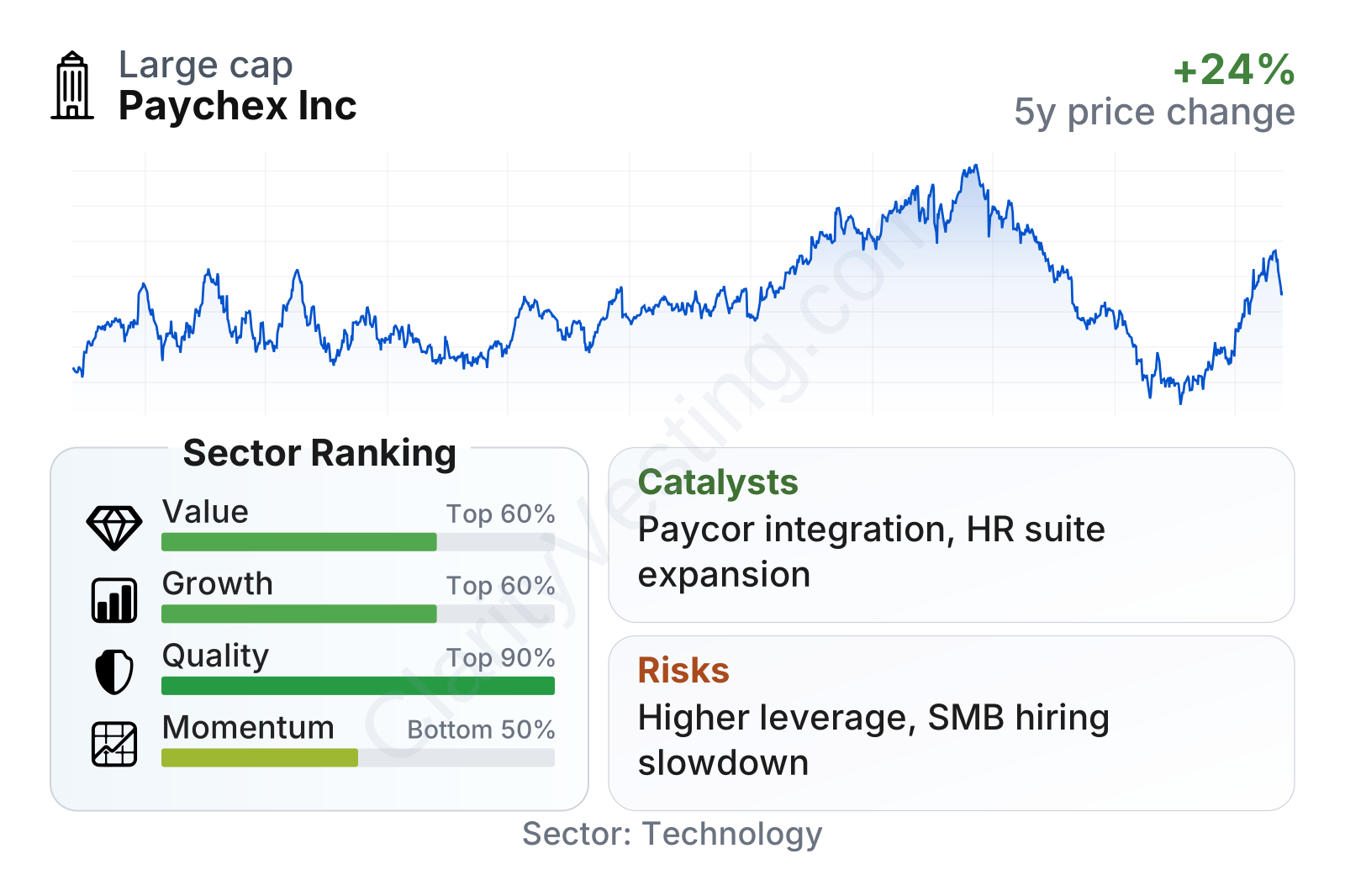
Paychex is a large, established company with relatively low share-price volatility for the technology sector, as suggested by a beta below 1. On valuation, it screens better than much of its sector, with a price-to-earnings ratio in the low 20s versus a noticeably higher sector median. Cash generation also stands out, with free cash flow yield and operating earnings relative to enterprise value both ahead of the typical peer.
Quality is where the company looks strongest. Returns on invested capital and operating margins are far above sector norms, showing that Paychex converts a large share of revenue into profit. Growth is solid rather than exceptional: recent revenue growth is around the low teens, near but slightly below the sector median, while longer-term per-share growth and cash flow growth have held up well. Share-price momentum has been weaker than many software names over longer periods, reflecting a more defensive profile and the stock’s pullback from its earlier highs.
Growth
Paychex operates in a part of the market with durable long-term demand. Payroll, HR compliance, benefits administration, and workforce management are not optional for employers. Complexity keeps rising as labor rules, tax requirements, and benefits expectations become harder to manage internally, especially for small businesses. That gives the company exposure to a sector that grows not only with employment levels, but also with outsourcing and software adoption.
The company’s strategy is coherent for future expansion. It combines core payroll services with adjacent products such as HR tools, retirement administration, insurance services, and PEO offerings. This matters because once a client uses Paychex for payroll, it becomes easier to sell additional services into the same relationship. That cross-selling approach can lift revenue per client without relying only on new customer wins.
Recent growth has reaccelerated after a softer period. Year-over-year revenue growth moved from mid-single-digit levels in parts of 2024 to low- to high-teen percentages through much of 2025 and early 2026, before moderating back toward the low teens. That pattern suggests the business is still expanding at a healthy pace, but not in a straight line.
Cash generation remains an important positive signal. Free cash flow has grown meaningfully over time and recently reached a level above $2.1 billion on a trailing basis. For a service-heavy company with recurring revenue, that supports flexibility for dividends, acquisitions, debt service, and platform investment.
One major catalyst is the company’s pending acquisition of Paycor, announced in 2025 and advanced through regulatory and shareholder steps. Strategically, the deal broadens Paychex’s reach in human capital management, especially in more modern software capabilities and upmarket customer segments. If integration goes well, it could strengthen product breadth, increase cross-selling opportunities, and support faster revenue growth than the legacy business alone.
A second catalyst comes from client fund interest income. Paychex benefits when short-term rates are healthy and client balances remain strong. That is not the core reason the business exists, but it has become a notable earnings support in recent years.
Risks
This article is for informational purposes only and does not constitute financial advice. Some content is AI-generated. See Disclaimer


