Stock Analysis · Payoneer Global Inc (PAYO)
Overview
Payoneer Global Inc is a financial technology company focused on cross-border payments for small and midsize businesses, online sellers, freelancers, contractors, and marketplaces. In simple terms, it helps businesses and professionals in many countries get paid, hold funds in different currencies, convert money, and send payments internationally. Its main use case is global commerce: a seller in one country can receive money from a marketplace or customer in another country without needing a complex international banking setup.
The company operates a platform that combines payment accounts, merchant services, working capital products, and payment processing. Payoneer is especially active in e-commerce, digital services, and business-to-business trade, where international transactions can be frequent, fragmented, and expensive through traditional banking channels.
Based on company reporting, revenue is mainly generated from fees tied to payment volume and related financial services. The mix can shift by quarter, but the main sources are broadly the following:
- Transaction and service revenue: approximately 75% to 85% of total revenue in recent periods. This includes fees for cross-border receivables, withdrawals, currency conversion, card and checkout-related services, and other account activity.
- Interest revenue: approximately 15% to 25% of total revenue in recent periods. This comes primarily from interest earned on customer balances and certain funds held within the platform, helped by higher interest rate environments.
- Other revenue streams: a small remainder when applicable, including value-added services connected to the broader customer relationship.
Geographically, Payoneer is built for international use rather than one domestic market. Its customer base spans more than 190 countries and territories, which reduces dependence on a single economy but also makes the business more exposed to regulation, currency movements, and regional demand swings.
The long-term appeal of the business model is straightforward: as more commerce moves online and more small businesses sell globally, the need for easy cross-border payment infrastructure rises. Payoneer sits in that middle layer between marketplaces, merchants, contractors, and banking networks.
The multi-year picture shows a company that scaled revenue substantially from 2021 through 2025 and moved from losses to profitability. Gross profit expanded strongly through 2024, while 2025 showed slower profit conversion as operating costs and cost of revenue increased faster than in the prior year.
Key Figures
| Metric | Value | Sector ⓘ |
|---|---|---|
| Date | Sep 12, 2026 | |
| Context | ||
| Sector | Technology | |
| Industry | Software - Infrastructure | |
| Market Cap ⓘ | $2.41B | |
| Beta ⓘ | 0.94 | |
Value (Cheapness) | ||
| P/E Ratio ⓘ | 50.86 | 29.51 |
| FCF Yield ⓘ | 6.75% | 4.25% |
| EBIT / EV ⓘ | 5.09% | 2.85% |
| PEG ⓘ | N/A | |
Growth (Business expansion) | ||
| Revenue Growth ⓘ | 5.20% | 15.40% |
| RPS Growth (5Y CAGR) ⓘ | 4.61% | 8.56% |
| EPS Growth (5Y CAGR) ⓘ | N/A | -11.88% |
| Margin Growth (5Y Trend) ⓘ | 16.27% | 0.46% |
| FCF Growth (5Y CAGR) ⓘ | N/A | 9.80% |
Quality (Business durability) | ||
| ROIC (Latest) ⓘ | 7.01% | 9.44% |
| ROIC (5Y Median) ⓘ | 10.24% | 8.30% |
| Net Debt / EBIT (Latest) ⓘ | -2.38 | 0.54 |
| Net Debt / EBIT (5Y Median) ⓘ | -3.87 | 0.44 |
| Operating Margin (Latest) ⓘ | 10.12% | 9.58% |
| Operating Margin (5Y Median) ⓘ | 10.98% | 8.25% |
| Debt to Equity (Latest) ⓘ | 13.18% | 33.33% |
| Profit Margin (Latest) ⓘ | 4.65% | 7.14% |
| Free Cash Flow (Latest) ⓘ | $162.74M | |
Momentum (Price trend) | ||
| 3Y Return ⓘ | +12.84% | +45.48% |
| 12M Return (excl. last month) ⓘ | +5.01% | +23.48% |
| 6M Return ⓘ | +60.72% | +20.93% |
| Price vs. 200-Day MA ⓘ | +21.35% | +7.43% |
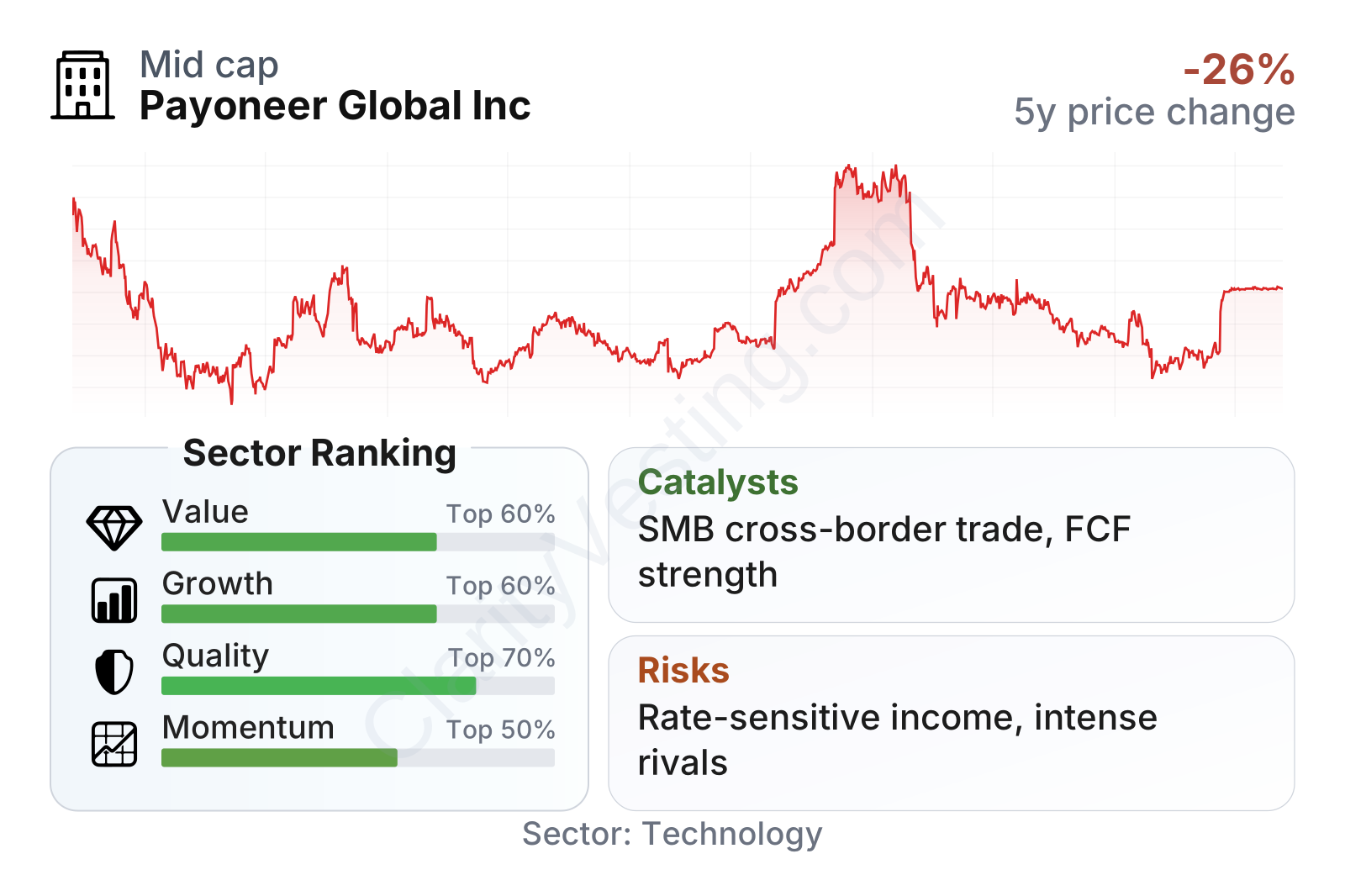
Payoneer is a mid-sized company with relatively low share-price volatility compared with many technology names. The overall metric profile is mixed but understandable: valuation is not cheap on earnings, cash generation is solid, balance-sheet risk is low, and recent growth is positive but no longer fast by sector standards. Profitability and capital structure look healthier than they did a few years ago, while share-price momentum has lagged much of the broader software group.
The stock history also reflects that transition. After a sharp decline following its early public-market period, the shares later rebounded, but recent trading has remained uneven. That pattern suggests the market has been reassessing the company from a high-expectation growth case toward a more measured profitability-and-execution case.
Growth
Payoneer operates in a sector with clear long-term support. Cross-border e-commerce, global freelance work, digital exports, and international marketplace selling are all structural trends that can expand over many years. Many smaller businesses still face friction in collecting payments internationally, especially outside large developed markets. That leaves room for platforms that simplify onboarding, collections, compliance, and currency handling.
Its strategy is logical for that environment. Rather than trying to be a broad consumer wallet, Payoneer is focused on business users that need practical payment infrastructure. That specialization matters because small exporters, marketplace sellers, and service providers often need more than a payment button: they need multi-currency accounts, faster settlement, compliance support, local collection capabilities, and increasingly access to working capital.
Revenue growth remains positive, but the pace has clearly cooled from the very strong expansion seen in 2021 through 2024. More recently, year-over-year growth has been running in the mid-single digits. That is still growth, but it means the next phase likely depends less on pure volume expansion and more on better monetization, larger customer cohorts, and deeper product usage.
Free cash flow is one of the more encouraging parts of the picture. Over the last several years, cash generation improved sharply and remains strong in absolute terms, even with some fluctuations. For a company in digital payments, that matters because it shows the platform is not just producing accounting earnings; it is also turning operations into cash that can support product development, partnerships, and balance-sheet flexibility.
A notable catalyst is Payoneer’s effort to deepen relationships with marketplace sellers and business customers through broader financial services. The company has highlighted growth in higher-value customers and larger accounts, which can raise payment volume per user and make customer relationships more durable. Another useful tailwind is that interest income can still support results when customer balances remain healthy, although that is less dependable than transaction-led growth over the long run.
Recent company updates have also pointed to continued execution around SMB cross-border commerce, regulatory expansion, and product additions for global trade workflows. Those are meaningful because the more Payoneer becomes embedded in how international sellers operate, the harder it is to replace with a basic payment processor.
Risks
This article is for informational purposes only and does not constitute financial advice. Some content is AI-generated. See Disclaimer


