Stock Analysis · Paycom Software Inc (PAYC)
Overview
Paycom Software is a human capital management, or HCM, software company. In simple terms, it provides a cloud-based platform that helps employers manage payroll, time and attendance, benefits, talent acquisition, onboarding, scheduling, HR administration, and compliance. Its main customers are businesses that want to run many employee-related processes in one system rather than using separate tools.
The company’s model is built around recurring software usage and related service fees. Paycom emphasizes a single-database platform, meaning employee and payroll information is entered once and then used across many HR functions. This matters because payroll and HR systems are deeply embedded in day-to-day operations, which can make customer relationships durable when the product works well.
Based on company filings, Paycom generates nearly all of its revenue from HCM and payroll software delivered as a service. Public filings do not break revenue into many detailed external segments, but the business can be understood through its major economic drivers:
- Recurring service revenue from payroll and HCM software: approximately 90%+. This includes subscription-like fees tied to payroll processing and access to modules for HR, time tracking, benefits, talent management, and employee self-service.
- Implementation, setup, and other service-related revenue: less than 10%. This includes onboarding customers onto the platform, configuration, training, and related support activities.
- Interest on funds held for clients: a small but meaningful supplemental source. Like several payroll processors, Paycom holds customer funds for short periods before payroll and tax remittances are made, which can generate interest income when rates are favorable.
One notable feature of the business is its profitability profile. Revenue has expanded strongly over the past several years, while a large share of each additional dollar of sales has converted into gross profit and cash flow. At the same time, the mix of spending has shifted: research and development has continued to rise, while selling and administrative costs became more efficient in 2024 before increasing again in 2025. That pattern suggests a company balancing product investment with margin discipline.
Key Figures
| Metric | Value | Sector ⓘ |
|---|---|---|
| Date | Sep 12, 2026 | |
| Context | ||
| Sector | Technology | |
| Industry | Software - Application | |
| Market Cap ⓘ | $9.87B | |
| Beta ⓘ | 0.79 | |
Value (Cheapness) | ||
| P/E Ratio ⓘ | 22.87 | 29.51 |
| FCF Yield ⓘ | 7.65% | 4.25% |
| EBIT / EV ⓘ | 6.68% | 2.85% |
| PEG ⓘ | 1.14 | |
Growth (Business expansion) | ||
| Revenue Growth ⓘ | 9.80% | 15.40% |
| RPS Growth (5Y CAGR) ⓘ | 19.16% | 8.56% |
| EPS Growth (5Y CAGR) ⓘ | -3.24% | -11.88% |
| Margin Growth (5Y Trend) ⓘ | 6.11% | 0.46% |
| FCF Growth (5Y CAGR) ⓘ | 20.55% | 9.80% |
Quality (Business durability) | ||
| ROIC (Latest) ⓘ | 31.30% | 9.44% |
| ROIC (5Y Median) ⓘ | 27.21% | 8.30% |
| Net Debt / EBIT (Latest) ⓘ | 1.12 | 0.54 |
| Net Debt / EBIT (5Y Median) ⓘ | -0.49 | 0.44 |
| Operating Margin (Latest) ⓘ | 32.83% | 9.58% |
| Operating Margin (5Y Median) ⓘ | 28.51% | 8.25% |
| Debt to Equity (Latest) ⓘ | 171.97% | 33.33% |
| Profit Margin (Latest) ⓘ | 22.78% | 7.14% |
| Free Cash Flow (Latest) ⓘ | $754.50M | |
Momentum (Price trend) | ||
| 3Y Return ⓘ | -21.03% | +45.48% |
| 12M Return (excl. last month) ⓘ | -0.89% | +23.48% |
| 6M Return ⓘ | +73.66% | +20.93% |
| Price vs. 200-Day MA ⓘ | +46.16% | +7.43% |
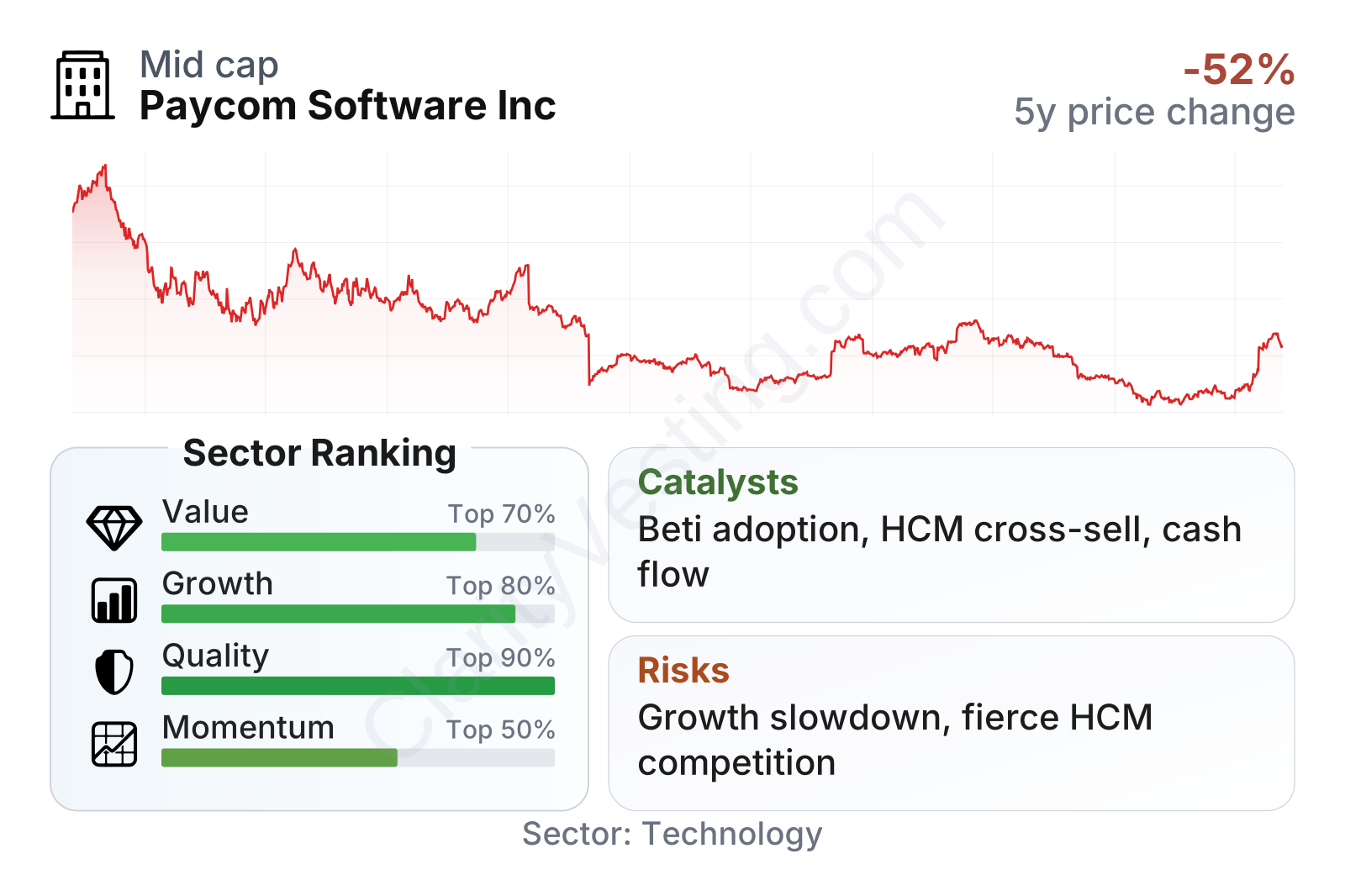
Paycom is now a mid-sized software company by market value, with a stock that has been less volatile than the broader market based on its beta below 1. In the factor summary, quality stands out the most: returns on invested capital and operating margins are far above the sector median, showing an unusually efficient software business. Growth remains solid over a five-year view, especially for revenue per share and free cash flow, although the most recent year-over-year revenue pace is below the sector median. Value metrics look more favorable than many software peers, with a lower earnings multiple than the sector median and a stronger free cash flow yield. Momentum is the weakest area: the stock has recovered sharply in recent months, but the longer three-year share-price record still reflects a major reset from earlier, much richer valuation levels.
Growth
Paycom operates in a large and still-growing market. Payroll, HR administration, compliance, time management, and employee workflow software remain essential functions for employers, and many businesses continue moving away from manual processes or older on-premise systems. This is not a niche need tied to a temporary cycle; it is part of the broader digitalization of back-office operations.
The company’s strategy for growth is logical. Rather than competing only on basic payroll processing, Paycom tries to deepen its role inside customer organizations by offering more modules on one platform. That can support expansion in two ways: winning new customers and increasing revenue per customer as more functions are adopted. Its Beti product, which allows employees to review and help fix payroll before submission, has been one of the most visible examples of this strategy because it aims to reduce payroll errors and administrative work for employers.
Revenue growth has clearly slowed from the very high levels seen in 2021 and 2022. Growth around 30% cooled into the low-double-digit and then high-single-digit range. That is an important change because it suggests Paycom is moving from an earlier rapid expansion phase into a more mature stage. Even so, growth remains positive, and over a five-year period the company still compares well with much of the software sector on a per-share basis.
Cash generation remains a major support for the growth case. Free cash flow has trended upward strongly over the past several years, indicating that the business is not relying on aggressive spending or weak economics to expand. A company that can keep investing in product development while also producing substantial cash has more flexibility to handle competitive pressure, acquisitions, and product rollouts.
Recent company communications have continued to emphasize product innovation, automation, and broader adoption of self-service tools. For Paycom, the clearest catalyst is not a single one-time event but the possibility that automation features such as payroll validation, scheduling, and employee-led workflow tools increase adoption within existing customers and improve new-customer wins, especially among organizations looking to replace fragmented HR systems.
Risks
This article is for informational purposes only and does not constitute financial advice. Some content is AI-generated. See Disclaimer


