Stock Analysis · Paymentus Holdings Inc (PAY)
Overview
Paymentus Holdings Inc is a cloud-based bill payment and presentment company. In simple terms, it helps businesses and public-sector organizations send bills digitally and collect payments through many channels, including websites, mobile apps, text, voice, contact centers, and other integrated methods. Its customers are mainly billers such as utilities, local governments, insurers, telecommunications providers, and other enterprises that need a modern way to get paid and communicate with end users.
The business model is largely transaction-driven. Paymentus earns money when bills are delivered, when payments are processed, and when related payment services are used. Based on company filings, revenue is primarily generated from bill payment services tied to electronic payment transactions, while a smaller portion comes from platform-related and other services. The exact split is not always disclosed in a highly granular way, but the company’s revenue base can be understood as follows:
- Payment processing and transaction revenue: approximately 80% to 90% of revenue. This includes fees associated with processing debit card, credit card, ACH, and other electronic bill payments made through the company’s platform.
- Platform, bill presentment, and related services: approximately 10% to 20% of revenue. This includes software-enabled billing workflows, digital engagement tools, communications, integrations, and other value-added services provided to billers.
One important feature of the model is scale. As more billers and end users use the platform, payment volume rises, and that can support faster revenue growth while spreading fixed technology costs over a larger base. Over the last several years, revenue has expanded strongly, but payment processing costs still absorb a large share of sales, which keeps gross margins below those of many pure software companies.
The financial flow also shows a clear improvement in operating leverage: revenue has climbed from roughly $396 million in 2021 to about $1.2 billion in 2025, while operating income and net income have turned meaningfully positive after a weak 2022.
Key Figures
| Metric | Value | Sector ⓘ |
|---|---|---|
| Date | Sep 12, 2026 | |
| Context | ||
| Sector | Technology | |
| Industry | Software - Infrastructure | |
| Market Cap ⓘ | $4.57B | |
| Beta ⓘ | 1.31 | |
Value (Cheapness) | ||
| P/E Ratio ⓘ | 53.35 | 29.51 |
| FCF Yield ⓘ | 3.48% | 4.25% |
| EBIT / EV ⓘ | 2.80% | 2.85% |
| PEG ⓘ | N/A | |
Growth (Business expansion) | ||
| Revenue Growth ⓘ | 28.80% | 15.40% |
| RPS Growth (5Y CAGR) ⓘ | 29.11% | 8.56% |
| EPS Growth (5Y CAGR) ⓘ | 96.20% | -11.88% |
| Margin Growth (5Y Trend) ⓘ | 4.50% | 0.46% |
| FCF Growth (5Y CAGR) ⓘ | N/A | 9.80% |
Quality (Business durability) | ||
| ROIC (Latest) ⓘ | 14.79% | 9.44% |
| ROIC (5Y Median) ⓘ | N/A | 8.30% |
| Net Debt / EBIT (Latest) ⓘ | -3.26 | 0.54 |
| Net Debt / EBIT (5Y Median) ⓘ | -5.20 | 0.44 |
| Operating Margin (Latest) ⓘ | 8.37% | 9.58% |
| Operating Margin (5Y Median) ⓘ | 4.09% | 8.25% |
| Debt to Equity (Latest) ⓘ | 1.44% | 33.33% |
| Profit Margin (Latest) ⓘ | 6.24% | 7.14% |
| Free Cash Flow (Latest) ⓘ | $159.14M | |
Momentum (Price trend) | ||
| 3Y Return ⓘ | +130.11% | +45.48% |
| 12M Return (excl. last month) ⓘ | +13.08% | +23.48% |
| 6M Return ⓘ | +50.83% | +20.93% |
| Price vs. 200-Day MA ⓘ | +26.59% | +7.43% |
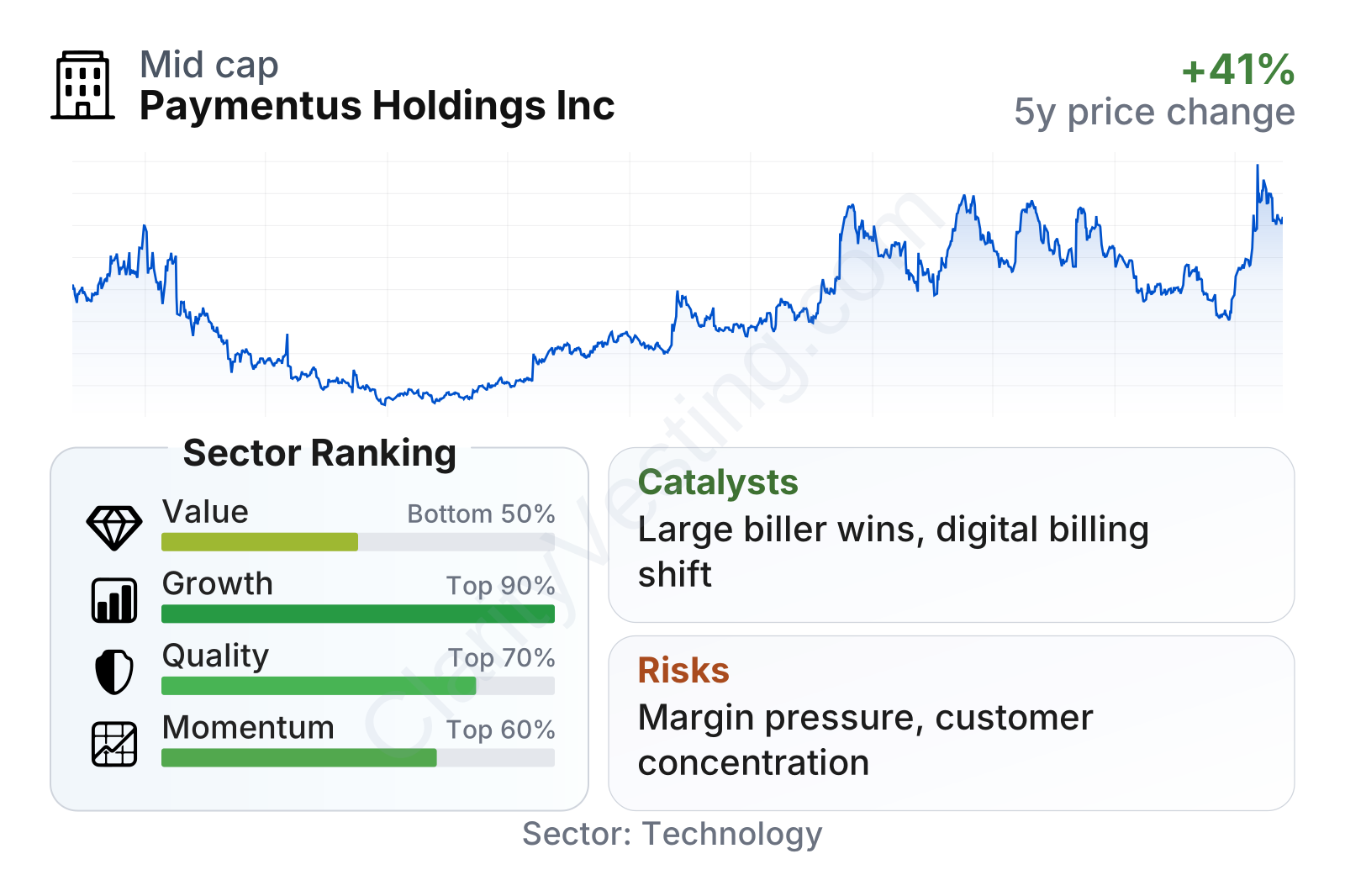
Paymentus is now a mid-cap software and payments company with a stock that has been volatile since its public listing. The business ranks strongly on growth relative to most technology peers, with revenue growth around 29% year over year and a five-year revenue-per-share growth rate near 29%. Quality is solid rather than exceptional: returns on invested capital are above the sector median, and the balance sheet is notably conservative, but margins remain only around sector averages. Valuation looks less comfortable, with earnings and free-cash-flow-based measures sitting on the richer side compared with much of the sector.
Growth
Paymentus operates in an attractive niche within digital payments and billing modernization. Many utilities, municipalities, insurers, and service providers still rely on older billing systems and fragmented payment options. That creates a long runway for conversion toward integrated digital billing, omnichannel payment acceptance, and automated customer communication. This is a structural trend rather than a short-lived cycle, which matters for long-term business durability.
The company’s strategy is coherent. Instead of competing only as a generic payment processor, Paymentus combines payment acceptance with bill presentment, customer engagement, and software integrations. That makes the platform more embedded in customer workflows and can raise switching costs over time. It also expands the addressable opportunity beyond a single payment fee into a broader service relationship with billers.
The growth track record has been consistently strong. Revenue growth has stayed mostly in the 20% to 30% range, with several periods materially above that level. The latest pace remains well ahead of the sector median, suggesting the company is still gaining share or benefiting from expanding usage among existing customers rather than merely following industry growth.
Another encouraging signal is the shift in cash generation. Free cash flow moved from negative territory a few years ago to clearly positive levels, and the trend has improved sharply. That matters because it suggests recent expansion is not being bought purely through aggressive spending. Instead, the business appears to be reaching a stage where scale is translating into stronger internal funding capacity.
Recent company updates have also pointed to continued customer additions, broader enterprise relationships, and ongoing demand for digital self-service payments. For Paymentus, large customer wins can have an outsized effect because once a major biller is live on the platform, transaction volume can build for years. This makes implementation progress and enterprise onboarding an important growth catalyst, even if the market does not always see the impact immediately.
Risks
This article is for informational purposes only and does not constitute financial advice. Some content is AI-generated. See Disclaimer