Stock Analysis · Patrick Industries Inc (PATK)
Overview
Patrick Industries is a manufacturer and distributor of component products used mainly in recreational vehicles, but also in marine, powersports, manufactured housing, and certain industrial markets. In simple terms, the company supplies many of the parts and materials that go into finished vehicles and housing units rather than selling the final RV or boat directly to consumers. Its products include interior materials, flooring, furniture, electronics, cabinets, countertops, wiring, audio systems, and various structural or decorative components.
This business model gives Patrick Industries exposure to several end markets while keeping its main focus on outdoor leisure and adjacent lifestyle categories. The company has also expanded through acquisitions over time, building a broad catalog of products and a large customer base across original equipment manufacturers and aftermarket channels.
Based on recent annual disclosures, revenue is primarily generated from the following end markets:
- Recreational Vehicles: approximately 47% of net sales. This includes interior and exterior components, electronics, seating, countertops, flooring, adhesives, and other parts used by RV manufacturers.
- Marine: approximately 21% of net sales. This covers products for boats such as seating, flooring, electronic systems, canvas, cabinetry, and related components.
- Manufactured Housing: approximately 15% of net sales. This business includes panels, flooring, countertops, doors, electrical products, and other materials used in factory-built housing.
- Powersports: approximately 8% of net sales. This segment supplies components for vehicles such as side-by-sides, motorcycles, golf carts, and similar products.
- Industrial and Other: approximately 9% of net sales. This includes a mix of products sold into industrial, transportation, and other specialty applications.
The company’s revenue mix matters because it shows both concentration and diversification at the same time: RV remains the largest driver, but marine, housing, and powersports reduce dependence on any single market.
The earnings flow over the past several years shows a business that can produce strong gross profit dollars, but also one whose net income is sensitive to changes in volume, operating costs, and interest expense. Revenue rebounded after the 2023 downturn, yet profit conversion has remained well below the 2022 peak.
Key Figures
| Metric | Value | Sector ⓘ |
|---|---|---|
| Date | Sep 12, 2026 | |
| Context | ||
| Sector | Consumer Cyclical | |
| Industry | Recreational Vehicles | |
| Market Cap ⓘ | $2.40B | |
| Beta ⓘ | 1.09 | |
Value (Cheapness) | ||
| P/E Ratio ⓘ | 18.30 | 17.10 |
| FCF Yield ⓘ | 5.32% | 8.53% |
| EBIT / EV ⓘ | 6.48% | 6.46% |
| PEG ⓘ | 3.46 | |
Growth (Business expansion) | ||
| Revenue Growth ⓘ | -0.60% | 5.75% |
| RPS Growth (5Y CAGR) ⓘ | -10.10% | 9.14% |
| EPS Growth (5Y CAGR) ⓘ | -31.47% | -18.21% |
| Margin Growth (5Y Trend) ⓘ | -2.26% | -0.23% |
| FCF Growth (5Y CAGR) ⓘ | 6.60% | 4.91% |
Quality (Business durability) | ||
| ROIC (Latest) ⓘ | 8.09% | 12.61% |
| ROIC (5Y Median) ⓘ | 11.59% | 10.72% |
| Net Debt / EBIT (Latest) ⓘ | 6.11 | 2.10 |
| Net Debt / EBIT (5Y Median) ⓘ | 4.60 | 2.32 |
| Operating Margin (Latest) ⓘ | 6.74% | 9.25% |
| Operating Margin (5Y Median) ⓘ | 7.50% | 9.64% |
| Debt to Equity (Latest) ⓘ | 146.01% | 75.78% |
| Profit Margin (Latest) ⓘ | 3.74% | 5.33% |
| Free Cash Flow (Latest) ⓘ | $127.82M | |
Momentum (Price trend) | ||
| 3Y Return ⓘ | +50.43% | +14.53% |
| 12M Return (excl. last month) ⓘ | -18.58% | +3.08% |
| 6M Return ⓘ | -34.42% | +0.55% |
| Price vs. 200-Day MA ⓘ | -28.12% | -0.54% |
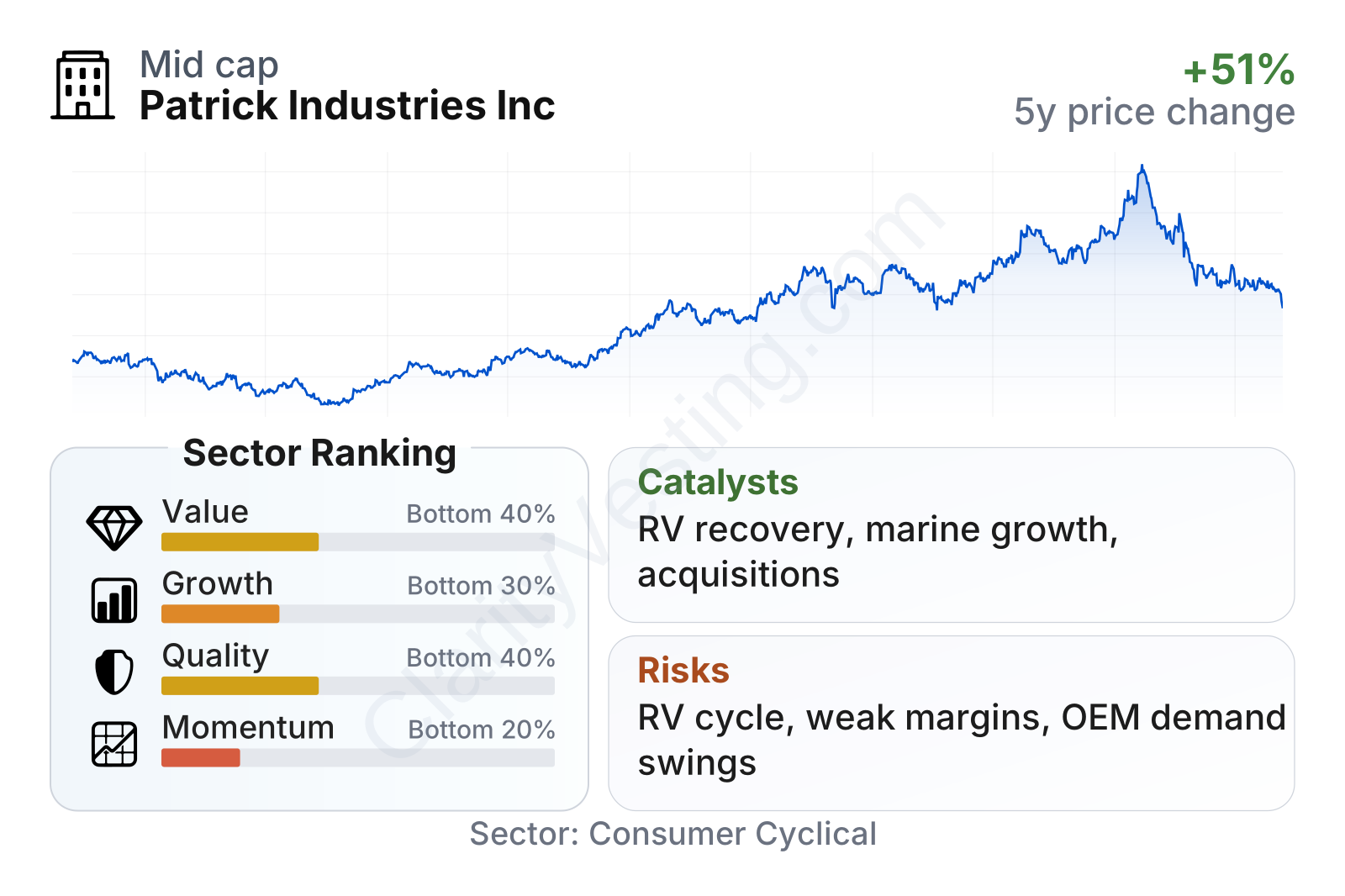
Patrick Industries sits in the mid-cap range and its share price has been volatile, which is normal for a company tied to cyclical consumer demand. The overall profile is mixed: valuation is not clearly cheap versus the broader consumer discretionary group, growth metrics currently rank weakly, and profitability trails sector medians. On the more favorable side, leverage looks much more conservative than the sector median on the latest reading, and free cash flow remains positive.
Growth
Patrick Industries operates in markets that can grow over long periods, but they do not grow in a straight line. Recreational vehicles, boats, and powersports products tend to follow consumer confidence, financing conditions, dealer inventory levels, and replacement cycles. Manufactured housing can provide a steadier long-term support because affordable housing remains a structural need in the United States, even if near-term demand can still be affected by interest rates.
The company’s strategy for growth is fairly logical for its industry. Rather than relying on one flagship product, Patrick builds scale through a broad component portfolio, cross-selling across end markets, and acquisitions that add new capabilities or customer relationships. That approach can strengthen its position with OEM customers because it becomes a larger, more integrated supplier across multiple product categories.
Recent sales trends suggest the business is moving out of the sharp downturn seen in 2023, but momentum has softened again in 2026, with year-over-year revenue hovering around flat to slightly negative. That does not erase the earlier recovery, but it does show that demand remains uneven and that the company is still exposed to cyclical pauses in RV and marine production.
Cash generation remains an important positive point. Free cash flow is still solidly positive, although it has come down from earlier highs. Even with slower earnings growth, the company has continued to generate meaningful cash, which supports debt reduction, acquisitions, and capital allocation flexibility.
One of the clearest catalysts is continued normalization in RV and marine dealer inventories after the industry correction of the past few years. If production schedules improve from current levels, Patrick can benefit without needing dramatic market share gains because it already has a wide installed customer base. Another potential support is further acquisition activity in adjacent categories, where management has historically used deals to expand product breadth and deepen its reach in outdoor enthusiast markets.
Recent company updates have also emphasized ongoing expansion in marine and powersports, which are strategically useful because they diversify the business away from a pure RV supplier identity. Over time, that may help smooth results somewhat, even if these categories are still cyclical in their own right.
Risks
This article is for informational purposes only and does not constitute financial advice. Some content is AI-generated. See Disclaimer


