Stock Analysis · Uipath Inc (PATH)
Overview
UiPath is a software company focused on automation. Its platform helps organizations make repetitive work run automatically instead of being handled manually by employees. That can include moving data between systems, processing documents, handling routine customer-service tasks, supporting internal workflows, and increasingly combining automation with artificial intelligence to manage more complex business processes.
The company is best known for robotic process automation, or RPA, but its platform now goes beyond basic task automation. UiPath offers tools for discovering which processes should be automated, building automation workflows, managing software robots, processing documents, and adding AI-based capabilities such as understanding unstructured information and supporting agents that can complete tasks across applications. Its customers include large enterprises, public-sector organizations, and companies in regulated industries that want productivity gains without replacing all of their core software systems.
UiPath generates most of its revenue from subscription-based software and support. Based on recent annual filings, the business mix is heavily concentrated in licenses and subscription services, with a smaller contribution from professional services.
- Licenses and subscription services: about 94% of revenue. This includes platform subscriptions, automation software, cloud offerings, maintenance, and support tied to the company’s automation products.
- Professional services and other: about 6% of revenue. This includes implementation, training, consulting, and related services that help customers deploy and expand use of the platform.
Geographically, UiPath is broadly international rather than dependent on a single country. Revenue is spread across the Americas, Europe, the Middle East and Africa, and Asia-Pacific, which reduces reliance on one local economy but also exposes the company to varied selling conditions and currency effects.
The financial profile has changed meaningfully over the last several years. Revenue has continued to rise, gross profit remains very high as expected from software, and operating costs have become more controlled. The result is a business that has moved from large losses to positive operating income and positive net income, while keeping a very light debt load.
The biggest shift visible over time is not only higher revenue, but a much cleaner path from sales to profit. Gross profit has expanded steadily, selling and administrative costs have become more disciplined, and the company has crossed from operating losses into operating profit.
Key Figures
| Metric | Value | Sector ⓘ |
|---|---|---|
| Date | Sep 12, 2026 | |
| Context | ||
| Sector | Technology | |
| Industry | Software - Infrastructure | |
| Market Cap ⓘ | $7.23B | |
| Beta ⓘ | 1.02 | |
Value (Cheapness) | ||
| P/E Ratio ⓘ | 20.10 | 29.51 |
| FCF Yield ⓘ | 5.02% | 4.25% |
| EBIT / EV ⓘ | 3.59% | 2.85% |
| PEG ⓘ | 0.50 | |
Growth (Business expansion) | ||
| Revenue Growth ⓘ | 13.40% | 15.40% |
| RPS Growth (5Y CAGR) ⓘ | 15.72% | 8.56% |
| EPS Growth (5Y CAGR) ⓘ | N/A | -11.88% |
| Margin Growth (5Y Trend) ⓘ | N/A | 0.46% |
| FCF Growth (5Y CAGR) ⓘ | N/A | 9.80% |
Quality (Business durability) | ||
| ROIC (Latest) ⓘ | 18.42% | 9.44% |
| ROIC (5Y Median) ⓘ | -3.15% | 8.30% |
| Net Debt / EBIT (Latest) ⓘ | -2.55 | 0.54 |
| Net Debt / EBIT (5Y Median) ⓘ | N/A | 0.44 |
| Operating Margin (Latest) ⓘ | 12.25% | 9.58% |
| Operating Margin (5Y Median) ⓘ | -5.80% | 8.25% |
| Debt to Equity (Latest) ⓘ | 3.56% | 33.33% |
| Profit Margin (Latest) ⓘ | 21.03% | 7.14% |
| Free Cash Flow (Latest) ⓘ | $362.96M | |
Momentum (Price trend) | ||
| 3Y Return ⓘ | -26.35% | +45.48% |
| 12M Return (excl. last month) ⓘ | +45.33% | +23.48% |
| 6M Return ⓘ | +20.93% | +20.93% |
| Price vs. 200-Day MA ⓘ | +6.56% | +7.43% |
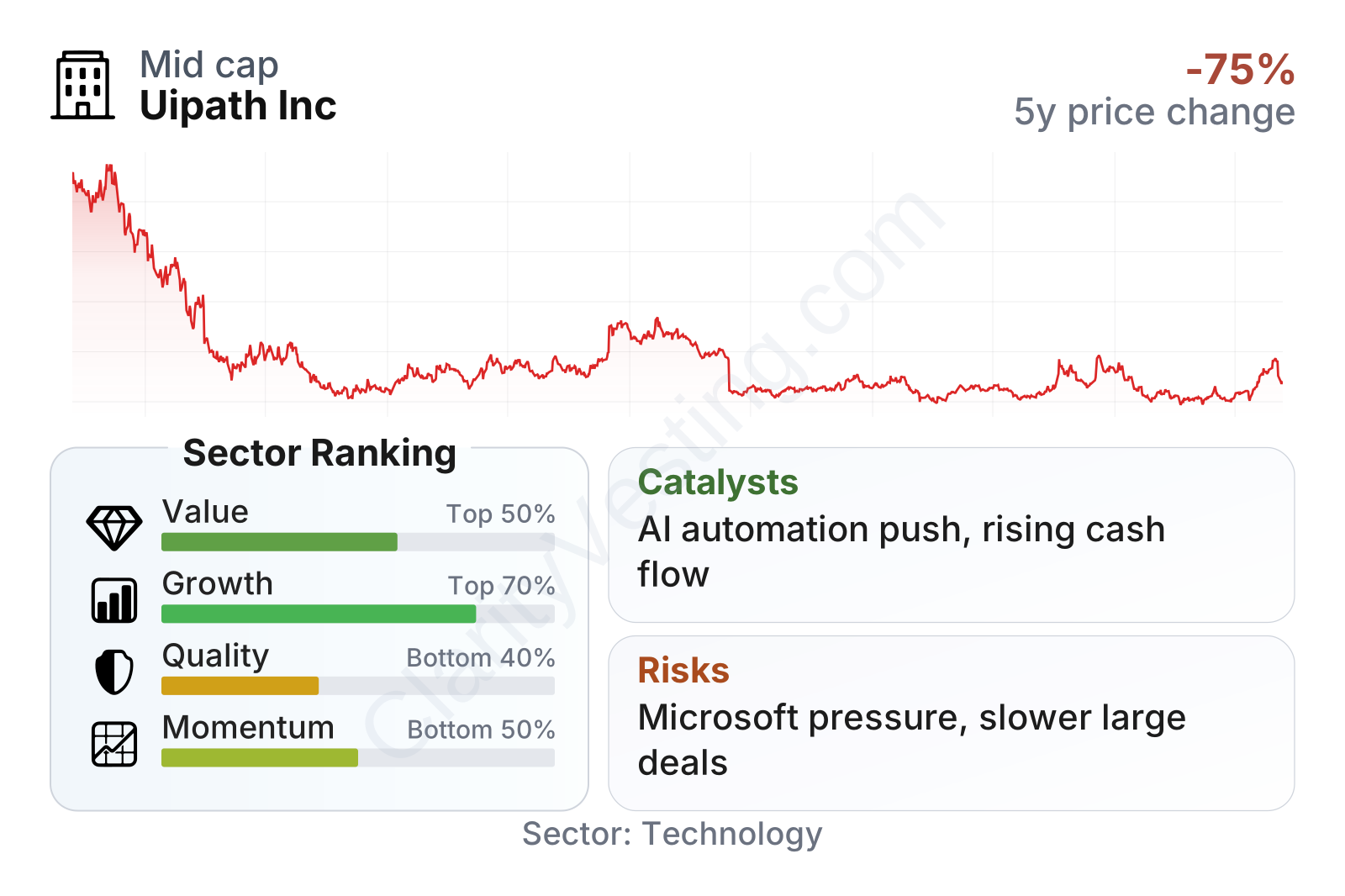
UiPath sits in the mid-sized range within software, with share-price volatility close to the broader market rather than at an extreme. The overall snapshot is mixed but improving: growth ranks well above much of the sector, profitability and cash generation have strengthened sharply, and leverage is unusually low. The weaker point is that some quality measures still reflect earlier years when the company was loss-making, which makes the long-term averages look less impressive than the current picture.
Growth
UiPath operates in a sector that still has room to grow. Companies continue to look for ways to cut manual work, reduce errors, speed up workflows, and use AI without rebuilding all of their systems from scratch. That makes automation one of the more durable themes in enterprise software. The addressable market is broader than traditional back-office task automation because businesses now want platforms that can discover inefficiencies, process documents, connect applications, and orchestrate actions across departments.
The company’s strategy broadly fits that direction. UiPath has been expanding from classic RPA into a wider automation platform, adding document understanding, process mining, communications mining, test automation, and AI capabilities. More recently, its product roadmap has emphasized agentic automation, where AI agents, robots, and people can work together on business workflows. That matters because basic automation can become commoditized over time, while a broader platform can raise switching costs and support larger deployments.
Growth has clearly moderated from the very high rates seen earlier in the company’s public life, but it remains positive. Recent year-over-year revenue growth has generally been in the low-teens range, which is slower than the fastest software names but still healthy for a company that is also improving profitability. Over a five-year span, revenue per share growth has remained strong relative to the sector, suggesting the business has continued to expand even as the market became more demanding.
Cash generation is an important part of the improvement. UiPath moved from negative free cash flow a few years ago to clearly positive levels, and the trend has continued upward. That suggests the company is no longer relying on growth alone to support its valuation narrative. A software business that can grow, keep gross margins high, and convert more of its sales into cash tends to have a more resilient long-term profile than one that needs constant external funding.
A notable catalyst is the enterprise push toward combining automation with AI. UiPath has positioned itself around this convergence rather than presenting automation and AI as separate tools. If customers increasingly want systems that can understand documents, make limited decisions, and trigger actions across existing software, that creates a meaningful opportunity for a platform already embedded in enterprise workflows. Recent company communications have also emphasized partnerships with major cloud and AI ecosystems, which can expand reach and make the platform more relevant in large corporate IT environments.
Risks
This article is for informational purposes only and does not constitute financial advice. Some content is AI-generated. See Disclaimer


