Stock Analysis · Palo Alto Networks Inc (PANW)
Overview
Palo Alto Networks is a cybersecurity company. In simple terms, it helps organizations protect their networks, cloud systems, applications, employees, and data from cyberattacks. Its products are used by large enterprises, governments, and smaller organizations that need security across offices, data centers, remote work, and cloud computing environments.
Over time, the company has expanded well beyond its original firewall business. Today, its strategy is built around becoming a broad security platform provider. That means offering many tools under fewer integrated systems so customers can reduce complexity, improve threat detection, and manage security from a smaller number of vendors.
Based on the company’s recent reporting structure, revenue mainly comes from the following sources:
- Subscription and support: about 78% of revenue — recurring contracts tied to security subscriptions, software updates, threat intelligence, cloud-delivered security, maintenance, and technical support.
- Product revenue: about 22% of revenue — mainly hardware and software products, including next-generation firewalls and related appliances.
Within the business mix, the company increasingly emphasizes platform-based offerings such as network security, cloud security, and security operations. This matters because recurring subscription revenue is usually more predictable than one-time product sales. The broader financial flow also shows a business that has scaled meaningfully in recent years: revenue and gross profit have risen strongly, while research and development spending has also climbed, showing that Palo Alto Networks is still investing heavily to maintain its product edge.
The business has become much larger, with revenue roughly doubling since fiscal 2022 and gross profit rising in parallel. At the same time, research and development spending has increased materially, which is consistent with a company pushing to stay ahead in a fast-moving cybersecurity market.
Key Figures
| Metric | Value | Sector ⓘ |
|---|---|---|
| Date | Sep 12, 2026 | |
| Context | ||
| Sector | Technology | |
| Industry | Software - Infrastructure | |
| Market Cap ⓘ | $270.47B | |
| Beta ⓘ | 0.91 | |
Value (Cheapness) | ||
| P/E Ratio ⓘ | 295.22 | 29.51 |
| FCF Yield ⓘ | 1.62% | 4.25% |
| EBIT / EV ⓘ | 0.20% | 2.85% |
| PEG ⓘ | 1.73 | |
Growth (Business expansion) | ||
| Revenue Growth ⓘ | 34.40% | 15.40% |
| RPS Growth (5Y CAGR) ⓘ | 12.72% | 8.56% |
| EPS Growth (5Y CAGR) ⓘ | 22.20% | -11.88% |
| Margin Growth (5Y Trend) ⓘ | 20.72% | 0.46% |
| FCF Growth (5Y CAGR) ⓘ | 26.25% | 9.80% |
Quality (Business durability) | ||
| ROIC (Latest) ⓘ | 2.28% | 9.44% |
| ROIC (5Y Median) ⓘ | 14.11% | 8.30% |
| Net Debt / EBIT (Latest) ⓘ | -0.03 | 0.54 |
| Net Debt / EBIT (5Y Median) ⓘ | -0.14 | 0.44 |
| Operating Margin (Latest) ⓘ | 4.67% | 9.58% |
| Operating Margin (5Y Median) ⓘ | 10.44% | 8.25% |
| Debt to Equity (Latest) ⓘ | 9.09% | 33.33% |
| Profit Margin (Latest) ⓘ | 2.67% | 7.14% |
| Free Cash Flow (Latest) ⓘ | $4.39B | |
Momentum (Price trend) | ||
| 3Y Return ⓘ | +169.12% | +45.48% |
| 12M Return (excl. last month) ⓘ | +120.64% | +23.48% |
| 6M Return ⓘ | +96.67% | +20.93% |
| Price vs. 200-Day MA ⓘ | +40.15% | +7.43% |
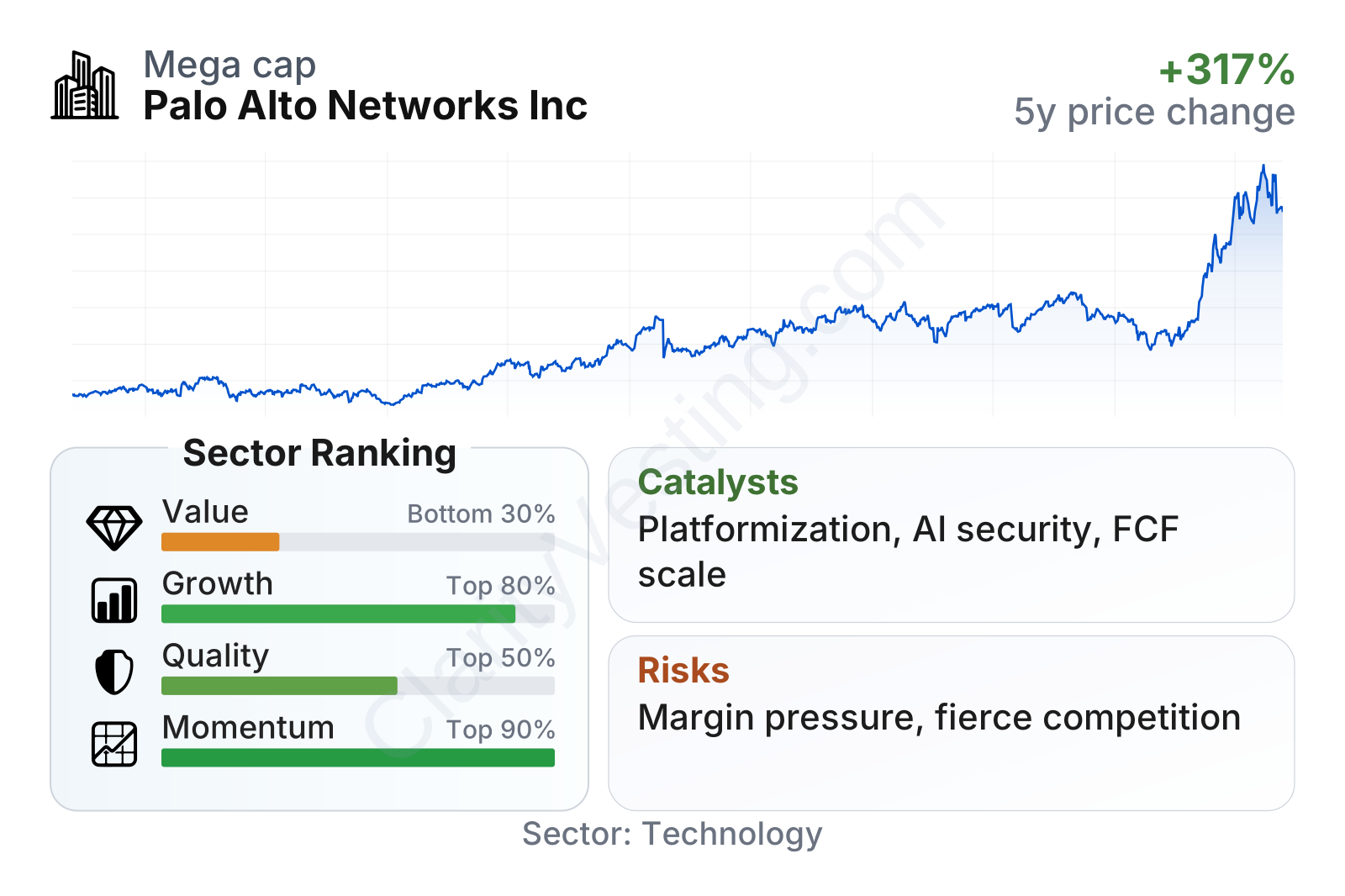
Palo Alto Networks is a very large software and cybersecurity company with relatively low share-price volatility compared with many technology names. In the factor breakdown, growth and momentum stand out as clear strengths, while valuation looks rich and current profitability is less impressive than the sector median. Quality is mixed: the balance sheet is strong, but recent operating and net margins have softened.
Growth
Cybersecurity remains one of the healthier long-term areas in technology. The basic demand driver is simple: companies and governments are moving more of their operations online, cyber threats are becoming more frequent and more costly, and security tools are becoming more essential rather than optional. That creates a durable backdrop for providers with broad product suites and strong reputations.
Palo Alto Networks appears well aligned with that trend. Its strategy centers on selling larger integrated platforms instead of isolated tools. Management has been pushing customers toward consolidated deployments across network security, cloud security, and security operations. The logic is straightforward: customers want fewer vendors, lower complexity, and better coordination between products. If that platform approach keeps working, it can support larger contract sizes, better retention, and more cross-selling.
Revenue growth has remained strong over a long period and recently re-accelerated into the low-30% range, clearly above the broader software infrastructure sector median. That is notable because many large technology companies slow down as they scale. Palo Alto Networks has so far avoided that pattern better than many peers.
Cash generation also strengthens the growth case. Trailing free cash flow has risen from roughly $1.5 billion in early 2022 to more than $4 billion by early 2026. That suggests the company is not just growing revenue, but also converting a meaningful share of that scale into cash that can support acquisitions, internal product development, and balance-sheet flexibility.
Another growth catalyst is artificial intelligence, but not in the hype-driven sense. AI increases the amount of data that security teams must analyze, and it also gives attackers new tools. That tends to raise demand for automated threat detection and response, areas where Palo Alto Networks has been investing. The company has also continued to expand through acquisitions and product integration, which can deepen its role inside customer environments if execution stays solid.
Recent company communications have continued to emphasize platformization, AI-driven security operations, and large customer adoption across multiple product families. For a long-term business outlook, that is important because the most attractive cybersecurity vendors are often the ones that become more embedded over time rather than simply adding one-off product sales.
Risks
This article is for informational purposes only and does not constitute financial advice. Some content is AI-generated. See Disclaimer