Stock Analysis · Ouster Inc (OUST)
Overview
Ouster Inc is a lidar company. Lidar is a sensing technology that uses laser light to measure distance and build a detailed 3D view of the surrounding environment. Its products are used in vehicles, industrial automation, robotics, security systems, and digital infrastructure. In simple terms, Ouster sells sensors and related software that help machines and systems “see” the world around them with high precision.
The company’s business broadened materially after its merger with Velodyne in 2023, which combined product lines, customer relationships, and intellectual property. Ouster now positions itself around several end markets, especially automotive, industrial, robotics, and smart infrastructure. Its strategy is to use a common digital lidar architecture across multiple applications, which can support scale and help lower product costs over time.
Revenue mainly comes from product sales, with a smaller contribution from software and services. Public filings do not always break every line item into precise percentages by end market each quarter, but the company does provide useful directional detail.
- Lidar sensors and related hardware: approximately more than 85% of revenue. This includes digital lidar units sold for industrial automation, robotics, automotive development programs, and infrastructure uses such as traffic or perimeter monitoring.
- Software, licensing, and services: approximately less than 15% of revenue. This includes perception software, subscription or recurring elements where applicable, and engineering or support tied to deployments.
From a broader business mix perspective, management commentary in filings and shareholder materials shows that non-automotive markets have historically provided the bulk of current revenue, while automotive programs may represent a larger future opportunity because design wins can scale later if vehicle platforms move into production.
The financial flow over the last few years shows a business that has been growing revenue while steadily improving gross profit. A notable change is that gross profit expanded sharply from 2023 to 2025, suggesting better pricing, product mix, manufacturing efficiency, or all three. At the same time, operating expenses remain heavy, especially research and development and selling costs, which explains why the company is still not profitable.
Key Figures
| Metric | Value | Sector ⓘ |
|---|---|---|
| Date | Sep 12, 2026 | |
| Context | ||
| Sector | Technology | |
| Industry | Electronic Components | |
| Market Cap ⓘ | $2.54B | |
| Beta ⓘ | 3.25 | |
Value (Cheapness) | ||
| P/E Ratio ⓘ | N/A | 29.51 |
| FCF Yield ⓘ | -3.25% | 4.25% |
| EBIT / EV ⓘ | -2.20% | 2.85% |
| PEG ⓘ | N/A | |
Growth (Business expansion) | ||
| Revenue Growth ⓘ | 55.90% | 15.40% |
| RPS Growth (5Y CAGR) ⓘ | 4.65% | 8.56% |
| EPS Growth (5Y CAGR) ⓘ | -49.69% | -11.88% |
| Margin Growth (5Y Trend) ⓘ | N/A | 0.46% |
| FCF Growth (5Y CAGR) ⓘ | -3.52% | 9.80% |
Quality (Business durability) | ||
| ROIC (Latest) ⓘ | -13.89% | 9.44% |
| ROIC (5Y Median) ⓘ | -44.81% | 8.30% |
| Net Debt / EBIT (Latest) ⓘ | N/A | 0.54 |
| Net Debt / EBIT (5Y Median) ⓘ | N/A | 0.44 |
| Operating Margin (Latest) ⓘ | -25.46% | 9.58% |
| Operating Margin (5Y Median) ⓘ | -286.71% | 8.25% |
| Debt to Equity (Latest) ⓘ | 4.42% | 33.33% |
| Profit Margin (Latest) ⓘ | -26.03% | 7.14% |
| Free Cash Flow (Latest) ⓘ | -$82.47M | |
Momentum (Price trend) | ||
| 3Y Return ⓘ | +648.52% | +45.48% |
| 12M Return (excl. last month) ⓘ | +60.70% | +23.48% |
| 6M Return ⓘ | +56.60% | +20.93% |
| Price vs. 200-Day MA ⓘ | +16.59% | +7.43% |
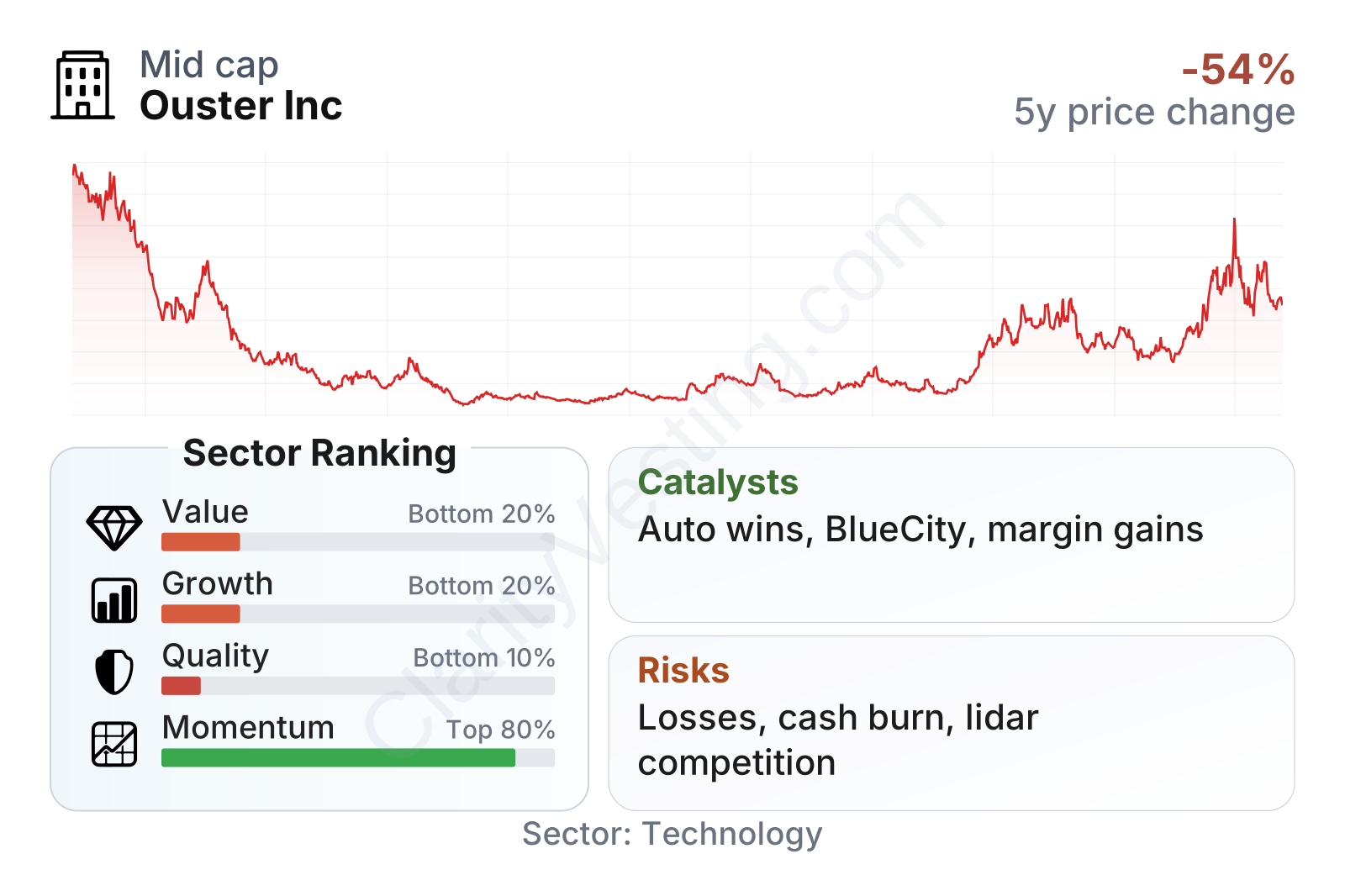
Ouster is still a relatively small public technology company, but no longer a very early micro-cap name. The stock has been extremely volatile, which fits a business that is still proving its long-term earning power. In the latest factor view, momentum is very strong versus the sector, while value, quality, and growth rankings remain weak in relative terms. That combination usually points to a market that is rewarding future expectations more than present-day fundamentals.
Revenue growth stands far above the sector median, but profitability and returns on capital are still deeply below normal industry levels. Free cash flow remains negative, and earnings-based valuation measures such as P/E are not meaningful because the company is still posting losses.
Growth
Lidar is part of a growing segment tied to automation, machine vision, robotics, autonomous systems, and smart infrastructure. That does not mean every lidar company will succeed, but the underlying demand drivers are real: more machines need better perception, safety requirements are increasing, and many industries are moving toward higher levels of automation. Ouster’s focus on a digital lidar platform is strategically logical because it can serve multiple industries rather than depending on one single market.
The company’s recent revenue trend is encouraging. Year-over-year growth has remained strong and, in recent periods, was around the mid-50% range, clearly above the broader sector median. That suggests Ouster is gaining commercial traction after the Velodyne combination and is converting a larger installed base and sales pipeline into actual shipments.
Another important point is margin improvement. Even though the company is still loss-making, the business has made visible progress from very weak historical margins toward a much narrower loss profile. This matters because for hardware companies, growth alone is not enough; investors also need evidence that scaling can eventually produce sustainable gross profit and operating leverage. The revenue and gross profit path over 2024 and 2025 suggests this transition is underway, even if it is incomplete.
Cash generation is the next hurdle. Free cash flow is still negative, but the burn rate improved substantially from earlier periods before worsening somewhat again more recently. That pattern suggests the company is moving in the right direction overall, but not in a straight line.
Several catalysts could matter over the next few years. One is automotive series production, where a design win can eventually turn into much larger unit volumes. Another is rising adoption in industrial and infrastructure projects, which may be less headline-grabbing than self-driving vehicles but can generate steadier near-term revenue. Ouster has also emphasized software-attached opportunities, including perception capabilities and digital solutions that can improve the economics of each deployment.
Recent company updates have highlighted new customer wins, expanded deployments, and product progress around long-range and solid-state-style offerings. The acquisition of BlueCity, announced earlier in 2026, is also meaningful because it strengthens Ouster’s presence in smart traffic and transportation infrastructure, an area where lidar can move from pilot programs to city-scale networks. That kind of installed base can support recurring software and service revenue over time.
Risks
This article is for informational purposes only and does not constitute financial advice. Some content is AI-generated. See Disclaimer


