Stock Analysis · Open Text Corp (OTEX)
Overview
Open Text is a Canadian enterprise software company focused on helping large organizations manage information. Its products are used to store documents, automate business workflows, secure data, exchange information with customers and suppliers, and operate technology systems. In simple terms, Open Text sells software that helps businesses run important back-office and compliance-heavy processes.
The company’s business model is built around recurring software and cloud revenue, supported by maintenance contracts and professional services. Open Text expanded its scale significantly with the acquisition of Micro Focus, which added infrastructure software, cybersecurity, and application modernization tools to the portfolio. That deal made the company broader, but also increased the amount of integration work and debt reduction required afterward.
Based on recent annual reporting, revenue is spread across a mix of cloud subscriptions, customer support, licenses, and services. The approximate breakdown is as follows:
- Cloud services and subscriptions: about 40%. This includes content cloud, security cloud, application modernization cloud, and other recurring subscription offerings.
- Customer support: about 38%. This is mainly recurring maintenance and support tied to installed software products.
- License: about 12%. This includes one-time or term software license sales.
- Professional service and other: about 10%. This covers consulting, implementation, training, and related work.
That mix matters because a high share of recurring revenue generally makes results more stable, even when new software sales are uneven. It also means Open Text is less dependent on large one-time deals than many smaller software vendors. Over the last several years, revenue increased sharply after the Micro Focus acquisition, while gross profit also climbed, showing that the combined business still keeps a large share of sales after direct delivery costs. More recently, total revenue has been relatively stable rather than rapidly expanding.
The business shows the typical economics of enterprise software: high gross margins, meaningful spending on research and development, and a noticeable effect from interest expense after a major acquisition. The latest picture suggests a company that now looks more focused on efficiency, debt cleanup, and improving profitability than on chasing very fast top-line growth.
Key Figures
| Metric | Value | Sector ⓘ |
|---|---|---|
| Date | Sep 12, 2026 | |
| Context | ||
| Sector | Technology | |
| Industry | Software - Application | |
| Market Cap ⓘ | $5.60B | |
| Beta ⓘ | 1.03 | |
Value (Cheapness) | ||
| P/E Ratio ⓘ | 8.77 | 29.51 |
| FCF Yield ⓘ | 26.62% | 4.25% |
| EBIT / EV ⓘ | 19.57% | 2.85% |
| PEG ⓘ | 1.02 | |
Growth (Business expansion) | ||
| Revenue Growth ⓘ | 2.90% | 15.40% |
| RPS Growth (5Y CAGR) ⓘ | 13.60% | 8.56% |
| EPS Growth (5Y CAGR) ⓘ | 7.37% | -11.88% |
| Margin Growth (5Y Trend) ⓘ | -1.06% | 0.46% |
| FCF Growth (5Y CAGR) ⓘ | -2.37% | 9.80% |
Quality (Business durability) | ||
| ROIC (Latest) ⓘ | 15.58% | 9.44% |
| ROIC (5Y Median) ⓘ | 6.40% | 8.30% |
| Net Debt / EBIT (Latest) ⓘ | 2.44 | 0.54 |
| Net Debt / EBIT (5Y Median) ⓘ | 5.84 | 0.44 |
| Operating Margin (Latest) ⓘ | 22.48% | 9.58% |
| Operating Margin (5Y Median) ⓘ | 16.63% | 8.25% |
| Debt to Equity (Latest) ⓘ | 148.79% | 33.33% |
| Profit Margin (Latest) ⓘ | 12.26% | 7.14% |
| Free Cash Flow (Latest) ⓘ | $1.49B | |
Momentum (Price trend) | ||
| 3Y Return ⓘ | -34.47% | +45.48% |
| 12M Return (excl. last month) ⓘ | -15.57% | +23.48% |
| 6M Return ⓘ | +1.06% | +20.93% |
| Price vs. 200-Day MA ⓘ | -7.06% | +7.43% |
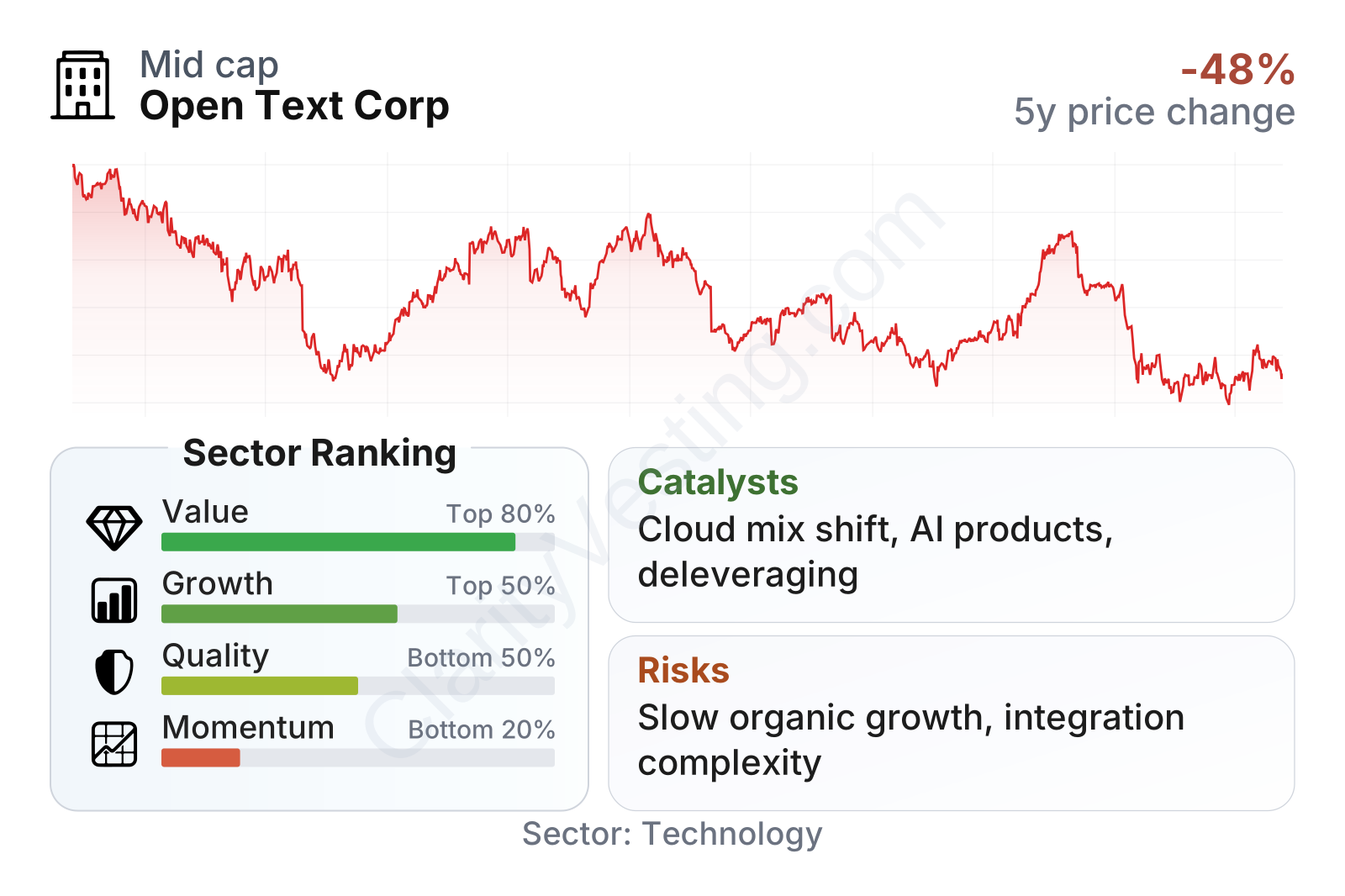
Open Text currently sits in the large-cap software range, with stock volatility close to the broader market rather than extreme. The overall metric profile is unusual for a technology company: valuation measures look much cheaper than the sector median, profitability is solid, but share-price momentum has been weak and growth is only average compared with peers. In other words, the market appears to be giving significant credit for cash generation and margins, while remaining cautious on future expansion.
Growth
Open Text operates in parts of software that are still important and durable: enterprise content management, cybersecurity, IT operations, DevOps, digital business networks, and application modernization. These are not the fastest-growing corners of technology, but they are deeply embedded in large enterprises and often linked to regulation, operational continuity, and legacy system complexity. That creates steady demand, especially from governments, banks, healthcare organizations, manufacturers, and other large institutions.
The company’s strategy for future growth is centered on moving customers toward cloud-delivered products, cross-selling a broader software portfolio, and using artificial intelligence to improve productivity and data usage. Management has been positioning Open Text around “information management” and “business AI,” trying to turn its large installed base and extensive enterprise data footprint into an advantage. If that works, the company can deepen relationships with existing customers without needing explosive new-customer growth.
Revenue growth has been volatile in recent years. The big spike after 2023 mainly reflects acquisition effects, while the periods that followed were much softer and at times negative. More recently, growth has returned to low single digits on a normalized basis, which is well below the sector median. For a long-term view, that suggests Open Text is currently more of a slow-growth software platform than a high-growth technology name.
Cash generation is one of the stronger parts of the investment case. Free cash flow remains substantial, even though it has not followed a smooth upward path. The recent rebound is important because it supports debt reduction, buybacks, dividends, and product investment at the same time. In software, durable cash flow often matters more than headline revenue growth, especially for mature businesses with sticky customers.
A meaningful catalyst is the continuing shift from legacy licenses and maintenance into cloud subscriptions, which can make revenue more predictable over time. Another is the company’s ability to cross-sell security, application modernization, and information management tools across a very large enterprise customer base built through years of acquisitions. Recent company communications have also emphasized AI-enabled capabilities across its platforms, which could help keep products relevant as enterprise software budgets increasingly favor automation and data-centric tools.
Risks
This article is for informational purposes only and does not constitute financial advice. Some content is AI-generated. See Disclaimer