Stock Analysis · OSI Systems Inc (OSIS)
Overview
OSI Systems is a diversified industrial technology company that sells specialized equipment and services used in security screening, healthcare diagnostics, and electronics manufacturing. In simple terms, it builds systems that help airports and borders inspect baggage and cargo, hospitals monitor patients and analyze samples, and device makers source critical electronic components.
The business is organized into three main segments, and the revenue mix is fairly visible from the company’s recent annual reporting. Based on fiscal 2025 results, the largest sources of revenue were approximately:
- Security division: about 65% of revenue. This segment includes airport and border screening systems, cargo and vehicle inspection, explosive and narcotics detection, checkpoint screening, and related maintenance and service contracts.
- Optoelectronics and Manufacturing division: about 21% of revenue. This area supplies electronic components, sensors, detectors, optoelectronics, and manufacturing services used in medical, aerospace, defense, and industrial applications.
- Healthcare division: about 14% of revenue. This segment includes patient monitoring, anesthesia systems, cardiology tools, fetal and neonatal care products, and laboratory and diagnostic solutions.
That mix matters for long-term analysis because OSI Systems is not a pure software company or a single-product manufacturer. Its biggest earnings engine is security screening, but it also has smaller businesses that provide diversification across end markets and customers.
Another useful point is how the company turns sales into profit. Over the last several years, revenue has climbed steadily from roughly $1.2 billion to nearly $1.8 billion, while operating income and net income have also increased. Gross profit has expanded in dollars, and spending on research and development has risen at the same time, suggesting the company has been growing without abandoning product investment.
The operating profile shows a business that has scaled up meaningfully since 2022. Revenue and gross profit have both advanced, while operating profit has improved faster than overhead, which points to better efficiency as the company has grown.
Key Figures
| Metric | Value | Sector ⓘ |
|---|---|---|
| Date | Sep 12, 2026 | |
| Context | ||
| Sector | Technology | |
| Industry | Electronic Components | |
| Market Cap ⓘ | $3.26B | |
| Beta ⓘ | 1.20 | |
Value (Cheapness) | ||
| P/E Ratio ⓘ | 22.52 | 29.51 |
| FCF Yield ⓘ | 7.47% | 4.25% |
| EBIT / EV ⓘ | 5.69% | 2.85% |
| PEG ⓘ | 1.49 | |
Growth (Business expansion) | ||
| Revenue Growth ⓘ | -4.10% | 15.40% |
| RPS Growth (5Y CAGR) ⓘ | 11.78% | 8.56% |
| EPS Growth (5Y CAGR) ⓘ | 15.51% | -11.88% |
| Margin Growth (5Y Trend) ⓘ | 1.77% | 0.46% |
| FCF Growth (5Y CAGR) ⓘ | 64.73% | 9.80% |
Quality (Business durability) | ||
| ROIC (Latest) ⓘ | 9.74% | 9.44% |
| ROIC (5Y Median) ⓘ | 23.73% | 8.30% |
| Net Debt / EBIT (Latest) ⓘ | 2.93 | 0.54 |
| Net Debt / EBIT (5Y Median) ⓘ | 2.48 | 0.44 |
| Operating Margin (Latest) ⓘ | 12.26% | 9.58% |
| Operating Margin (5Y Median) ⓘ | 11.61% | 8.25% |
| Debt to Equity (Latest) ⓘ | 120.18% | 33.33% |
| Profit Margin (Latest) ⓘ | 8.66% | 7.14% |
| Free Cash Flow (Latest) ⓘ | $243.19M | |
Momentum (Price trend) | ||
| 3Y Return ⓘ | +67.86% | +45.48% |
| 12M Return (excl. last month) ⓘ | -0.69% | +23.48% |
| 6M Return ⓘ | -25.85% | +20.93% |
| Price vs. 200-Day MA ⓘ | -18.31% | +7.43% |
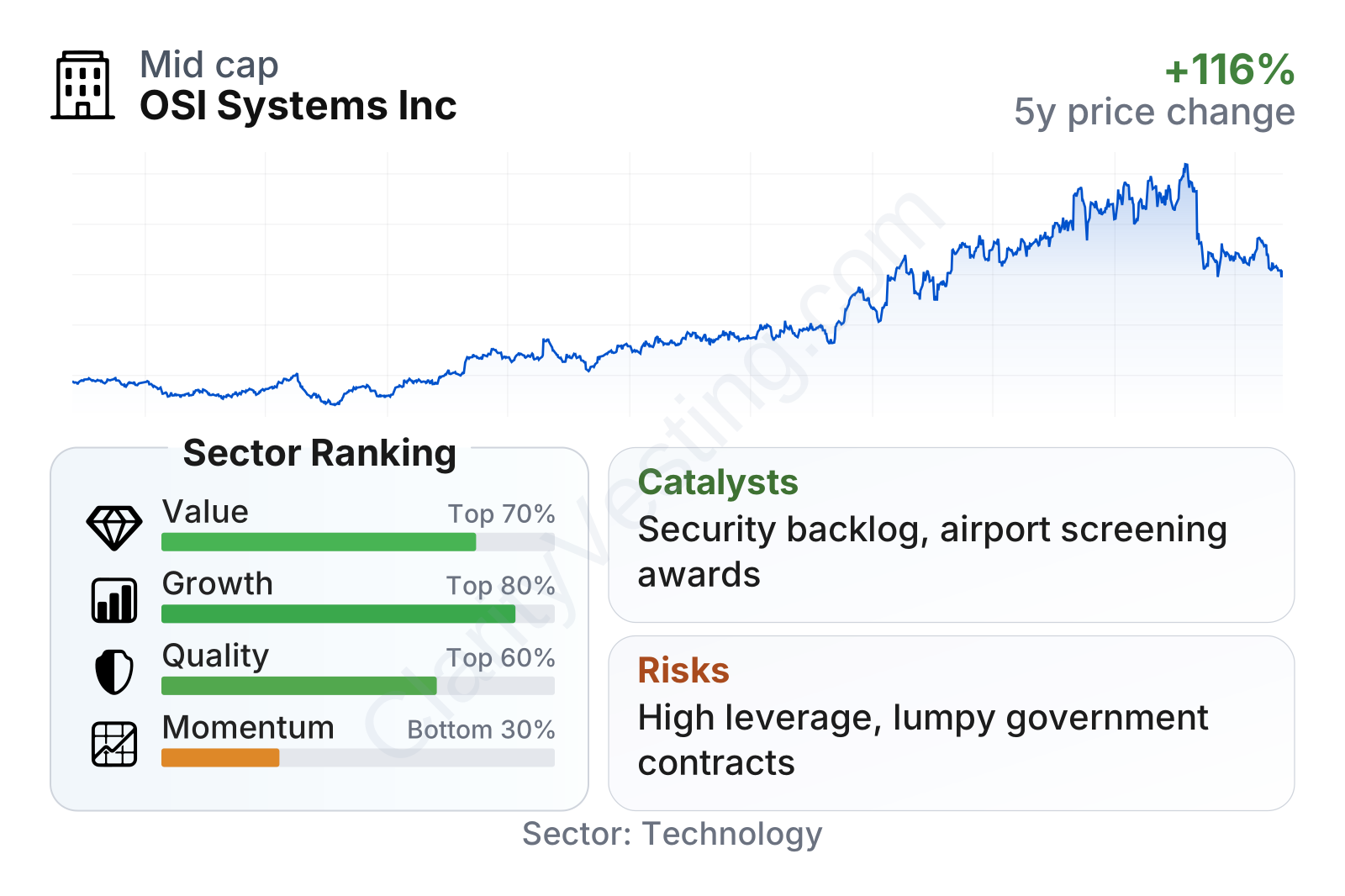
OSI Systems appears as a mid-sized technology-industrial company with a mixed but generally solid fundamental profile. On valuation, it screens cheaper than the sector median on earnings and cash-flow-based measures. On quality, margins and returns on invested capital are better than many peers, although leverage is clearly heavier than normal for the sector. Growth metrics look uneven in the latest year because revenue recently dipped, but the longer-term record for revenue per share, earnings per share, and especially free cash flow remains strong. Share-price momentum, however, has weakened materially in recent months after a powerful multi-year rise.
Growth
OSI Systems operates in markets that have long-duration demand drivers rather than short consumer cycles. Security screening is supported by airport traffic growth, border-control spending, cargo inspection needs, and government security modernization. Healthcare equipment demand is tied to hospital replacement cycles and clinical monitoring needs. The optoelectronics business benefits from demand in defense, aerospace, medical devices, and industrial sensing. These are not uniformly fast-growing markets every year, but they are areas where customers often must keep investing.
The company’s strategy broadly makes sense for future growth because it focuses on regulated, mission-critical equipment where reliability matters more than the lowest initial price. That can support repeat business, service revenue, and long customer relationships. In security, installed systems can lead to maintenance contracts, upgrades, and follow-on orders. In healthcare, recurring relationships with hospitals and care providers can help sustain sales beyond one-time equipment placements.
A major growth catalyst is the company’s order backlog, particularly in the security segment. OSI Systems has regularly highlighted large awards tied to international checkpoint screening, cargo inspection, and border-security projects. For a business like this, backlog is important because it gives visibility into future revenue even when quarterly results move around. The security division also has room to benefit from stricter screening standards and replacement cycles as governments upgrade equipment.
Recent growth has not been perfectly smooth. Year-over-year revenue has swung between strong expansion and occasional contraction, including a recent decline of about 4%. That softness needs to be viewed in context: the five-year picture is much stronger, with revenue per share growth in the low teens and earnings per share growth in the mid-teens annually. This suggests the business has been compounding over time even though individual quarters can be lumpy.
The recent revenue pattern shows why OSI Systems should be viewed as an execution-and-project company rather than a steady subscription model. Large contract timing can shift revenue recognition from one quarter to another, so the trend is better judged over several years than over a single period.
Cash generation has also improved over time, although it has been volatile. Free cash flow moved from very low levels a few years ago to a much stronger trailing level, with a sharp dip in between. That kind of swing is common in contract-heavy equipment businesses because working capital can move significantly as orders ramp and deliveries are completed.
The larger pattern is still favorable: cash generation has recovered well from the earlier trough, and the current free-cash-flow level is meaningful relative to the company’s size. If backlog converts efficiently and working capital remains under control, cash flow could remain an important support for future flexibility.
As for recent opportunity signals, the most relevant public developments have been contract wins and continued demand for security screening systems. OSI Systems has repeatedly announced sizable awards from transportation, customs, and border-security customers, reinforcing that its core market still has active spending programs.
Risks
This article is for informational purposes only and does not constitute financial advice. Some content is AI-generated. See Disclaimer


