Stock Analysis · Oracle Corporation (ORCL)
Overview
Oracle Corporation is a large enterprise software and cloud infrastructure company. It is best known for database software, business applications, and the technology used by large organizations to run finance, human resources, supply chains, customer systems, and core data workloads. Over time, Oracle has shifted from a mainly on-premise software vendor into a broader cloud platform provider, while still monetizing a large installed base of existing customers.
Its revenue mix is now centered on recurring software and cloud services, with hardware and traditional services playing a much smaller role. Based on Oracle’s latest fiscal 2026 disclosures, the main sources of revenue are approximately:
- Cloud services and license support: about 77% — recurring subscriptions and support contracts for Oracle Cloud Infrastructure, cloud applications, database services, and maintenance for existing software customers.
- Cloud license and on-premise license: about 10% — sales of new software licenses, including both cloud-related licenses and traditional on-premise software licenses.
- Hardware: about 9% — servers, engineered systems, storage products, and related hardware offerings.
- Services: about 4% — consulting, implementation, and other professional services tied to Oracle products.
This mix matters because recurring revenue tends to be more predictable than one-time license sales. Oracle’s business model also benefits from deep integration into customer operations: replacing a database platform or enterprise resource planning system is usually difficult, costly, and slow.
The broader financial picture also shows a business that has expanded meaningfully in recent years. Revenue, gross profit, operating income, and net income have all moved higher, while research and development spending has remained significant. That combination suggests Oracle is growing without stepping away from product investment.
Over the last several years, Oracle has turned a larger revenue base into even faster growth in operating income and net income. The company has also kept research and development spending high, which supports the view that profitability has improved alongside ongoing product expansion rather than through cost cutting alone.
Key Figures
| Metric | Value | Sector ⓘ |
|---|---|---|
| Date | Sep 14, 2026 | |
| Context | ||
| Sector | Technology | |
| Industry | Software - Infrastructure | |
| Market Cap ⓘ | $432.88B | |
| Beta ⓘ | 1.73 | |
Value (Cheapness) | ||
| P/E Ratio ⓘ | 23.52 | 29.51 |
| FCF Yield ⓘ | -6.63% | 4.25% |
| EBIT / EV ⓘ | 4.78% | 2.85% |
| PEG ⓘ | 0.85 | |
Growth (Business expansion) | ||
| Revenue Growth ⓘ | 29.60% | 15.40% |
| RPS Growth (5Y CAGR) ⓘ | 10.98% | 8.56% |
| EPS Growth (5Y CAGR) ⓘ | -29.71% | -11.88% |
| Margin Growth (5Y Trend) ⓘ | 11.40% | 0.46% |
| FCF Growth (5Y CAGR) ⓘ | N/A | 9.80% |
Quality (Business durability) | ||
| ROIC (Latest) ⓘ | 14.31% | 9.44% |
| ROIC (5Y Median) ⓘ | 14.62% | 8.30% |
| Net Debt / EBIT (Latest) ⓘ | 4.49 | 0.54 |
| Net Debt / EBIT (5Y Median) ⓘ | 5.26 | 0.44 |
| Operating Margin (Latest) ⓘ | 37.09% | 9.58% |
| Operating Margin (5Y Median) ⓘ | 28.80% | 8.25% |
| Debt to Equity (Latest) ⓘ | 232.05% | 33.33% |
| Profit Margin (Latest) ⓘ | 26.36% | 7.14% |
| Free Cash Flow (Latest) ⓘ | -$28.72B | |
Momentum (Price trend) | ||
| 3Y Return ⓘ | +42.05% | +45.48% |
| 12M Return (excl. last month) ⓘ | -38.93% | +23.48% |
| 6M Return ⓘ | -4.92% | +20.93% |
| Price vs. 200-Day MA ⓘ | -9.91% | +7.43% |
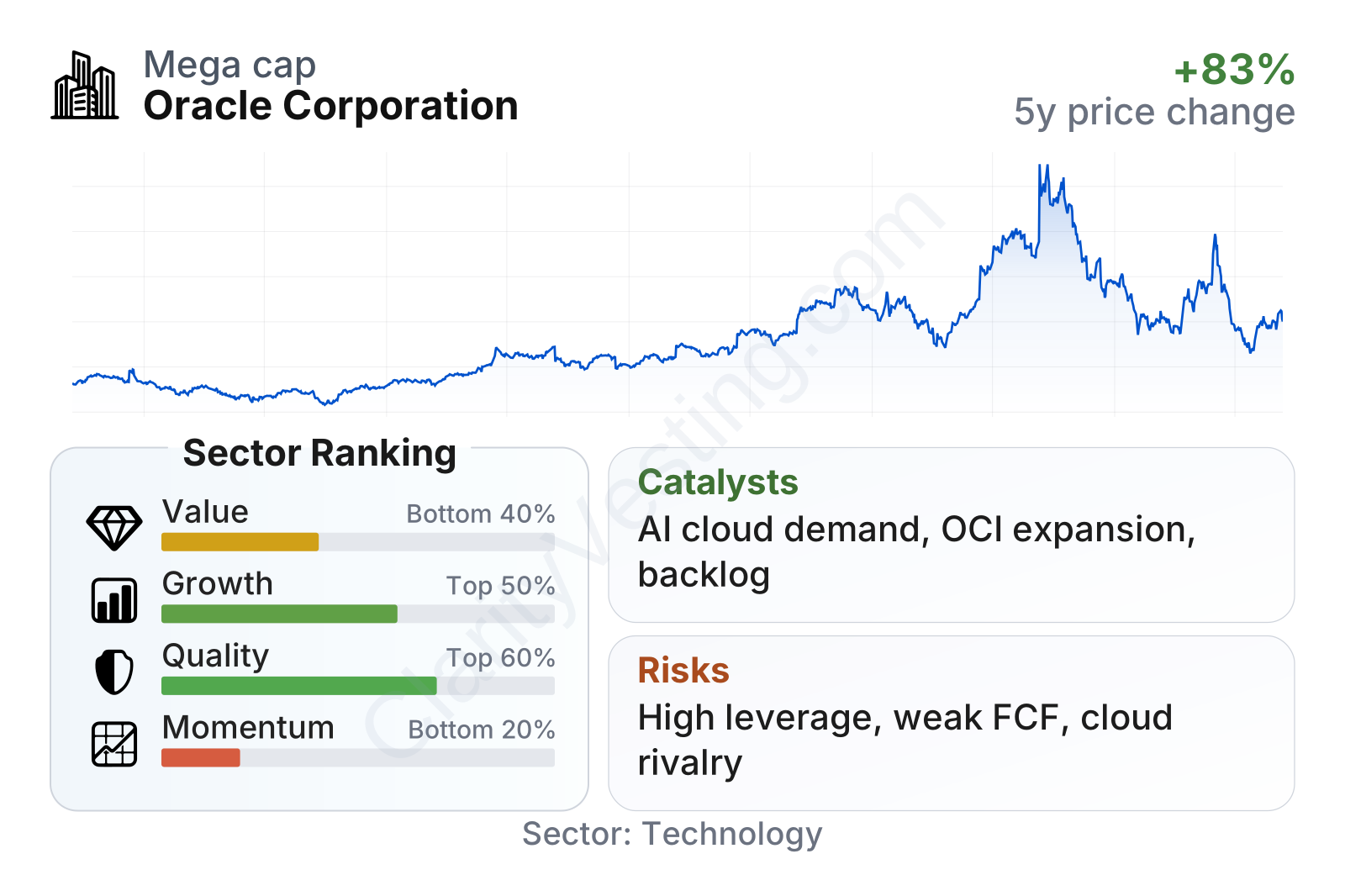
Oracle stands out as one of the largest companies in enterprise software, with above-average share price volatility for a business of its size. The overall factor profile is mixed but understandable: growth and profitability look stronger than many peers, valuation is not stretched relative to the sector median on earnings, while momentum has weakened after a very sharp run-up and pullback. The table also points to an important tension in the current profile: Oracle combines strong margins and returns on capital with unusually heavy leverage and recently weak free cash flow.
Growth
Oracle operates in a sector with durable long-term demand. Businesses continue moving workloads to the cloud, storing larger amounts of data, and adopting AI-related computing capacity. These trends support demand for databases, cloud infrastructure, cybersecurity, analytics, and enterprise applications. Oracle is not the largest cloud platform overall, but it is active in several attractive segments at once, especially databases, mission-critical enterprise software, and high-performance cloud infrastructure.
Its strategy for future growth is fairly coherent. Oracle is using its existing customer relationships to cross-sell cloud infrastructure and cloud applications, while also positioning Oracle Cloud Infrastructure as a platform for AI training and inference workloads. That is especially relevant because AI applications require large computing clusters, fast networking, and efficient data management — areas where Oracle has been investing heavily.
Revenue growth had slowed materially in parts of 2024, but it has reaccelerated strongly more recently, rising into the low-20% range and then close to 30% year over year in the latest period shown. That is well above the sector median and suggests Oracle is no longer being valued only as a mature software company. The market is increasingly treating it as a business with a meaningful cloud infrastructure growth engine.
A key recent catalyst has been demand for Oracle’s cloud capacity tied to AI and large-scale enterprise workloads. Management has highlighted very strong backlog and remaining performance obligations, indicating that customer demand is running ahead of currently available capacity in some areas. Oracle has also continued expanding data center buildouts and partnerships, which could support further cloud revenue growth if that capacity comes online as planned.
Free cash flow has been more volatile than revenue and earnings. It improved strongly through 2024, then turned sharply negative in the latest trailing period. For a cloud infrastructure business in expansion mode, that can reflect elevated capital spending rather than deterioration in the core business. Still, it is an important point to monitor because large infrastructure investment only creates value if utilization and pricing remain strong.
Risks
This article is for informational purposes only and does not constitute financial advice. Some content is AI-generated. See Disclaimer


