Stock Analysis · Opera Ltd (OPRA)
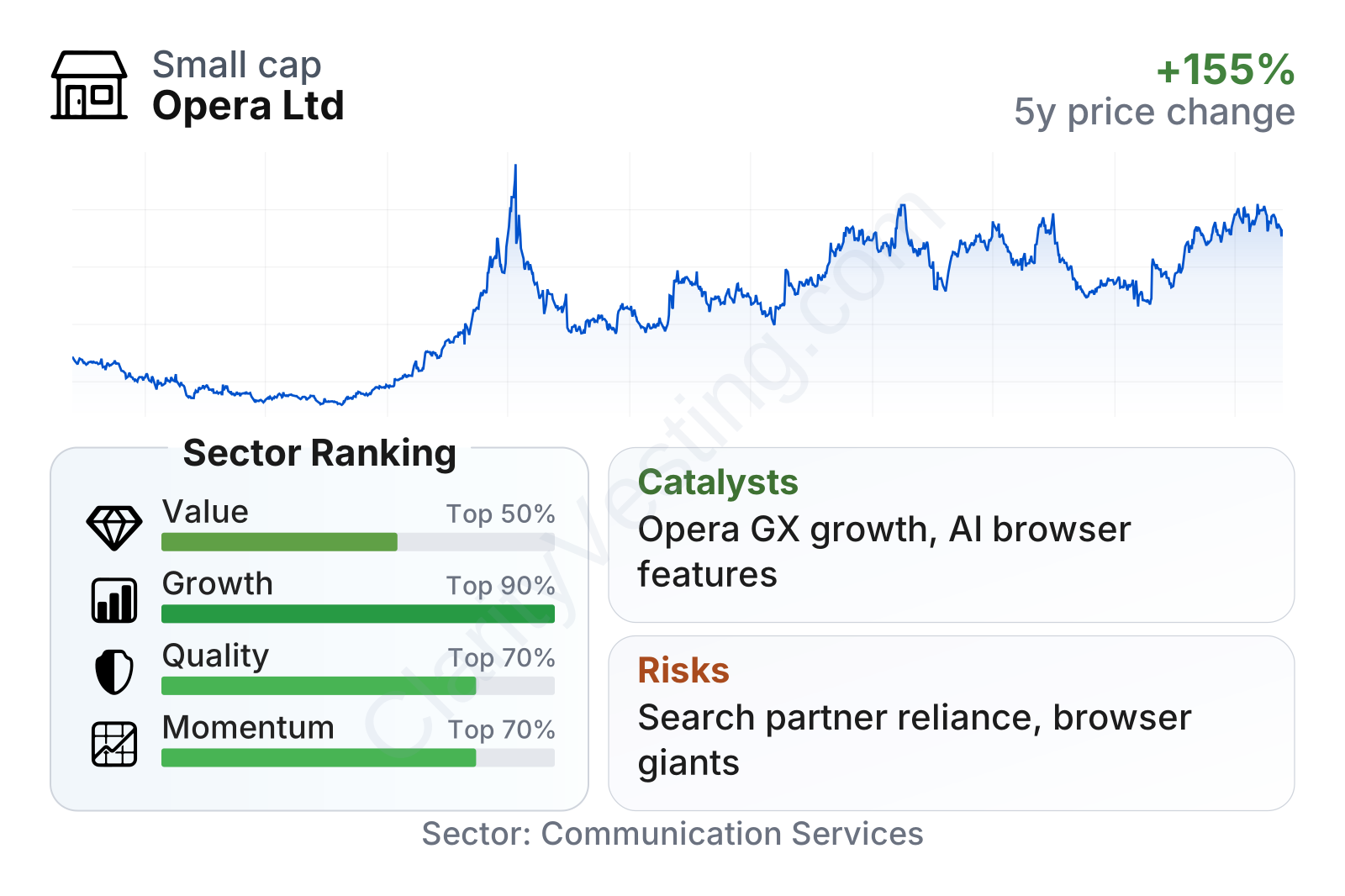
Overview
Opera Ltd is a consumer internet company best known for its web browsers, but its business today is broader than a browser download. Opera develops browser products for desktop and mobile, operates a gaming-focused browser called Opera GX, runs advertising and traffic-monetization activities, and offers embedded content and service features such as news, search, e-commerce integrations, and newer artificial intelligence tools inside its products. The company is incorporated in the Cayman Islands and trades in the U.S., while its user base is spread across multiple international markets.
Its revenue model is largely built on monetizing user attention and activity across its browser ecosystem. Based on company reporting in recent annual materials, Opera’s revenue mix is centered on advertising and search-related arrangements, with additional contributions from newer business lines such as e-commerce and gaming-related initiatives.
- Advertising revenue: approximately 50% to 60% of revenue in recent periods. This includes display advertising, performance advertising, and monetization tied to Opera’s owned media and user traffic.
- Search revenue: approximately 30% to 40%. This generally comes from agreements with search partners when users search through Opera products.
- Technology licensing and other revenue: approximately 5% to 15%. This includes areas such as e-commerce-related activity, value-added services, and other partner-based monetization streams.
Opera’s business has become materially larger over the last few years, with annual revenue rising from roughly $251 million in 2021 to about $617 million in 2025. One notable shift is that gross profit did not rise in the same straight line as revenue in 2025, which suggests a mix change toward lower-margin activity or heavier traffic-acquisition and monetization costs. Even so, the company remained profitable and cash generative.
Key Figures
| Metric | Value | Sector ⓘ |
|---|---|---|
| Date | Sep 12, 2026 | |
| Context | ||
| Sector | Communication Services | |
| Industry | Internet Content & Information | |
| Market Cap ⓘ | $1.63B | |
| Beta ⓘ | 1.24 | |
Value (Cheapness) | ||
| P/E Ratio ⓘ | 13.26 | 18.61 |
| FCF Yield ⓘ | 7.42% | 13.68% |
| EBIT / EV ⓘ | 9.95% | 4.54% |
| PEG ⓘ | N/A | |
Growth (Business expansion) | ||
| Revenue Growth ⓘ | 24.60% | 5.40% |
| RPS Growth (5Y CAGR) ⓘ | 32.80% | 4.62% |
| EPS Growth (5Y CAGR) ⓘ | 17.64% | -18.01% |
| Margin Growth (5Y Trend) ⓘ | 37.51% | 1.10% |
| FCF Growth (5Y CAGR) ⓘ | 53.66% | 5.88% |
Quality (Business durability) | ||
| ROIC (Latest) ⓘ | 12.44% | 8.38% |
| ROIC (5Y Median) ⓘ | 8.73% | 8.32% |
| Net Debt / EBIT (Latest) ⓘ | -0.94 | 1.99 |
| Net Debt / EBIT (5Y Median) ⓘ | -0.90 | 2.94 |
| Operating Margin (Latest) ⓘ | 21.39% | 14.89% |
| Operating Margin (5Y Median) ⓘ | 20.47% | 12.96% |
| Debt to Equity (Latest) ⓘ | 0.79% | 59.59% |
| Profit Margin (Latest) ⓘ | 18.55% | 8.77% |
| Free Cash Flow (Latest) ⓘ | $120.69M | |
Momentum (Price trend) | ||
| 3Y Return ⓘ | +59.37% | +46.64% |
| 12M Return (excl. last month) ⓘ | +26.91% | +2.16% |
| 6M Return ⓘ | +29.07% | +5.05% |
| Price vs. 200-Day MA ⓘ | +13.38% | +2.88% |
Opera is a mid-sized internet company with a market value around $1.7 billion and a share price that has been volatile but much stronger over the last three years than during the 2022 trough. In the factor snapshot, the company stands out most clearly on growth, where it ranks near the top of its sector, and on balance-sheet quality, with very low leverage and net cash. Profitability metrics are also comfortably above the sector median, while valuation appears moderate rather than stretched on earnings. The weaker point in the table is free-cash-flow yield versus the sector median, which means the stock is not obviously cheap on every measure despite the low debt and strong expansion profile.
Growth
Opera operates in a digital market that is still structurally growing. Online advertising, search monetization, gaming-related engagement, and AI-enhanced software experiences remain active parts of the internet economy. That does not mean growth is automatic, but it does mean the company is positioned in categories where user time, personalization, and monetization tools continue to matter.
The company’s recent operating record supports the idea that its strategy has been working. Revenue growth has remained strong for an extended period, often staying well above sector norms, and the latest year-over-year pace is around 24%, compared with a sector median near 6%. Over five years, revenue per share growth and earnings growth have also been markedly stronger than typical peers. That points to more than just a temporary rebound.
One of Opera’s most important catalysts is the continued expansion of Opera GX, its browser aimed at gamers. This product gives Opera a clearer identity than a generic browser competitor and opens cross-selling opportunities in advertising, partnerships, and engagement. Another growth driver is the company’s push to embed AI capabilities directly into the browsing experience. If users increasingly want browsers to act as a gateway for AI-assisted search, content summaries, shopping, and productivity tasks, Opera could benefit by improving engagement and monetization without needing to win the whole browser market.
Cash generation has also been moving in the right direction. Trailing free cash flow has climbed sharply over the past few years and now sits above $120 million, showing that revenue growth has been translating into real financial capacity. That matters because it gives Opera flexibility to invest in product development, marketing, and partnerships without relying on debt.
Recent company communications have also emphasized browser AI features, product innovation, and user growth initiatives. Those developments matter because browsers are no longer just utilities; they are increasingly becoming platforms for search, commerce, discovery, and assistant-based workflows. If Opera can deepen usage per user rather than only chase headline user counts, the business could keep expanding even without matching the scale of the largest global browser platforms.
Risks
This article is for informational purposes only and does not constitute financial advice. Some content is AI-generated. See Disclaimer


