Stock Analysis · Onto Innovation Inc (ONTO)
Overview
Onto Innovation is a semiconductor equipment company. In simple terms, it makes the tools and software that chip manufacturers use to inspect, measure, and monitor wafers and advanced packaging during production. These systems help customers detect defects, improve yield, and control increasingly complex manufacturing steps. The company serves both front-end wafer fabrication and back-end advanced packaging, which gives it exposure to several parts of the semiconductor production chain.
Its business is organized around process control and metrology. That includes optical inspection systems, metrology tools that measure tiny features on wafers, software analytics, and related service and support. The company’s role becomes more important as chips get smaller, packaging gets more sophisticated, and manufacturers need tighter control over defects and performance.
Based on company disclosures, Onto Innovation’s revenue comes mainly from product sales, with a smaller but recurring contribution from service and support. A practical breakdown is:
- Equipment systems: approximately 80% to 85% of revenue. This includes inspection, metrology, and process control tools used in semiconductor manufacturing and advanced packaging.
- Service, support, and other recurring revenue: approximately 15% to 20% of revenue. This includes maintenance, spare parts, upgrades, software-related support, and other customer services tied to the installed base.
Within equipment, the company is especially tied to advanced packaging, specialty devices, and process control steps where optical measurement and inspection matter. Geographically, like many semiconductor equipment suppliers, sales are international and can shift meaningfully by year depending on customer spending patterns in Asia and the United States.
The company’s financial structure shows a business that can produce strong gross profit when demand is healthy, but earnings still move with semiconductor spending cycles. Revenue rose from about $789 million in 2021 to just over $1.0 billion in 2022, fell to about $816 million in 2023 during the downturn, recovered to about $987 million in 2024, and was roughly flat around $1.0 billion in 2025. That pattern reflects a company with attractive products but clear exposure to industry cycles.
Over the last several years, Onto Innovation has kept gross profit relatively strong while continuing to fund research and development. The more notable recent change is that operating costs have risen faster than net income, which helps explain why revenue stability in 2025 did not translate into equally strong bottom-line performance.
Key Figures
| Metric | Value | Sector ⓘ |
|---|---|---|
| Date | Sep 12, 2026 | |
| Context | ||
| Sector | Technology | |
| Industry | Semiconductor Equipment & Materials | |
| Market Cap ⓘ | $17.19B | |
| Beta ⓘ | 1.58 | |
Value (Cheapness) | ||
| P/E Ratio ⓘ | 101.17 | 29.51 |
| FCF Yield ⓘ | 1.47% | 4.25% |
| EBIT / EV ⓘ | 1.24% | 2.85% |
| PEG ⓘ | 0.76 | |
Growth (Business expansion) | ||
| Revenue Growth ⓘ | 35.30% | 15.40% |
| RPS Growth (5Y CAGR) ⓘ | 6.49% | 8.56% |
| EPS Growth (5Y CAGR) ⓘ | -13.27% | -11.88% |
| Margin Growth (5Y Trend) ⓘ | -3.53% | 0.46% |
| FCF Growth (5Y CAGR) ⓘ | 16.41% | 9.80% |
Quality (Business durability) | ||
| ROIC (Latest) ⓘ | 5.51% | 9.44% |
| ROIC (5Y Median) ⓘ | 10.58% | 8.30% |
| Net Debt / EBIT (Latest) ⓘ | 1.38 | 0.54 |
| Net Debt / EBIT (5Y Median) ⓘ | -0.98 | 0.44 |
| Operating Margin (Latest) ⓘ | 14.11% | 9.58% |
| Operating Margin (5Y Median) ⓘ | 19.73% | 8.25% |
| Debt to Equity (Latest) ⓘ | 76.55% | 33.33% |
| Profit Margin (Latest) ⓘ | 11.84% | 7.14% |
| Free Cash Flow (Latest) ⓘ | $252.47M | |
Momentum (Price trend) | ||
| 3Y Return ⓘ | +123.86% | +45.48% |
| 12M Return (excl. last month) ⓘ | +206.10% | +23.48% |
| 6M Return ⓘ | +52.37% | +20.93% |
| Price vs. 200-Day MA ⓘ | +15.25% | +7.43% |
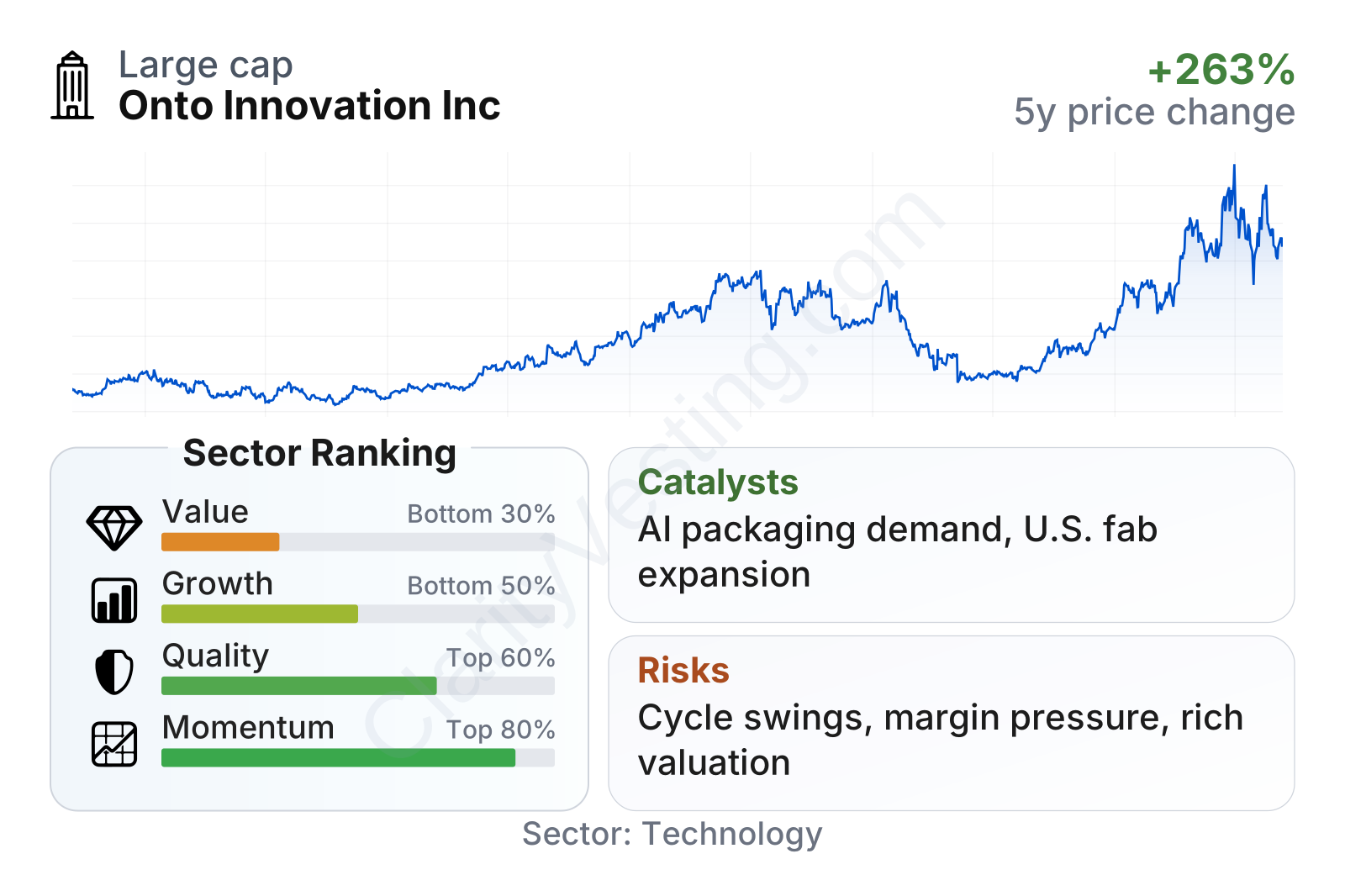
Onto Innovation is a mid-sized semiconductor equipment company with above-average share price momentum, solid profitability compared with much of the sector, and an unusually strong balance sheet. The weaker areas are valuation and some recent pressure on returns and margin direction. Revenue growth has recently improved sharply, but the market is already assigning a much richer earnings multiple than the sector median.
The stock’s history also highlights how cyclical sentiment can be. After a strong run through 2023 and 2024, the shares became volatile in 2025 before rebounding sharply in 2026. That kind of movement is common in semiconductor equipment names, where expectations can shift quickly with customer capital spending plans.
Growth
Onto Innovation operates in a sector with durable long-term demand drivers. Semiconductor content continues to rise in data centers, artificial intelligence infrastructure, automotive electronics, mobile devices, industrial systems, and edge computing. On top of that, advanced packaging has become a strategic part of performance improvement, especially as chipmakers combine multiple dies and memory components in more complex designs. That trend directly supports demand for inspection and metrology tools.
The company’s strategy broadly fits these trends. Rather than trying to cover every category of wafer-fab equipment, Onto focuses on areas where measurement, defect detection, and packaging complexity are increasing. This is sensible because customers are under pressure to improve yields, and the cost of missing defects rises as chips become more advanced. Onto’s installed base and software content can also create follow-on service revenue after initial tool placement.
Recent sales growth has clearly reaccelerated after the 2023 downturn. The company went from negative year-over-year growth during that industry pullback to positive growth in 2024, then to a much stronger rate in mid-2026. That rebound stands out relative to the broader sector median and suggests Onto is benefiting from a favorable part of the semiconductor spending cycle, particularly where advanced packaging and specialty process control are important.
Cash generation has also improved meaningfully over the last few years. Free cash flow is well above 2022 and 2023 levels, even if the most recent reading eased slightly from the prior peak. For a capital equipment supplier, this matters because it shows the business is still converting demand into cash rather than relying on debt or equity financing to support operations.
A key catalyst is the growing importance of high-bandwidth memory and advanced packaging in AI-related hardware. As chip designs become more layered and interconnected, inspection and metrology requirements tend to increase. Onto has repeatedly emphasized these applications in its public communications, and this part of the market appears to be one of the clearest growth opportunities for the company. Another support factor is ongoing domestic semiconductor manufacturing investment in the United States, which can expand the customer base and provide additional process control demand over time.
Risks
This article is for informational purposes only and does not constitute financial advice. Some content is AI-generated. See Disclaimer


