Stock Analysis · Ondas Holdings Inc (ONDS)
Overview
Ondas Holdings Inc is a technology company focused on two specialized areas: industrial wireless communications and autonomous drone systems. In simple terms, it sells tools that help customers run critical operations where ordinary consumer networks or standard drones may not be reliable enough. Its customers are mainly in infrastructure, public safety, defense, rail, utilities, and industrial inspection.
The business is organized around two main segments. The first is Ondas Networks, which develops private wireless broadband systems used in industrial settings, especially for mission-critical communications. The second is Ondas Autonomous Systems, which includes drone-related businesses such as aerial intelligence, inspection, and security solutions through brands including American Robotics and Airobotics.
Based on the latest annual reporting, revenue is now primarily coming from autonomous systems rather than the older wireless networking activity. The mix can shift materially from year to year because contract timing is important for the company, but the broad picture is:
- Autonomous Systems: approximately 90% to 95% of recent annual revenue. This includes drone platforms, automated docking and operating systems, urban security and inspection solutions, and related services.
- Ondas Networks: approximately 5% to 10% of recent annual revenue. This includes private wireless network equipment, software, and support for industrial and transportation applications.
The biggest visible trend in the operating profile is that revenue has scaled up sharply from very low levels over the past few years, but spending on research, product development, and overhead has also remained high. That means Ondas is no longer just an early concept company, yet it is still in a buildout phase where commercial traction matters more than mature profitability.
The long-term pattern shows a company that has expanded its sales base meaningfully since 2023, but expenses have stayed well above gross profit. Revenue growth is real, yet the business model still depends on turning new contracts into repeatable, higher-margin activity.
Key Figures
| Metric | Value | Sector ⓘ |
|---|---|---|
| Date | Sep 12, 2026 | |
| Context | ||
| Sector | Technology | |
| Industry | Communication Equipment | |
| Market Cap ⓘ | $4.13B | |
| Beta ⓘ | 2.74 | |
Value (Cheapness) | ||
| P/E Ratio ⓘ | 101.22 | 29.51 |
| FCF Yield ⓘ | -4.13% | 4.25% |
| EBIT / EV ⓘ | 6.99% | 2.85% |
| PEG ⓘ | N/A | |
Growth (Business expansion) | ||
| Revenue Growth ⓘ | 1235.40% | 15.40% |
| RPS Growth (5Y CAGR) ⓘ | 28.07% | 8.56% |
| EPS Growth (5Y CAGR) ⓘ | -38.45% | -11.88% |
| Margin Growth (5Y Trend) ⓘ | N/A | 0.46% |
| FCF Growth (5Y CAGR) ⓘ | N/A | 9.80% |
Quality (Business durability) | ||
| ROIC (Latest) ⓘ | 50.83% | 9.44% |
| ROIC (5Y Median) ⓘ | -41.29% | 8.30% |
| Net Debt / EBIT (Latest) ⓘ | -4.14 | 0.54 |
| Net Debt / EBIT (5Y Median) ⓘ | N/A | 0.44 |
| Operating Margin (Latest) ⓘ | 254.42% | 9.58% |
| Operating Margin (5Y Median) ⓘ | -478.06% | 8.25% |
| Debt to Equity (Latest) ⓘ | 0.41% | 33.33% |
| Profit Margin (Latest) ⓘ | 96.25% | 7.14% |
| Free Cash Flow (Latest) ⓘ | -$170.63M | |
Momentum (Price trend) | ||
| 3Y Return ⓘ | +768.99% | +45.48% |
| 12M Return (excl. last month) ⓘ | +127.74% | +23.48% |
| 6M Return ⓘ | -30.01% | +20.93% |
| Price vs. 200-Day MA ⓘ | -24.12% | +7.43% |
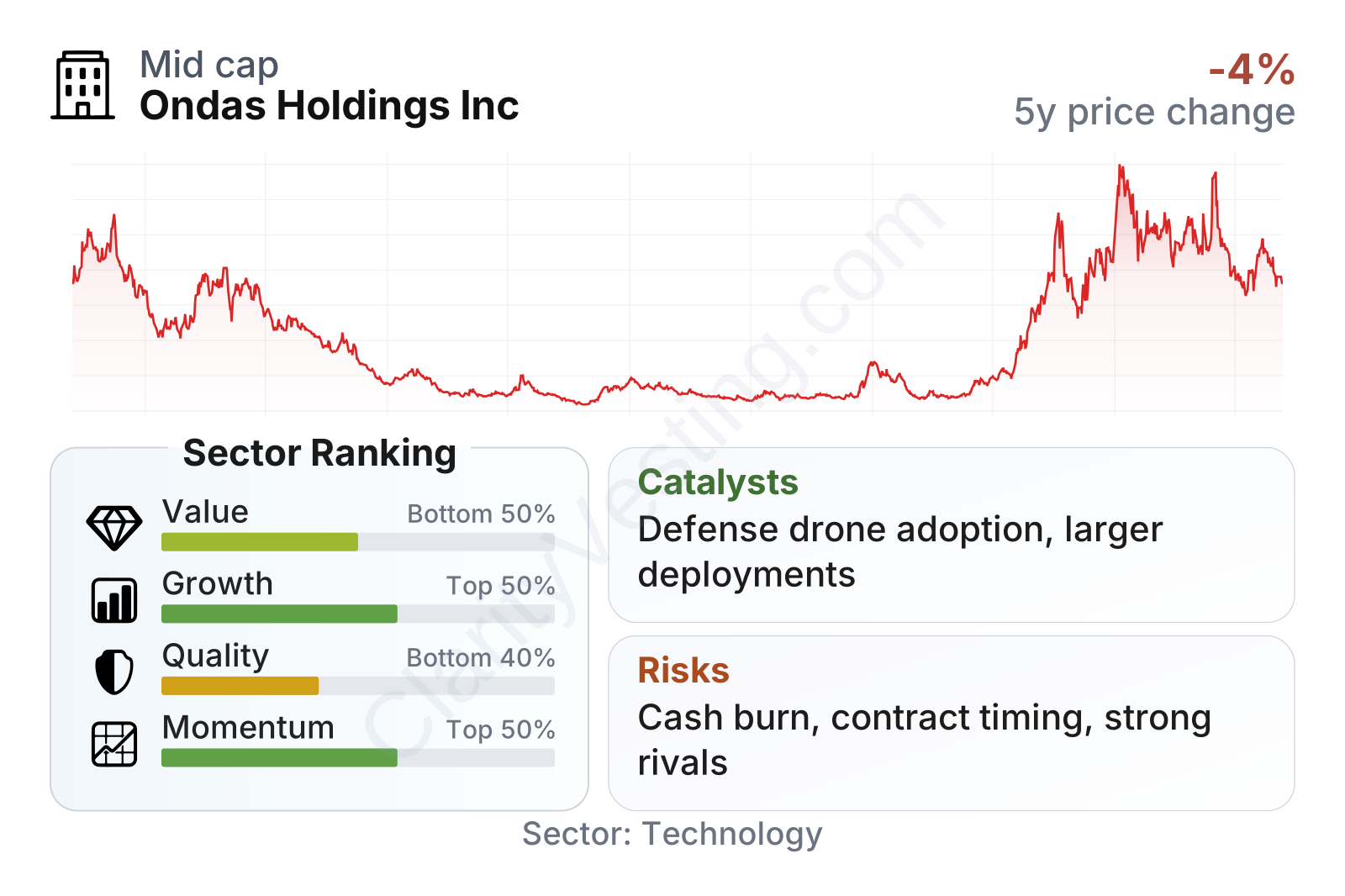
Ondas is a mid-sized company by market value within the communication equipment space, but its trading profile is much more volatile than the average technology stock, with a beta around 2.75. The factor breakdown is mixed: growth ranks relatively well versus the sector, while value and overall business quality rank lower. Recent profitability metrics look unusually strong on the surface, but the longer history remains much weaker, so the current picture should be read as a sharp improvement from a low base rather than evidence of a fully mature earnings profile.
The stock chart also highlights how dramatic sentiment changes have been. After a long decline through 2022 to 2024, the shares rebounded very strongly in 2025 and into 2026. That kind of move usually signals that the market is reassessing the company’s commercial prospects, but it also means expectations are no longer low.
Growth
Ondas operates in markets that are clearly growing over the long run. Governments, industrial operators, and security agencies are spending more on automation, remote sensing, AI-enabled surveillance, inspection drones, and resilient communications. These are not niche themes with shrinking demand. The broad direction of the sector supports the company’s strategic focus.
Its strategy also makes sense on paper. Rather than competing directly in consumer drones or mass-market telecom, Ondas is targeting high-value use cases where autonomy, regulatory approvals, reliability, and integration matter more than low price. That can create a more defensible position if the products become embedded in customer workflows.
Revenue growth has been extremely uneven over time, which is common for small contract-driven companies, but the latest trend is clearly strong. The most recent year-over-year growth rate is above 1,200%, far ahead of the sector median. Over a five-year span, revenue per share growth has also been much stronger than the typical peer. This suggests the business has moved beyond its earliest stage and is starting to convert its technology platform into larger commercial activity.
A notable catalyst is the company’s push into government, defense, and public-safety applications for autonomous drone systems. Those markets can be slow to develop, but once products are validated and deployed, they can support larger contracts, recurring software and service revenue, and follow-on orders. Urban security, critical infrastructure monitoring, and automated drone-in-a-box systems are all areas where Ondas is trying to establish itself.
The weak point in the growth picture is cash generation. Free cash flow remains deeply negative and has worsened recently, showing that expansion is still consuming significant capital. In other words, sales momentum has improved much faster than cash self-sufficiency. For long-term analysis, the key question is not whether the addressable market is attractive, but whether Ondas can scale without repeatedly needing outside funding.
Recent company communications have centered on contract wins, deployments, and expansion of autonomous drone use cases. Those developments matter because Ondas is still at the stage where each new deployment serves two purposes at once: it adds revenue and it validates the platform for future customers. That can create a compounding effect if adoption broadens across public-safety and industrial users.
Risks
This article is for informational purposes only and does not constitute financial advice. Some content is AI-generated. See Disclaimer


