Stock Analysis · ON Semiconductor Corporation (ON)
Overview
ON Semiconductor Corporation, now branded as onsemi, designs and sells power and sensing chips. These components are used to control electricity, convert power efficiently, and detect images or movement inside electronic systems. Its products are especially important in electric vehicles, advanced driver-assistance systems, industrial automation, energy infrastructure, cloud power systems, and some consumer electronics.
The company has spent the past several years reshaping its business away from lower-margin, more commoditized products and toward applications where efficiency, reliability, and long product cycles matter more. In simple terms, onsemi is trying to be a more specialized semiconductor supplier focused on markets where its chips can become deeply embedded in customers’ designs.
Based on recent company reporting, revenue is mainly organized into three operating groups.
- Power Solutions Group (PSG): about 48% of revenue in 2025 — power discrete, modules, and integrated circuits used in electric vehicles, industrial power, charging, energy, and computing power systems.
- Analog & Mixed-Signal Group (AMG): about 33% of revenue in 2025 — analog chips, signal chain products, power management, interface, and sensing-related solutions used across automotive and industrial systems.
- Intelligent Sensing Group (ISG): about 19% of revenue in 2025 — image sensors and related technologies used in automotive vision, industrial sensing, and selected other imaging applications.
End-market exposure is also concentrated in areas that management considers more strategic. Automotive represented roughly 59% of 2025 revenue, industrial about 26%, and all other markets about 15%. That makes onsemi much more tied to vehicle electrification and industrial investment than a broad chip supplier serving many consumer gadgets.
The business mix has become more cyclical in the short run, but potentially stronger in the long run, because automotive and industrial customers usually require high performance, long qualification cycles, and dependable supply. That can create stickier customer relationships once a chip is designed into a vehicle platform or industrial system.
The long-term pattern shows a company that lifted profitability sharply through 2022 and 2023, then ran into a much weaker downcycle in 2024 and especially 2025. Revenue fell meaningfully from its peak, and profit compressed even faster, which is typical in semiconductors when factory utilization drops. The positive point is that research and development spending remained substantial, suggesting the company kept funding future products even during the slowdown.
Key Figures
| Metric | Value | Sector ⓘ |
|---|---|---|
| Date | Sep 12, 2026 | |
| Context | ||
| Sector | Technology | |
| Industry | Semiconductors | |
| Market Cap ⓘ | $27.32B | |
| Beta ⓘ | 2.00 | |
Value (Cheapness) | ||
| P/E Ratio ⓘ | 46.16 | 29.51 |
| FCF Yield ⓘ | 6.49% | 4.25% |
| EBIT / EV ⓘ | 2.66% | 2.85% |
| PEG ⓘ | 0.16 | |
Growth (Business expansion) | ||
| Revenue Growth ⓘ | 9.20% | 15.40% |
| RPS Growth (5Y CAGR) ⓘ | -1.05% | 8.56% |
| EPS Growth (5Y CAGR) ⓘ | -32.06% | -11.88% |
| Margin Growth (5Y Trend) ⓘ | -15.74% | 0.46% |
| FCF Growth (5Y CAGR) ⓘ | 2.40% | 9.80% |
Quality (Business durability) | ||
| ROIC (Latest) ⓘ | 6.04% | 9.44% |
| ROIC (5Y Median) ⓘ | 15.32% | 8.30% |
| Net Debt / EBIT (Latest) ⓘ | 1.29 | 0.54 |
| Net Debt / EBIT (5Y Median) ⓘ | 0.36 | 0.44 |
| Operating Margin (Latest) ⓘ | 12.14% | 9.58% |
| Operating Margin (5Y Median) ⓘ | 26.82% | 8.25% |
| Debt to Equity (Latest) ⓘ | 62.10% | 33.33% |
| Profit Margin (Latest) ⓘ | 10.17% | 7.14% |
| Free Cash Flow (Latest) ⓘ | $1.77B | |
Momentum (Price trend) | ||
| 3Y Return ⓘ | -21.33% | +45.48% |
| 12M Return (excl. last month) ⓘ | +66.61% | +23.48% |
| 6M Return ⓘ | +31.98% | +20.93% |
| Price vs. 200-Day MA ⓘ | -3.47% | +7.43% |
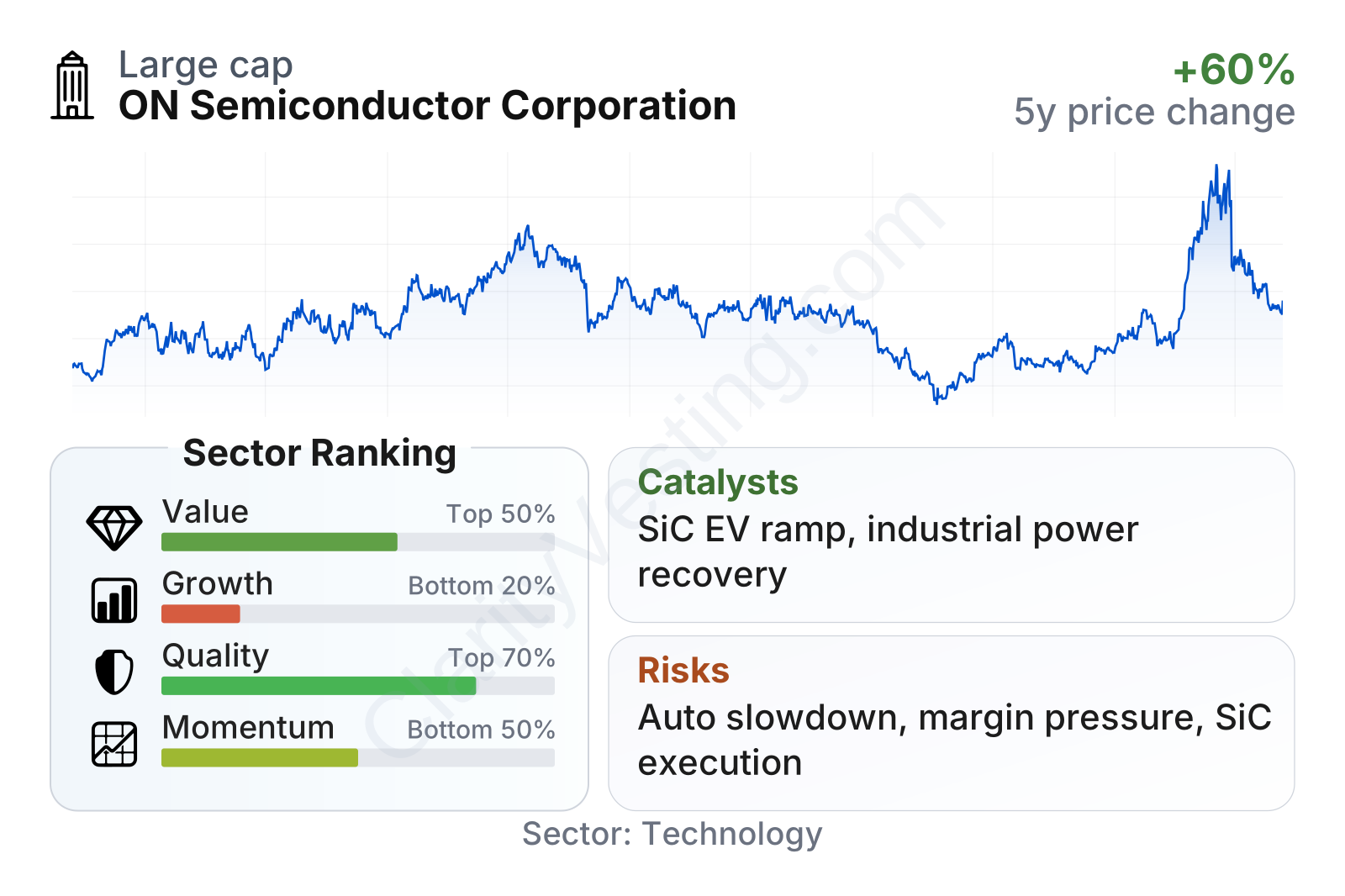
onsemi remains a large semiconductor company, with a market value in the tens of billions of dollars, but its stock has been volatile. The beta is around 2.0, which means the shares have tended to move much more sharply than the broader market. The table also points to a mixed profile: valuation measures look attractive on cash generation, quality remains decent, and recent stock momentum has improved, but growth metrics are weak relative to much of the sector because the company is still emerging from a difficult industry downturn.
Growth
onsemi operates in several markets with credible long-term expansion potential. Electric vehicles need much more power semiconductor content than internal combustion vehicles, and advanced safety features require more sensing and processing. Industrial automation, energy storage, solar, charging infrastructure, and AI-related power systems also need efficient power conversion. These are all areas where onsemi has products that address real engineering needs rather than discretionary features.
The strategy broadly makes sense. The company has emphasized silicon carbide for high-voltage power applications, especially in electric vehicles and energy systems. Silicon carbide devices can improve efficiency, reduce heat, and support faster charging in some use cases. onsemi has also invested in a more integrated supply chain, including manufacturing capacity and wafer capability, to serve customers that want secure long-term supply.
Revenue growth has been highly cyclical rather than linear. After very strong expansion in 2021 and 2022, growth slowed sharply, turned negative through much of 2024 and 2025, and only returned to positive territory in early 2026. That recent rebound matters because it suggests the company may be moving past the deepest part of the correction, although current growth is still below the broader semiconductor sector median.
Cash generation has held up better than earnings through the downturn. Free cash flow remains in the range of roughly $1.4 billion to $1.8 billion on a trailing basis across the periods shown, which is a useful sign for resilience. Even with weaker margins, the company is still producing meaningful cash that can support capital spending, debt management, and strategic investment.
A notable recent opportunity is onsemi’s push into large automotive and industrial electrification programs tied to silicon carbide and intelligent power solutions. Public company updates in 2026 continued to highlight design wins, customer programs, and manufacturing progress around these products. If electric vehicle demand, grid investment, and industrial power spending strengthen together, onsemi is positioned to participate across several layers of that buildout rather than depending on a single product cycle.
Risks
This article is for informational purposes only and does not constitute financial advice. Some content is AI-generated. See Disclaimer


