Stock Analysis · Omnicom Group Inc (OMC)
Overview
Omnicom Group Inc is one of the largest global advertising and marketing services companies. It helps brands plan campaigns, create ads, buy media, manage public relations, improve customer experience, use data and analytics, and run precision marketing programs across digital and traditional channels. Its clients include large multinational companies as well as local and regional businesses, and the group operates through a wide network of agency brands in more than 70 countries.
Omnicom’s revenue comes mainly from fees charged for professional services rather than from selling physical products. Based on the company’s recent annual reporting structure, revenue is organized primarily by discipline.
- Media & Advertising: about 52% of 2025 revenue. This includes media planning and buying, creative advertising, digital campaign development, and related brand services.
- Precision Marketing: about 18%. This covers CRM, customer targeting, commerce-related marketing, data-driven marketing, and personalized communications.
- Execution & Support: about 13%. This includes field marketing, merchandising, events, sampling, and other marketing execution services.
- Public Relations: about 9%. This includes corporate communications, reputation management, healthcare communications, and public affairs work.
- Healthcare: about 8%. This includes specialized marketing and communications for pharmaceutical, biotech, and broader health-sector clients.
Geographically, Omnicom remains heavily exposed to the United States, which typically represents a little more than half of revenue, with the rest spread across Europe, Asia-Pacific, Latin America, the Middle East, and Africa. That mix gives the company broad diversification, but it also ties results to the health of large corporate advertising budgets.
The business model is attractive in one important way: it does not require heavy capital spending to operate. Even when reported earnings fluctuate, the company has historically produced solid cash flow because clients pay for services, talent, and intellectual property rather than for factories or inventory. Over the last several years, revenue advanced from roughly $14.3 billion to more than $17.2 billion, while operating profit remained meaningful despite a sharp 2025 earnings disruption.
The revenue base has expanded steadily over the last five years, and gross profit also moved higher. The key change is lower profitability in 2025: revenue rose again, but operating income and net income fell sharply, showing that recent pressure came less from demand weakness and more from costs, charges, or integration-related effects.
Key Figures
| Metric | Value | Sector ⓘ |
|---|---|---|
| Date | Sep 12, 2026 | |
| Context | ||
| Sector | Communication Services | |
| Industry | Advertising Agencies | |
| Market Cap ⓘ | $21.80B | |
| Beta ⓘ | 0.67 | |
Value (Cheapness) | ||
| P/E Ratio ⓘ | 214.73 | 18.61 |
| FCF Yield ⓘ | 10.96% | 13.68% |
| EBIT / EV ⓘ | 4.23% | 4.54% |
| PEG ⓘ | 15.97 | |
Growth (Business expansion) | ||
| Revenue Growth ⓘ | 63.40% | 5.40% |
| RPS Growth (5Y CAGR) ⓘ | 6.20% | 4.62% |
| EPS Growth (5Y CAGR) ⓘ | -11.34% | -18.01% |
| Margin Growth (5Y Trend) ⓘ | -12.21% | 1.10% |
| FCF Growth (5Y CAGR) ⓘ | 21.50% | 5.88% |
Quality (Business durability) | ||
| ROIC (Latest) ⓘ | 4.86% | 8.38% |
| ROIC (5Y Median) ⓘ | 17.95% | 8.32% |
| Net Debt / EBIT (Latest) ⓘ | 6.45 | 1.99 |
| Net Debt / EBIT (5Y Median) ⓘ | 1.07 | 2.94 |
| Operating Margin (Latest) ⓘ | 5.59% | 14.89% |
| Operating Margin (5Y Median) ⓘ | 15.07% | 12.96% |
| Debt to Equity (Latest) ⓘ | 114.65% | 59.59% |
| Profit Margin (Latest) ⓘ | 1.74% | 8.77% |
| Free Cash Flow (Latest) ⓘ | $2.39B | |
Momentum (Price trend) | ||
| 3Y Return ⓘ | +10.99% | +46.64% |
| 12M Return (excl. last month) ⓘ | +20.74% | +2.16% |
| 6M Return ⓘ | +2.50% | +5.05% |
| Price vs. 200-Day MA ⓘ | +2.25% | +2.88% |
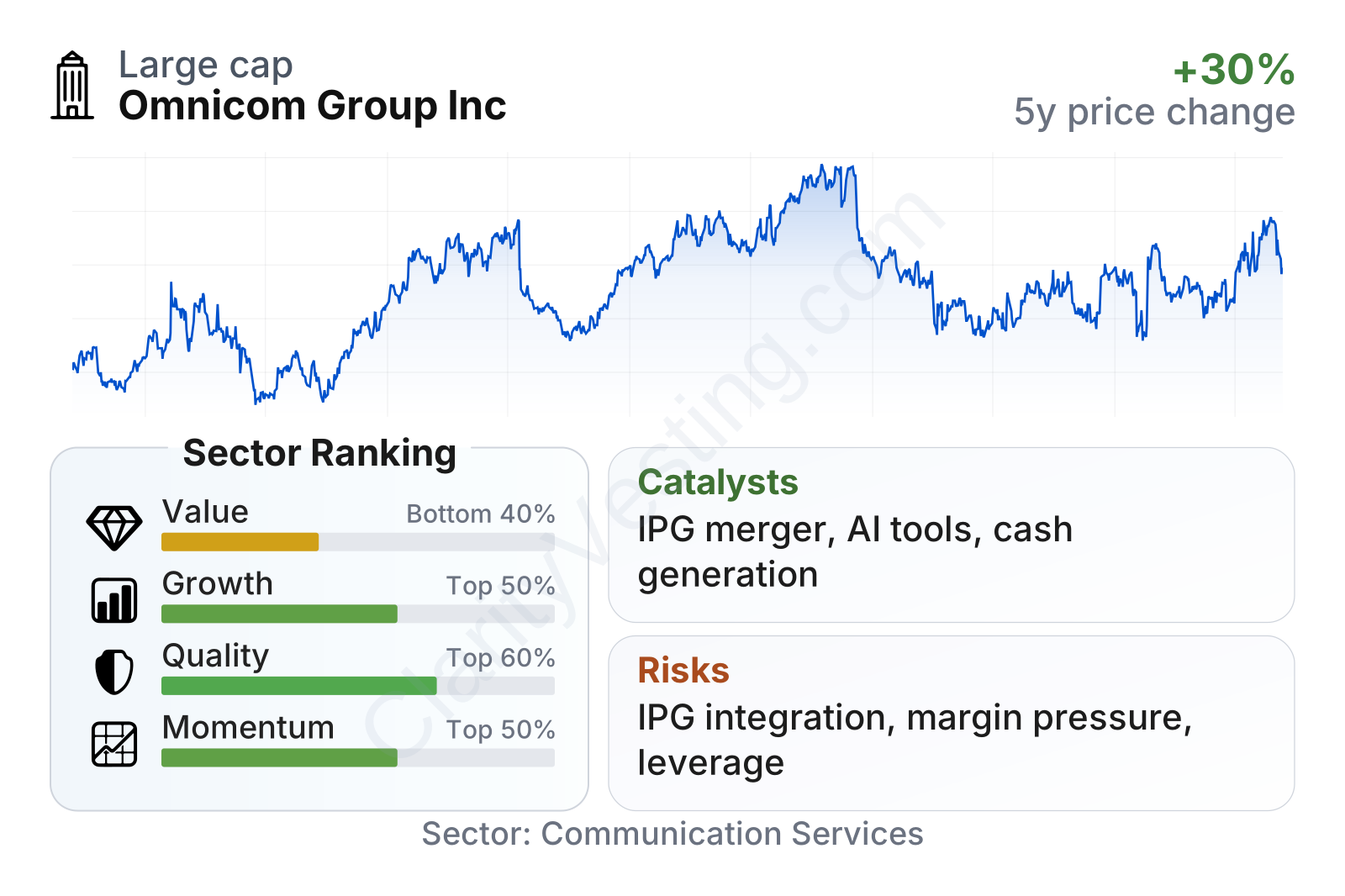
Omnicom is a large-cap company with lower share-price volatility than the broader market, as shown by its beta below 1. The overall factor picture is mixed. Growth measures look relatively solid versus the sector, helped by very strong recent reported revenue growth and strong multi-year free cash flow expansion. Quality is more uneven: long-term returns on invested capital have been respectable, but current leverage and recent margin pressure weaken the profile. On valuation metrics, the latest reading looks distorted by depressed trailing earnings, so cash-flow-based measures are more useful than the headline P/E alone.
Growth
Advertising and marketing services remain a growing sector over the long run, but growth is not uniform. Traditional ad spending is mature, while digital media, commerce media, retail media, data-driven targeting, healthcare communications, and customer experience services continue to attract spending. Omnicom is positioned in these areas, which matters because large clients increasingly want one partner that can combine creativity, media buying, data, and measurable performance.
Its strategy broadly fits that direction. The company has spent years building stronger capabilities in precision marketing, commerce, healthcare, and analytics rather than relying only on classic ad agency work. That makes strategic sense in a market where clients want campaigns tied more closely to sales outcomes and customer data. Omnicom’s scale also helps it negotiate media, invest in tools, and serve multinational accounts across regions.
Recent reported revenue growth has accelerated sharply, reaching levels far above the sector median. That kind of jump usually points to a major portfolio event rather than purely organic expansion, so it should be viewed carefully. Even so, the longer-term pattern before that step-up was still positive, with revenue per share rising modestly over five years.
Cash generation is a more reassuring part of the growth picture. Trailing free cash flow climbed strongly over the past few years and recently reached roughly $2.4 billion, with an even higher run-rate visible earlier in 2026. For a service business, that matters because strong cash conversion supports acquisitions, dividends, debt reduction, and operational flexibility even when accounting earnings are temporarily under pressure.
A major catalyst is Omnicom’s planned acquisition of Interpublic Group, announced in late 2024. If completed and integrated well, the combination would create one of the world’s largest marketing and communications groups, with broader client reach, larger media-buying scale, deeper data assets, and meaningful cost synergy potential. The transaction also reflects the industry’s shift toward consolidation as agency groups respond to pressure from digital platforms, consulting firms, and in-house client marketing teams.
Another favorable backdrop is the increasing use of artificial intelligence across marketing workflows. Omnicom has been highlighting AI-enabled tools to improve media planning, targeting, content production, and campaign measurement. In this industry, AI is less about replacing agencies entirely and more about improving productivity and giving large clients better return tracking. If Omnicom can pair AI tools with its existing client relationships, the technology can reinforce rather than weaken its relevance.
Risks
This article is for informational purposes only and does not constitute financial advice. Some content is AI-generated. See Disclaimer