Stock Analysis · Grupo Aeroportuario del Centro Norte SAB de CV (OMAB)
Overview
Grupo Aeroportuario del Centro Norte, commonly known as OMA, is a Mexican airport operator. It holds concessions to run, maintain, and develop 13 airports in the central and northern parts of Mexico, including Monterrey, Culiacán, Chihuahua, Ciudad Juárez, Acapulco, and Zihuatanejo. In simple terms, the company makes money by operating airport infrastructure and charging airlines, passengers, tenants, and other commercial users for access to that network.
The business is attractive because airports are hard to replicate. An airport operator usually benefits from regulated but recurring traffic-related revenue, while also earning higher-margin commercial income from stores, restaurants, parking, car rentals, advertising, and service contracts inside the terminals.
Based on the company’s recent annual disclosures, OMA’s revenue mix is led by aeronautical services, with non-aeronautical activities providing an important second engine of growth. Approximate revenue sources can be summarized as follows:
- Aeronautical services: about 60% to 65% — passenger charges, aircraft landing and parking fees, security-related services, passenger walkways, and terminal use regulated under the airport concession framework.
- Non-aeronautical services: about 25% to 30% — leasing of commercial space, parking, advertising, car rentals, food and retail areas, and other passenger-facing services inside the airports.
- Construction services and other activities: about 10% to 15% — recognized mainly when the company builds or upgrades concession assets, plus complementary service revenue.
Monterrey is especially important within the portfolio because it is one of Mexico’s busiest airports and a major business hub. That concentration gives OMA access to a large, economically active catchment area, but it also means one airport has an outsized influence on results.
Over the last several years, the company has expanded revenue while keeping direct operating costs relatively contained, which has supported very strong operating profitability. Revenue rose from roughly $471 million in 2021 to about $862 million in 2025, while operating income more than doubled over the same period. That pattern suggests good operating leverage: as passenger traffic and commercial activity increase, a meaningful portion of additional revenue can flow through to profit.
The overall income structure points to a business with high gross and operating margins, supported by relatively modest cost of revenue compared with total sales. Interest and taxes are meaningful uses of cash, but the company still converts a large share of revenue into net income.
Key Figures
| Metric | Value | Sector ⓘ |
|---|---|---|
| Date | Nov 16, 2026 | |
| Context | ||
| Sector | Industrials | |
| Industry | Airports & Air Services | |
| Market Cap ⓘ | $5.28B | |
| Beta ⓘ | 0.25 | |
Value (Cheapness) | ||
| P/E Ratio ⓘ | 17.06 | 21.48 |
| P/B Ratio ⓘ | N/A | 3.37 |
| FCF Yield ⓘ | 5.66% | 4.91% |
| Dividend Yield ⓘ | N/A | 1.92% |
| EBIT / EV ⓘ | 8.58% | 6.14% |
| PEG ⓘ | 17.05 | |
Growth (Business expansion) | ||
| Revenue Growth ⓘ | 23.80% | 9.25% |
| RPS Growth (5Y CAGR) ⓘ | 16.32% | 7.71% |
| EPS Growth (5Y CAGR) ⓘ | 5.39% | -6.55% |
| BVPS Growth (5Y CAGR) ⓘ | 0.08% | 6.12% |
| Margin Growth (5Y Trend) ⓘ | 7.13% | 0.83% |
| FCF Growth (5Y CAGR) ⓘ | 30.74% | 10.86% |
| DPS Growth (5Y CAGR) ⓘ | 22.57% | 9.31% |
Quality (Business durability) | ||
| ROIC (Latest) ⓘ | 26.10% | 10.39% |
| ROA (Latest) ⓘ | 16.63% | 5.41% |
| ROIC (5Y Median) ⓘ | 27.62% | 9.47% |
| ROA (5Y Median) ⓘ | 18.37% | 4.92% |
| Net Debt / EBIT (Latest) ⓘ | 1.19 | 2.06 |
| Net Debt / EBIT (5Y Median) ⓘ | 1.13 | 2.25 |
| Net Debt / EBITDA (Latest) ⓘ | 1.08 | 1.40 |
| Net Debt / Assets ⓘ | 32.18% | 19.16% |
| EBITDA / Interest ⓘ | 6.82 | 10.09 |
| Operating Margin (Latest) ⓘ | 54.30% | 10.44% |
| Operating Margin (5Y Median) ⓘ | 55.72% | 10.29% |
| Debt to Equity (Latest) ⓘ | 140.07% | 64.67% |
| Profit Margin (Latest) ⓘ | 31.67% | 6.78% |
| Free Cash Flow (Latest) ⓘ | $298.74M | |
Momentum (Price trend) | ||
| 3Y Return ⓘ | +124.59% | +56.13% |
| 12M Return (excl. last month) ⓘ | -3.78% | +10.78% |
| 6M Return ⓘ | +7.72% | +1.39% |
| Price vs. 200-Day MA ⓘ | +3.00% | +1.02% |
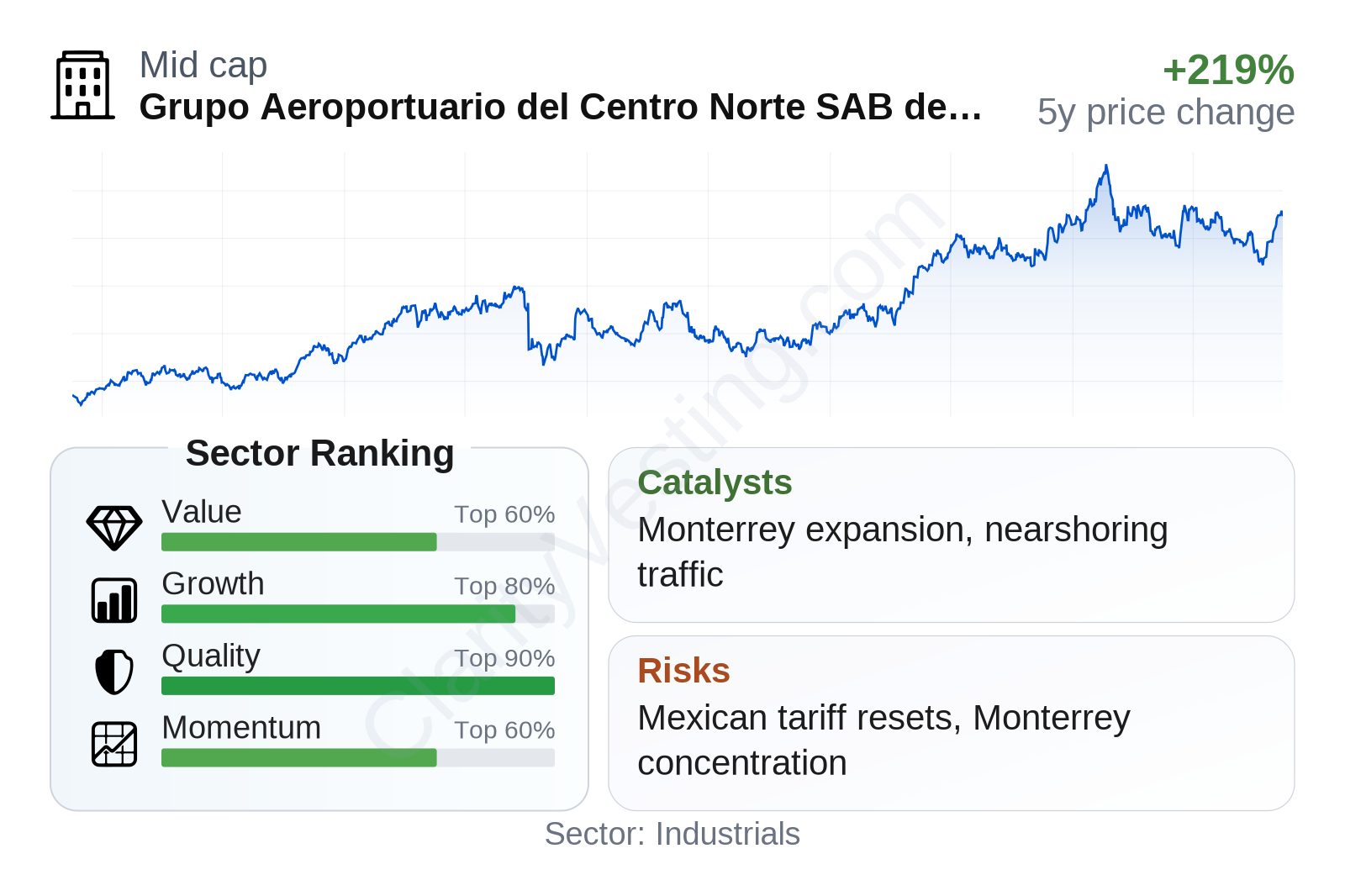
OMA stands out most on business quality and growth. Profitability is far above the industry median, with operating margin above 50% and net margin around the low 30% range, which is unusually strong for the broader transportation space. Returns on capital and assets are also well ahead of sector norms. On growth, revenue expansion, free cash flow growth, and dividend growth have all been stronger than most peers. Valuation is not stretched on standard earnings and cash flow measures, although the PEG ratio looks elevated because growth is not perfectly smooth from year to year. The stock has also shown strong multiyear performance, while short-term momentum has been more mixed.
Growth
OMA operates in a sector with favorable long-term drivers. Air travel in Mexico is supported by population growth, tourism, business mobility, industrial activity near the U.S. border, and the expansion of manufacturing and logistics corridors. Airports also tend to benefit from inflation pass-through mechanisms, commercial pricing power inside terminals, and rising passenger spending as traffic normalizes and grows.
OMA’s strategy for future growth is coherent. The company continues to invest in airport capacity, terminal upgrades, and service improvements under its concession framework. That matters because airport operators need to expand infrastructure before congestion limits traffic growth. Monterrey is the clearest example: it serves a large metropolitan economy and remains one of the most relevant business travel gateways in the country, which can support both passenger growth and commercial revenue per traveler.
Revenue growth has not been linear, but the broader pattern still shows expansion well above the sector median. There were periods of softer or even negative year-over-year comparisons, yet the more recent readings point back to positive growth, including a strong rebound in the latest period. That kind of volatility is normal in airport operations, where calendar effects, traffic mix, and regulatory timing can influence quarterly comparisons.
Cash generation has also remained solid. Free cash flow has stayed in a healthy range over the last several years, showing that profit is not just an accounting result but is being converted into real cash after capital spending. That is particularly important for an airport operator because these businesses must continuously reinvest in runways, terminals, and security infrastructure.
A meaningful catalyst is Mexico’s ongoing airport infrastructure development cycle. OMA’s concession-driven investment plans can support higher regulated asset usage and commercial monetization over time. Another potential tailwind is continued growth in nearshoring and industrial activity in northern Mexico, which can lift both business travel and cargo-related airport use in OMA’s regions. Recent operating momentum also suggests the company continues to benefit from resilient domestic demand and the strategic relevance of Monterrey.
Risks
This article is for informational purposes only and does not constitute financial advice. Some content is AI-generated. See Disclaimer