Stock Analysis · Olaplex Holdings Inc (OLPX)
Overview
Olaplex Holdings Inc is a hair care company built around bond-building products designed to repair and protect hair damaged by coloring, heat, and chemical treatments. The brand became well known first in professional salons and later expanded into specialty retail, e-commerce, and international markets. Its business is centered on a relatively focused portfolio: treatments, shampoos, conditioners, styling products, and related hair health items sold under the Olaplex name.
The company’s revenue mainly comes from selling branded hair care products through a mix of channels and geographies. Based on recent annual filings, the business can be summarized this way:
- Specialty retail: approximately 41% of revenue. This includes sales through beauty-focused retail partners such as specialty stores and other authorized retailers.
- Professional: approximately 39% of revenue. This channel includes products sold to salons, stylists, and professional distributors.
- Direct-to-consumer: approximately 20% of revenue. This includes the company’s own website and other direct digital sales.
By geography, Olaplex is still led by North America, but it also has meaningful international exposure across Europe, the Middle East, Africa, Asia-Pacific, and Latin America. That international footprint matters because future growth depends not only on new products, but also on expanding brand reach beyond its strongest home market.
The financial picture has changed sharply from the company’s peak period. Revenue climbed strongly through 2022, then fell back as demand normalized, competition intensified, and brand momentum weakened. Gross profitability remains relatively strong for a beauty brand, but a larger share of revenue is now being absorbed by operating costs, especially selling and marketing expenses, which has reduced earnings power.
The business remains asset-light and brand-driven, which is attractive in principle, but it currently looks more like a turnaround case than a straightforward compounding growth company.
The long-term pattern shows a business that once converted a very large share of sales into profit, but that margin structure has narrowed substantially. Revenue has fallen from its 2022 high, while selling and administrative costs have become much heavier relative to sales, leaving much less room for net income.
Key Figures
| Metric | Value | Sector ⓘ |
|---|---|---|
| Date | Sep 12, 2026 | |
| Context | ||
| Sector | Consumer Cyclical | |
| Industry | Specialty Retail | |
| Market Cap ⓘ | $1.39B | |
| Beta ⓘ | 1.84 | |
Value (Cheapness) | ||
| P/E Ratio ⓘ | N/A | 17.10 |
| FCF Yield ⓘ | 4.88% | 8.53% |
| EBIT / EV ⓘ | 1.33% | 6.46% |
| PEG ⓘ | N/A | |
Growth (Business expansion) | ||
| Revenue Growth ⓘ | 2.50% | 5.75% |
| RPS Growth (5Y CAGR) ⓘ | -8.92% | 9.14% |
| EPS Growth (5Y CAGR) ⓘ | -58.96% | -18.21% |
| Margin Growth (5Y Trend) ⓘ | -47.78% | -0.23% |
| FCF Growth (5Y CAGR) ⓘ | -26.88% | 4.91% |
Quality (Business durability) | ||
| ROIC (Latest) ⓘ | 1.85% | 12.61% |
| ROIC (5Y Median) ⓘ | 7.44% | 10.72% |
| Net Debt / EBIT (Latest) ⓘ | 1.40 | 2.10 |
| Net Debt / EBIT (5Y Median) ⓘ | 0.97 | 2.32 |
| Operating Margin (Latest) ⓘ | 4.42% | 9.25% |
| Operating Margin (5Y Median) ⓘ | 29.78% | 9.64% |
| Debt to Equity (Latest) ⓘ | 40.15% | 75.78% |
| Profit Margin (Latest) ⓘ | -3.53% | 5.33% |
| Free Cash Flow (Latest) ⓘ | $67.95M | |
Momentum (Price trend) | ||
| 3Y Return ⓘ | -47.86% | +14.53% |
| 12M Return (excl. last month) ⓘ | +61.90% | +3.08% |
| 6M Return ⓘ | +22.49% | +0.55% |
| Price vs. 200-Day MA ⓘ | +29.64% | -0.54% |
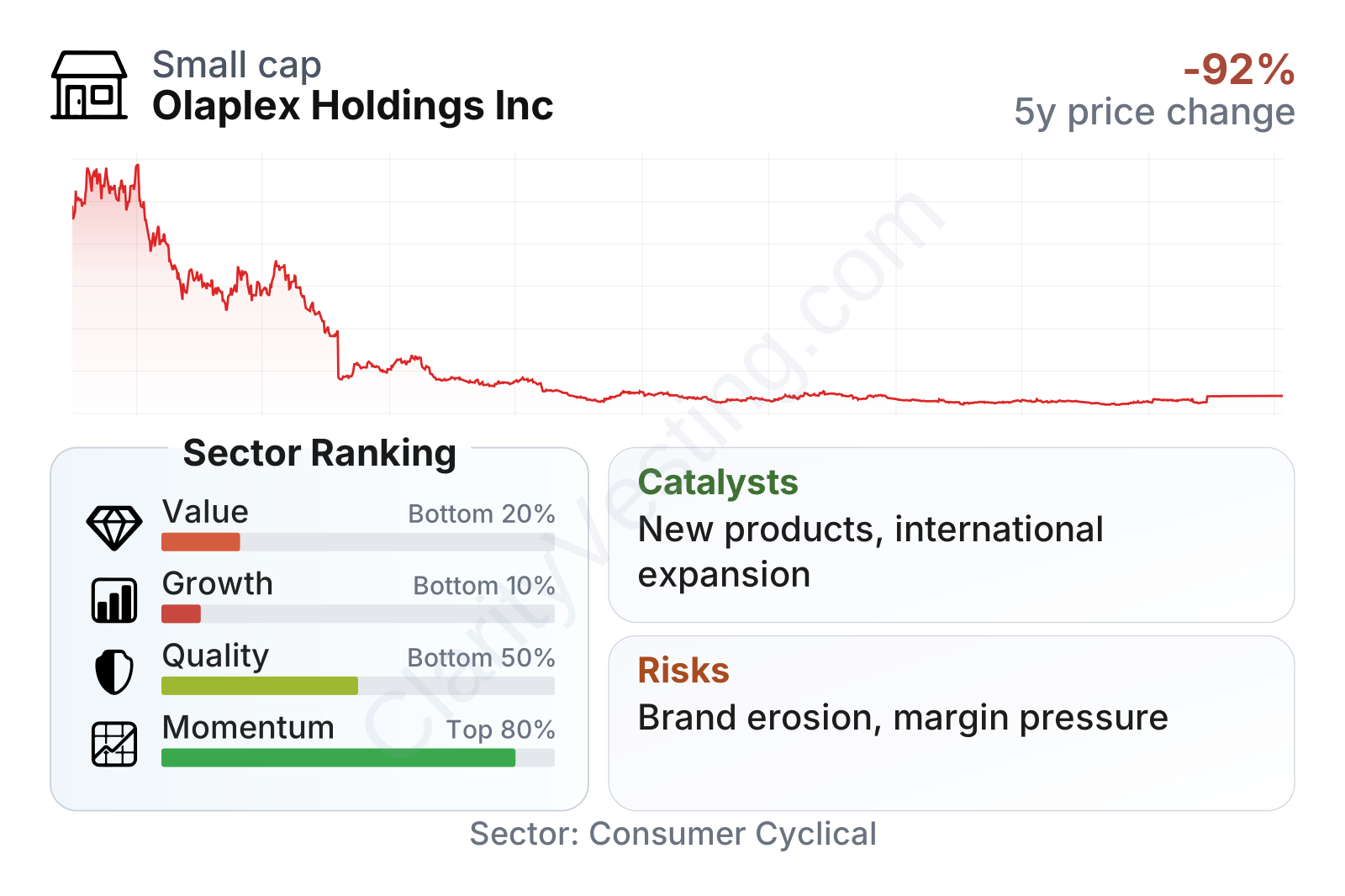
Olaplex is currently a small-cap company with a stock that has been highly volatile, as reflected by a beta well above 1. The factor profile is mixed: momentum has improved recently, but value, growth, and quality metrics remain weak relative to most companies in its sector. The balance sheet is less stretched than many peers, yet profitability and returns on capital are currently well below industry norms.
The stock history also helps explain market sentiment. After trading above $20 shortly after listing, the shares dropped sharply over the following years and only recently stabilized in the low single digits. That pattern usually signals that the market has already priced in a major business reset, but it also shows how much confidence was lost after the earlier growth phase faded.
Growth
The beauty and prestige hair care market is generally attractive for long-term growth. Consumers often remain engaged with hair care across economic cycles, and premium products can benefit from brand loyalty, repeat purchases, and pricing power when the brand remains relevant. Hair repair and scalp or hair health categories also continue to attract attention, which supports the broader segment where Olaplex operates.
That said, being in a growing sector is not enough on its own. Olaplex’s challenge is that its recent growth has lagged the wider sector. Revenue has stopped shrinking and has returned to low single-digit year-over-year growth in the latest period, which is a meaningful improvement from the steep declines seen in 2023 and much of 2024. Still, the recovery remains modest rather than decisive.
The recent trend suggests that the worst phase of the sales contraction may be over, but the rebound is still fragile. For a brand business, a return from negative growth to low single digits is encouraging only if it can be sustained across channels and supported by stronger consumer demand rather than short-term promotions or inventory movements.
Management’s strategy for future expansion is centered on three familiar levers: product innovation, broader distribution, and international development. That approach makes sense for a beauty company. Olaplex does not need to invent an entirely new business model; it needs to restore brand relevance, improve execution in retail and professional channels, and keep users engaged with a wider product routine beyond hero repair treatments.
One practical support for that strategy is cash generation. Even though earnings have weakened, the company is still producing positive free cash flow on a trailing basis.
Free cash flow has declined significantly from earlier years, but it remains positive. That matters because it gives the company room to invest in marketing, product launches, and international expansion without relying entirely on new borrowing or equity financing. In a turnaround situation, positive cash generation often matters more than reported earnings alone.
A notable recent opportunity is the company’s continued push to broaden its product lineup and deepen salon and retail partnerships. If newer products gain traction and the brand reconnects with stylists and repeat consumers, Olaplex has room to improve because it is rebuilding from a much lower base than at its peak. The setup is not one of explosive industry-driven growth, but of a recognized brand trying to recover share and stabilize demand in an appealing category.
Risks
This article is for informational purposes only and does not constitute financial advice. Some content is AI-generated. See Disclaimer


