Stock Analysis · Nextracker Inc (NXT)
Overview
Nextracker is a solar technology company focused on equipment and software that help large solar power plants produce more electricity. Its core product is a tracker system: a motorized structure that lets solar panels follow the sun during the day instead of staying fixed in one position. The company mainly serves utility-scale solar projects, which are the very large installations built by power producers, developers, and engineering firms.
Beyond the tracker hardware itself, Nextracker also offers related components and digital tools designed to improve energy output, reliability, and site management. The business is tied directly to new solar project construction, especially in markets where developers want better efficiency and lower lifetime power costs.
Based on company filings, revenue is overwhelmingly generated from solar tracker systems and associated products for utility-scale projects. The company does not report many separate operating segments, so precise percentages by product line are limited, but the mix can be described as follows:
- Solar tracker systems and related hardware: likely more than 85% of revenue. This includes the mechanical and electrical systems that move panels and the main balance-of-system components sold with those projects.
- Software, controls, and project add-ons: a smaller share, likely less than 15% of revenue. This includes monitoring, optimization, and tools that improve performance and operations.
- Services and other revenue: a limited portion of sales, mainly connected to project support and complementary offerings.
Nextracker’s financial profile has improved sharply over the last several years. Revenue has expanded from roughly $1.5 billion in fiscal 2022 to about $3.6 billion in fiscal 2026, while gross profit and net income have risen even faster. That matters because it suggests the company is not only benefiting from a growing market, but also capturing more value from each dollar of sales.
The long-term trend shows a business that has scaled efficiently: revenue has climbed strongly, gross profit has widened faster than sales, and net income has increased substantially. That combination points to stronger pricing, favorable product mix, and disciplined operating execution rather than growth at any cost.
Key Figures
| Metric | Value | Sector ⓘ |
|---|---|---|
| Date | Sep 12, 2026 | |
| Context | ||
| Sector | Technology | |
| Industry | Solar | |
| Market Cap ⓘ | $12.74B | |
| Beta ⓘ | 1.92 | |
Value (Cheapness) | ||
| P/E Ratio ⓘ | 20.98 | 29.51 |
| FCF Yield ⓘ | 4.32% | 4.25% |
| EBIT / EV ⓘ | 5.06% | 2.85% |
| PEG ⓘ | 3.15 | |
Growth (Business expansion) | ||
| Revenue Growth ⓘ | 8.20% | 15.40% |
| RPS Growth (5Y CAGR) ⓘ | -7.46% | 8.56% |
| EPS Growth (5Y CAGR) ⓘ | 22.42% | -11.88% |
| Margin Growth (5Y Trend) ⓘ | 14.72% | 0.46% |
| FCF Growth (5Y CAGR) ⓘ | N/A | 9.80% |
Quality (Business durability) | ||
| ROIC (Latest) ⓘ | 28.41% | 9.44% |
| ROIC (5Y Median) ⓘ | 59.84% | 8.30% |
| Net Debt / EBIT (Latest) ⓘ | -1.45 | 0.54 |
| Net Debt / EBIT (5Y Median) ⓘ | -0.49 | 0.44 |
| Operating Margin (Latest) ⓘ | 20.13% | 9.58% |
| Operating Margin (5Y Median) ⓘ | 20.13% | 8.25% |
| Debt to Equity (Latest) ⓘ | 2.26% | 33.33% |
| Profit Margin (Latest) ⓘ | 16.36% | 7.14% |
| Free Cash Flow (Latest) ⓘ | $550.72M | |
Momentum (Price trend) | ||
| 3Y Return ⓘ | +89.81% | +45.48% |
| 12M Return (excl. last month) ⓘ | +90.22% | +23.48% |
| 6M Return ⓘ | -28.48% | +20.93% |
| Price vs. 200-Day MA ⓘ | -23.51% | +7.43% |
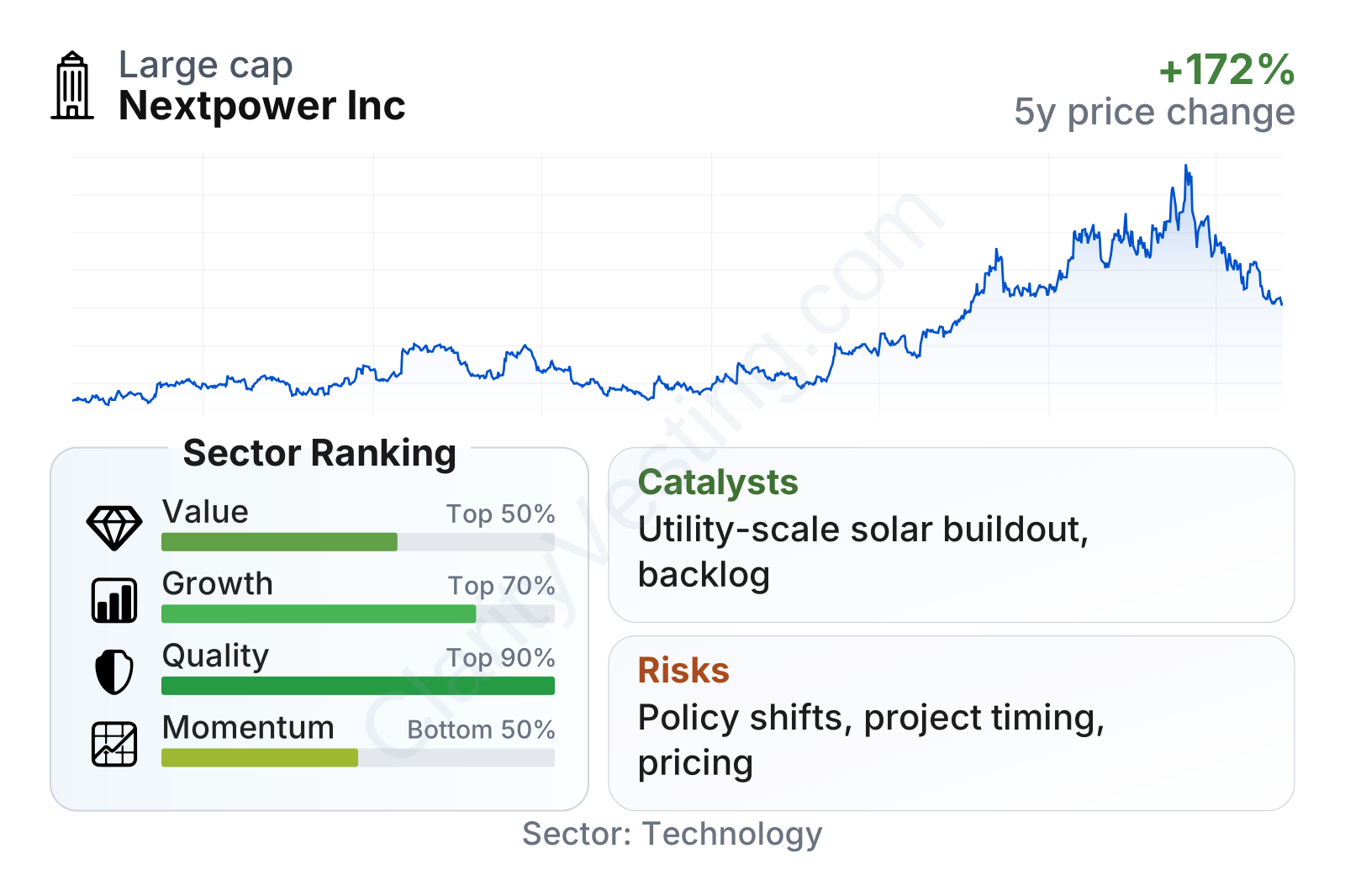
Nextracker sits in the large-cap range and has shown stronger business quality than most companies in its sector. Profitability, returns on invested capital, and balance sheet strength stand out, while valuation remains below the sector median on earnings. Growth is still positive, but the recent pace is less exceptional than the company’s earlier surge, and the stock has also become more volatile, with weaker short-term momentum despite a strong multiyear rise.
Growth
Nextracker operates in a part of the energy market that still has a long runway. Utility-scale solar continues to expand as power demand rises, renewable targets remain in place in many regions, and solar developers look for better output per project. Trackers are especially important in large installations because even modest efficiency gains can have a meaningful impact on project economics over many years.
The company’s strategy appears coherent for long-term expansion. It is not trying to compete across every corner of solar equipment. Instead, it is focused on a specific layer of the value chain where performance, reliability, and project execution matter. That specialization can be valuable because utility-scale customers tend to prioritize proven systems, bankability, and the ability to deliver large projects on time.
Growth has not been perfectly smooth. After several periods of very strong year-over-year expansion, recent revenue growth has slowed and even turned negative in one quarter before returning to positive territory. That pattern is common in project-driven businesses, where timing of deliveries and revenue recognition can make quarterly comparisons look uneven. Even so, the broader direction over the last few years remains clearly upward.
Cash generation has also become a meaningful strength. Free cash flow increased dramatically from fiscal 2023 through fiscal 2025 and remains high even after a pullback from the peak. For a long-term analysis, this is important because it shows that earnings are being supported by actual cash creation, not only accounting results.
One of the strongest catalysts is the continued buildout of utility-scale solar, particularly in the United States, where grid demand, manufacturing policy, and energy security have encouraged investment across the solar supply chain. Nextracker has also expanded its product offering beyond the core tracker into adjacent solutions that can raise project value. If the company continues to deepen customer relationships and increase content per project, growth may come not only from more solar plants being built, but also from more revenue captured on each installation.
Recent company updates have also pointed to a substantial backlog and pipeline tied to utility-scale demand. That does not eliminate cyclicality, but it gives more visibility than many industrial-growth businesses typically have.
Risks
This article is for informational purposes only and does not constitute financial advice. Some content is AI-generated. See Disclaimer


