Stock Analysis · NXP Semiconductors NV (NXPI)
Overview
NXP Semiconductors is a large chipmaker focused on mixed-signal and embedded semiconductors. In simple terms, it designs specialized chips that help cars, industrial machines, mobile devices, payment cards, and connected products sense, process, communicate, and operate securely. The company is especially well known for automotive electronics, secure identification, near-field communication, microcontrollers, and analog chips used in systems that need reliability over many years.
Its business is less dependent on consumer gadgets than many semiconductor peers. NXP’s products are deeply embedded in vehicles, factory equipment, building controls, payment systems, and identification infrastructure. That matters for long-term analysis because these markets often have long product cycles, strict qualification requirements, and high switching costs once a chip is designed into a system.
Based on recent annual reporting, revenue is mainly generated from four end markets:
- Automotive: about 56% — chips for advanced driver assistance, vehicle networking, battery management, electrification, radar, in-vehicle processing, and car access systems.
- Industrial & IoT: about 22% — microcontrollers, processors, analog, connectivity, and security products used in factories, smart homes, energy systems, medical devices, and connected equipment.
- Mobile: about 14% — secure mobile transactions, ultra-wideband, NFC, eSIM-related functions, and other smartphone-related components.
- Communication Infrastructure & Other: about 8% — products for networking, wireless infrastructure, and selected computing or edge communications uses.
NXP’s revenue mix shows a company shaped primarily by the auto industry, with industrial and connected-device markets providing a second growth leg. That concentration can create cycles, but it also places NXP in segments where semiconductor content per device is increasing over time.
The flow of the business over recent years points to a company that has kept gross profit strong even during softer revenue periods, while continuing to spend heavily on research and development. Revenue peaked above $13 billion in 2023 before easing in 2024 and 2025, and profitability compressed during that downturn, but the overall structure still reflects a high-margin semiconductor franchise rather than a low-cost commodity supplier.
Key Figures
| Metric | Value | Sector ⓘ |
|---|---|---|
| Date | Sep 12, 2026 | |
| Context | ||
| Sector | Technology | |
| Industry | Semiconductors | |
| Market Cap ⓘ | $57.11B | |
| Beta ⓘ | 1.82 | |
Value (Cheapness) | ||
| P/E Ratio ⓘ | 19.05 | 29.51 |
| FCF Yield ⓘ | 5.17% | 4.25% |
| EBIT / EV ⓘ | 6.39% | 2.85% |
| PEG ⓘ | 0.44 | |
Growth (Business expansion) | ||
| Revenue Growth ⓘ | 19.50% | 15.40% |
| RPS Growth (5Y CAGR) ⓘ | 4.71% | 8.56% |
| EPS Growth (5Y CAGR) ⓘ | -21.14% | -11.88% |
| Margin Growth (5Y Trend) ⓘ | 1.22% | 0.46% |
| FCF Growth (5Y CAGR) ⓘ | 1.57% | 9.80% |
Quality (Business durability) | ||
| ROIC (Latest) ⓘ | 14.77% | 9.44% |
| ROIC (5Y Median) ⓘ | 14.45% | 8.30% |
| Net Debt / EBIT (Latest) ⓘ | 1.88 | 0.54 |
| Net Debt / EBIT (5Y Median) ⓘ | 2.24 | 0.44 |
| Operating Margin (Latest) ⓘ | 31.22% | 9.58% |
| Operating Margin (5Y Median) ⓘ | 27.72% | 8.25% |
| Debt to Equity (Latest) ⓘ | 96.29% | 33.33% |
| Profit Margin (Latest) ⓘ | 22.56% | 7.14% |
| Free Cash Flow (Latest) ⓘ | $2.95B | |
Momentum (Price trend) | ||
| 3Y Return ⓘ | +24.52% | +45.48% |
| 12M Return (excl. last month) ⓘ | +7.96% | +23.48% |
| 6M Return ⓘ | +24.81% | +20.93% |
| Price vs. 200-Day MA ⓘ | -2.77% | +7.43% |
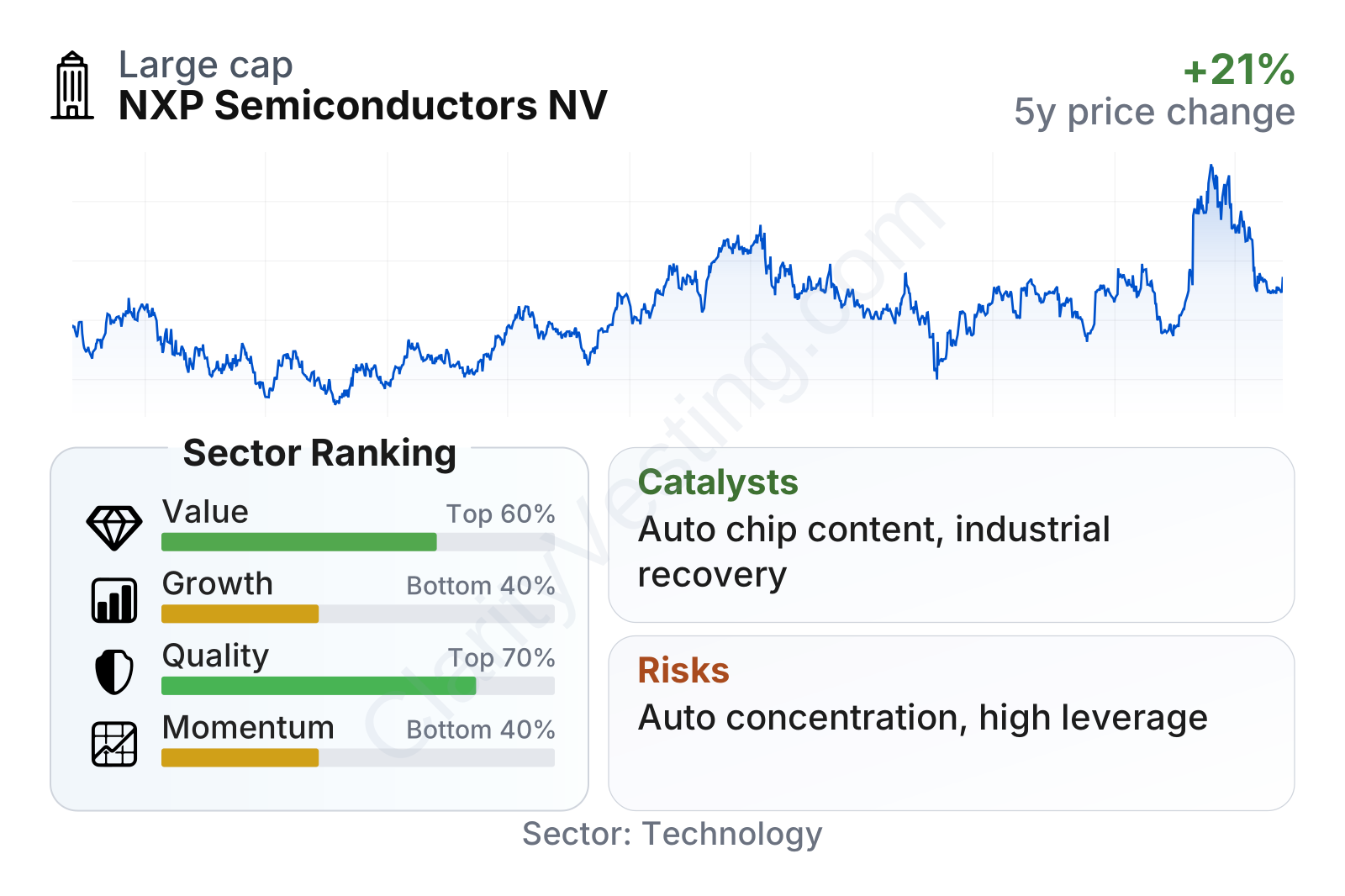
NXP combines strong profitability with mixed growth and only average market momentum. On quality, the company stands well above the sector median: operating margin is a little above 31%, profit margin is around 23%, and return on invested capital is near 15%, all clearly stronger than typical semiconductor peers. On value, the picture is more nuanced. The headline P/E is elevated, but cash-based measures remain more favorable than much of the sector. Growth looks weaker over a five-year view even though the latest year-over-year revenue rebound is stronger than the sector median. The balance sheet remains the main offset, with leverage noticeably higher than many peers despite recent improvement.
Growth
NXP operates in parts of the semiconductor industry that are supported by long-term structural demand. Vehicles are becoming more electronic, with more chips needed for electrification, driver assistance, connectivity, safety, secure access, and in-car networking. Industrial systems are also becoming smarter and more connected, which raises demand for microcontrollers, sensors, analog components, wireless links, and embedded security. These are favorable markets for a company with NXP’s portfolio.
The company’s strategy also makes industrial sense. Rather than chasing the most crowded segments of cutting-edge AI training chips, NXP focuses on areas where product life cycles are longer and customers value reliability, certification, and system-level know-how. In automotive especially, design wins can remain in production for many years. That can make growth slower than in the hottest chip niches, but often more durable once programs are secured.
Recent revenue trends suggest the company has been moving through a cyclical reset rather than a broken business model. After a period of flat to declining comparisons in 2023 through much of 2025, year-over-year growth turned positive again and accelerated into 2026, reaching roughly 19% in the latest period shown. That recovery matters because it indicates demand is improving after an inventory correction, especially in markets where customers had reduced purchases to work through excess stock.
Cash generation remains an important support point. Free cash flow fell sharply during the weaker part of the cycle, then recovered to just under $3.0 billion on a trailing basis. That is not a straight-line growth pattern, but it does show the company can still generate substantial cash even when end markets are uneven. For long-term business assessment, this is important because strong cash generation helps fund research, acquisitions, debt reduction, and shareholder returns without relying too heavily on external financing.
One of the most visible catalysts is the continued increase in semiconductor content per vehicle. NXP has strong exposure to areas such as radar, processors, microcontrollers, battery management, and in-vehicle networking. Another catalyst is the spread of edge intelligence in industrial and connected devices, where secure processing close to the device becomes more valuable. Recent company communications have also emphasized opportunities tied to software-defined vehicles, electrification platforms, and secure connected systems, all of which align well with NXP’s product base.
Risks
This article is for informational purposes only and does not constitute financial advice. Some content is AI-generated. See Disclaimer


