Stock Analysis · Next PLC (NXGPY)
Overview
Next PLC is a British retail company focused on clothing, footwear, home products, and beauty. It operates through a mix of physical stores, online sales, and a set of service and brand-management activities that make the group broader than a traditional apparel chain. In simple terms, Next sells its own products directly to shoppers, runs a large online platform, and also helps other brands sell through its infrastructure.
The company’s revenue base is spread across several activities. Based on the latest annual reporting for the year ended January 2026, the largest sources are approximately:
- Online product sales: about 50% to 55% of group sales. This includes UK online demand for Next-branded merchandise and online sales to customers outside the UK.
- Retail stores: about 20% to 25%. This is the traditional store estate, mainly in the UK and Ireland.
- Finance interest income: about 10% to 15%. Next offers credit to customers, and the interest generated is a meaningful profit contributor.
- Total Platform and third-party services: about 10% to 15%. This activity includes online fulfillment, website, warehousing, and related support for partner brands, plus revenues tied to branded partnerships and equity interests.
- International retail and franchise-related activities outside core channels: a small single-digit percentage. This includes franchise and other overseas arrangements where the exact split is less central than the overall contribution.
That mix matters because Next is no longer only a store-based fashion retailer. The business has evolved into a hybrid model with digital scale, credit income, logistics capability, and an ecosystem that can support other brands. Over the last several years, total revenue has climbed from roughly £4.6 billion to about £6.9 billion, while operating profit and net income have also moved higher overall, showing that growth has not come only from adding low-margin sales.
The revenue and profit flow shows a business that has expanded steadily since 2022, with gross profit and operating income rising faster than many traditional apparel chains. Costs have increased as well, but the overall structure still points to a company that has preserved attractive profitability while scaling.
Key Figures
| Metric | Value | Sector ⓘ |
|---|---|---|
| Date | Sep 12, 2026 | |
| Context | ||
| Sector | Consumer Cyclical | |
| Industry | Apparel Retail | |
| Market Cap ⓘ | $23.17B | |
| Beta ⓘ | 1.04 | |
Value (Cheapness) | ||
| P/E Ratio ⓘ | 20.14 | 17.10 |
| FCF Yield ⓘ | 8.74% | 8.53% |
| EBIT / EV ⓘ | N/A | 6.46% |
| PEG ⓘ | 2.96 | |
Growth (Business expansion) | ||
| Revenue Growth ⓘ | 15.30% | 5.75% |
| RPS Growth (5Y CAGR) ⓘ | 12.79% | 9.14% |
| EPS Growth (5Y CAGR) ⓘ | -8.92% | -18.21% |
| Margin Growth (5Y Trend) ⓘ | -1.11% | -0.23% |
| FCF Growth (5Y CAGR) ⓘ | 8.42% | 4.91% |
Quality (Business durability) | ||
| ROIC (Latest) ⓘ | 71.72% | 12.61% |
| ROIC (5Y Median) ⓘ | 37.61% | 10.72% |
| Net Debt / EBIT (Latest) ⓘ | 0.73 | 2.10 |
| Net Debt / EBIT (5Y Median) ⓘ | 1.57 | 2.32 |
| Operating Margin (Latest) ⓘ | 18.03% | 9.25% |
| Operating Margin (5Y Median) ⓘ | 18.82% | 9.64% |
| Debt to Equity (Latest) ⓘ | 108.79% | 75.78% |
| Profit Margin (Latest) ⓘ | 12.87% | 5.33% |
| Free Cash Flow (Latest) ⓘ | $2.03B | |
Momentum (Price trend) | ||
| 3Y Return ⓘ | +144.62% | +14.53% |
| 12M Return (excl. last month) ⓘ | +42.69% | +3.08% |
| 6M Return ⓘ | +20.20% | +0.55% |
| Price vs. 200-Day MA ⓘ | +17.65% | -0.54% |
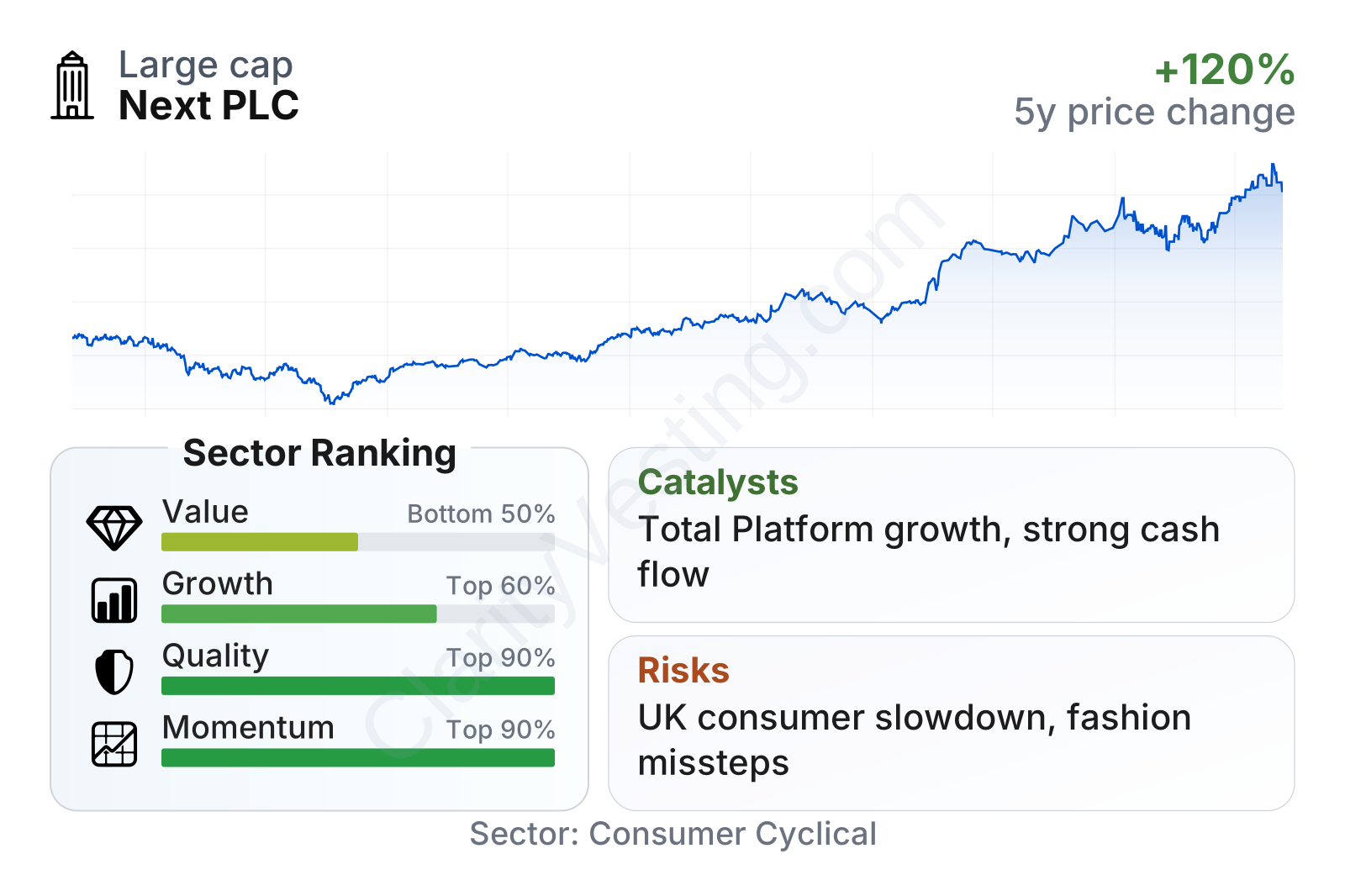
Next stands out most on business quality and market performance. Profitability is clearly above the sector median, with operating margin around 18% and profit margin near 13%, both well ahead of typical apparel retailers. Returns on invested capital are exceptionally strong, and leverage measured against earnings remains moderate. Growth metrics are also better than the sector in several areas, especially revenue and free cash flow over multi-year periods. Valuation is less obviously attractive, however, as earnings multiples are not low relative to peers.
The share price trend has been strong over the past few years, recovering from 2022 weakness and then moving to new highs by 2026. That rise reflects improving business performance, but it also means the market is already recognizing much of the company’s recent execution strength.
Growth
Next operates in a mature retail segment, so the main question is not whether apparel retail itself is a fast-growing sector, but whether the company can continue gaining share and expanding into higher-value activities. On that point, the strategy makes sense. Management has spent years building online infrastructure, integrating warehousing and delivery, and extending the business beyond selling only Next-branded products. This creates more room for growth than a standard clothing chain would typically have.
A key catalyst is the continued development of Total Platform, where Next provides technology, logistics, and operational support to other brands. This gives the company a way to grow without relying entirely on opening more stores or dramatically increasing its own fashion ranges. It also deepens relationships with partner brands and can improve asset utilization across warehousing and delivery networks.
Another support for future growth is the company’s ability to generate cash. Strong cash production gives Next flexibility to invest in systems, distribution, overseas expansion, acquisitions, and shareholder distributions while still keeping balance-sheet pressure manageable.
Recent growth has been stronger than the sector median, which suggests Next is gaining ground rather than simply drifting with the wider consumer cycle. Over five years, revenue per share and free cash flow have both compounded at rates above many peers, which is a useful sign for long-term business durability.
Free cash flow remains substantial for a company of this size. That is particularly important in retail, where accounting profits can sometimes look healthy while inventory, leases, or expansion spending absorb cash. Here, the cash profile appears to support the earnings profile rather than contradict it.
Recent company updates in 2026 have also pointed to continued resilience in full-price sales and ongoing confidence in guidance, despite a still-uncertain consumer backdrop. That does not remove cyclicality, but it does reinforce the view that the operating model is currently working well.
Risks
This article is for informational purposes only and does not constitute financial advice. Some content is AI-generated. See Disclaimer