Stock Analysis · New China Life Insurance Company Ltd (NWWCF)
Overview
New China Life Insurance Company Ltd is one of China’s largest life insurers. The company sells long-term protection and savings products to individuals and families, and it also manages insurance funds generated from those policies. In simple terms, it collects premiums from policyholders, pays claims and benefits over time, and invests a very large pool of assets to earn returns. That makes it a business with two engines: insurance underwriting and investment income.
Its operations are mainly concentrated in mainland China, where demand for life insurance, retirement planning, health protection, and wealth-preservation products is tied to household income trends, demographics, and confidence in long-term savings products. The company distributes products through a large sales force, bancassurance partnerships, and other channels commonly used in the Chinese insurance market.
The broad revenue mix in life insurance is usually driven by both insurance service activity and returns from invested assets. For New China Life, the most relevant sources are:
- Insurance service and premium-related income: approximately the majority of business activity. This includes life insurance, health insurance, annuity products, and long-duration protection policies sold to retail customers.
- Investment income: a very significant secondary source, often material enough to shape yearly profit swings. This includes interest, dividends, fair-value changes, and gains from the insurer’s large investment portfolio.
- Other smaller operating income: a limited share, including service-related and ancillary items.
Because insurance accounting can make reported revenue volatile from year to year, profit and book value often give a clearer picture than headline sales alone. Over the last few years, the company’s earnings profile has shown that investment conditions and product mix can matter just as much as policy growth.
The operating picture has been uneven, but one notable improvement is that profitability recovered strongly after weaker years. Recent results show a better balance between revenue generation and expenses, with net income rebounding meaningfully by 2024 and 2025 after a softer 2023.
Key Figures
| Metric | Value | Sector ⓘ |
|---|---|---|
| Date | Nov 21, 2026 | |
| Context | ||
| Sector | Financial Services | |
| Industry | Insurance - Life | |
| Market Cap ⓘ | $14.62B | |
| Beta ⓘ | 0.84 | |
Value (Cheapness) | ||
| P/E Ratio ⓘ | 3.84 | 12.01 |
| P/B Ratio ⓘ | N/A | 1.48 |
| FCF Yield ⓘ | 231.39% | 8.77% |
| Dividend Yield ⓘ | 62.03% | 3.01% |
| EBIT / EV ⓘ | N/A | 8.31% |
| PEG ⓘ | 0.34 | |
Growth (Business expansion) | ||
| Revenue Growth ⓘ | -73.30% | 6.70% |
| RPS Growth (5Y CAGR) ⓘ | 46.35% | 12.35% |
| EPS Growth (5Y CAGR) ⓘ | -2.29% | -0.27% |
| BVPS Growth (5Y CAGR) ⓘ | 68.20% | 4.83% |
| Margin Growth (5Y Trend) ⓘ | 25.74% | -4.16% |
| FCF Growth (5Y CAGR) ⓘ | 21.26% | 4.69% |
| DPS Growth (5Y CAGR) ⓘ | 110.49% | 8.82% |
Quality (Business durability) | ||
| ROIC (Latest) ⓘ | N/A | 9.49% |
| ROE (Latest) ⓘ | 34.67% | 14.02% |
| ROA (Latest) ⓘ | 2.22% | 1.53% |
| ROIC (5Y Median) ⓘ | 56.15% | 7.80% |
| ROE (5Y Median) ⓘ | 14.22% | 12.09% |
| ROA (5Y Median) ⓘ | 1.69% | 1.28% |
| Net Debt / EBIT (Latest) ⓘ | N/A | 0.88 |
| Net Debt / EBIT (5Y Median) ⓘ | -0.04 | 0.73 |
| Net Debt / EBITDA (Latest) ⓘ | -0.22 | 0.71 |
| Operating Margin (Latest) ⓘ | N/A | 23.37% |
| Operating Margin (5Y Median) ⓘ | 62.27% | 24.29% |
| Debt to Equity (Latest) ⓘ | 15.11% | 59.34% |
| Profit Margin (Latest) ⓘ | 41.65% | 26.65% |
| Free Cash Flow (Latest) ⓘ | $33.82B | |
Momentum (Price trend) | ||
| 3Y Return ⓘ | +339.86% | +73.29% |
| 12M Return (excl. last month) ⓘ | +4.75% | +18.35% |
| 6M Return ⓘ | -22.58% | +3.24% |
| Price vs. 200-Day MA ⓘ | -27.91% | +2.17% |
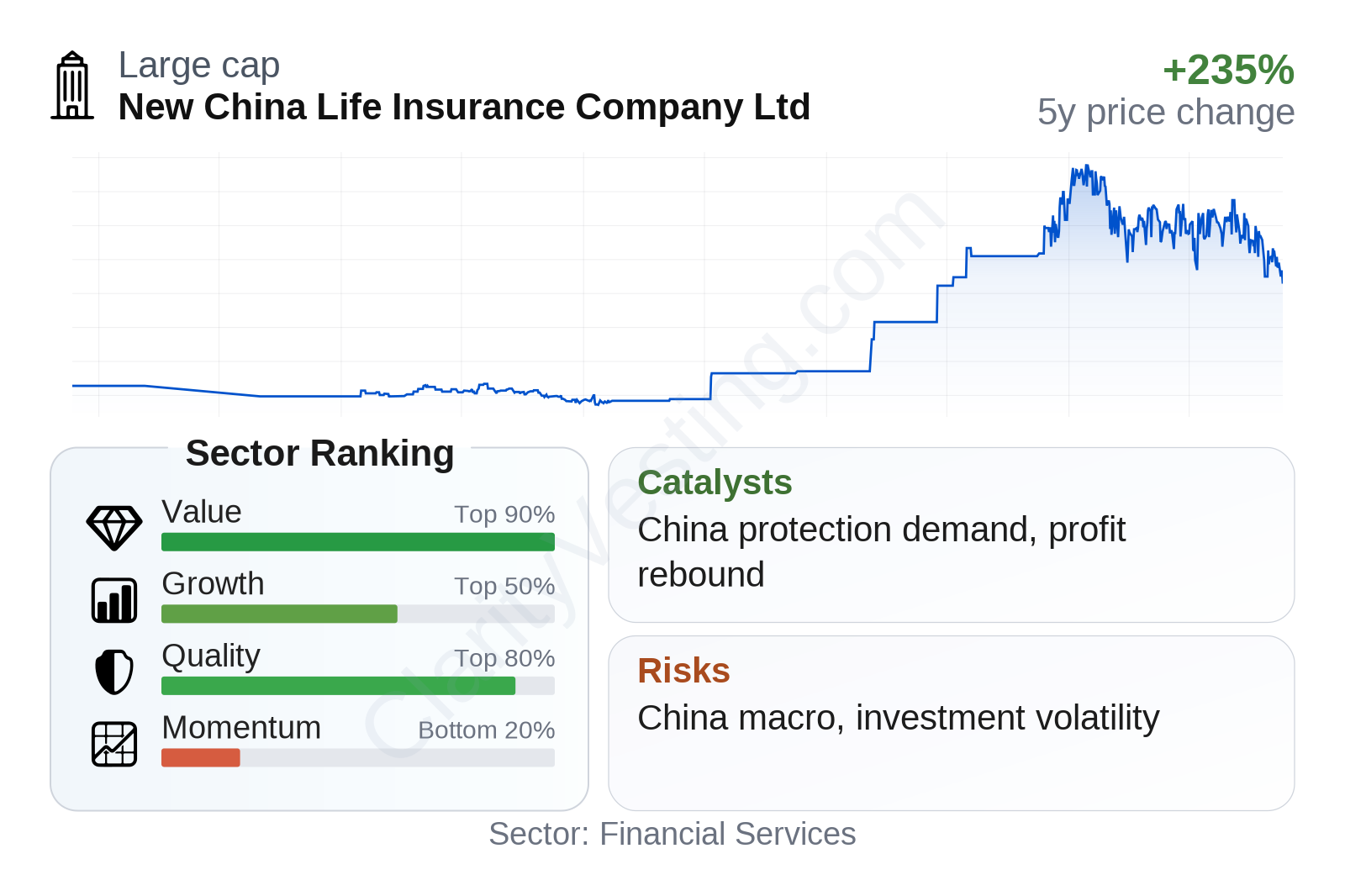
On valuation, New China Life screens as inexpensive relative to much of the insurance sector, with a low earnings multiple and a high dividend yield. On quality, returns on equity and assets are above sector medians, profit margin is strong, and leverage appears conservative for an insurer. Growth is more mixed: the latest year-over-year revenue comparison is weak, but longer-term growth in revenue per share, free cash flow, dividends, and especially book value per share has been much stronger. Momentum is the weakest area, with the share price below its longer-term trend after a recent pullback despite a very strong multi-year gain.
The stock’s past price path has also been volatile, which is not unusual for Chinese financial companies listed over the counter in the U.S. A low beta suggests that day-to-day moves have not always been tightly correlated with the broader equity market, but liquidity and sentiment can still create large swings.
Growth
New China Life operates in a sector with a credible long-term foundation. China’s life and health insurance market is supported by an aging population, rising retirement needs, and the gradual expansion of private financial protection. Those structural drivers matter because life insurance penetration in China still has room to develop over time, especially in retirement, health coverage, and long-duration savings products.
The company’s strategy also makes sense in that context. Large life insurers in China increasingly focus on products with better margins, more predictable risk, and stronger long-term customer value rather than simply chasing policy volume. For New China Life, this is important because profit quality matters more than short-term premium growth. A disciplined product mix, stronger agency productivity, and steadier investment management can create better results than rapid but low-quality expansion.
One of the clearest favorable signals is the sharp long-term rise in book value per share, even with some volatility in between. That matters for an insurer because book value reflects the capital base supporting future business and investment capacity. The jump visible in the latest period is unusually large and likely reflects a combination of earnings, capital changes, and accounting effects, so it deserves attention rather than being treated as a simple straight-line trend.
A strong catalyst is the company’s exposure to a recovery in Chinese household demand for protection and retirement products. If consumer confidence and savings flows continue to normalize, insurers with established distribution networks can benefit. Another catalyst is the investment portfolio: when equity markets, bond yields, or dividend income move in the right direction, profits can improve quickly. The sharp earnings recovery seen in recent periods suggests this operating leverage is real.
Recent company disclosures have also pointed to improving profitability and higher net profit in the latest full-year period. That does not remove cyclicality, but it supports the view that the company has been able to convert a difficult backdrop into materially better earnings.
Risks
This article is for informational purposes only and does not constitute financial advice. Some content is AI-generated. See Disclaimer