Stock Analysis · News Corp B (NWS)
Overview
News Corp is a global media and information company with a mix of digital real estate services, news publishing, book publishing, and subscription-based business information. While the company is widely associated with newspapers such as The Wall Street Journal, its business is broader and increasingly shaped by digital subscriptions, property listings, and professional information services. Its structure gives it exposure to several different end markets rather than relying on a single media product.
Based on the company’s latest annual reporting for fiscal 2026, revenue is spread across several operating segments. The main sources of revenue are approximately:
- Digital Real Estate Services: about 20% to 25% — primarily REA Group in Australia, plus Move in the United States, which operates Realtor.com. This segment includes online property listings, developer products, media, and related digital real estate services.
- Dow Jones: about 20% to 25% — includes professional information products, consumer subscriptions, news and data services, and risk and compliance tools, with recurring revenue supported by subscriptions and business customers.
- Book Publishing: about 15% to 20% — mainly HarperCollins, which earns revenue from print, digital, and audio books across consumer and educational categories.
- News Media: about 15% to 20% — newspapers, digital news subscriptions, advertising, and related content services across markets including the U.S., U.K., and Australia.
- Subscription Video Services: about 10% to 15% — largely Australian pay-TV and streaming-related operations.
- Other: a low-single-digit share — includes smaller corporate and digital activities not large enough to drive the overall company on their own.
This mix matters for long-term analysis. News Corp is no longer just a traditional newspaper group. Its most important pieces are assets with subscription or marketplace characteristics, especially Dow Jones and digital real estate, which typically carry better economics than print advertising alone.
The company’s financial flow over recent years also shows a business that recovered after a weak 2023 period. Revenue, gross profit, operating income, and net income have all improved through fiscal 2026, although operating expenses remain significant and selling, general, and administrative costs absorb a large share of gross profit.
Key Figures
| Metric | Value | Sector ⓘ |
|---|---|---|
| Date | Sep 12, 2026 | |
| Context | ||
| Sector | Communication Services | |
| Industry | Entertainment | |
| Market Cap ⓘ | $17.54B | |
| Beta ⓘ | 0.92 | |
Value (Cheapness) | ||
| P/E Ratio ⓘ | 31.76 | 18.61 |
| FCF Yield ⓘ | 6.09% | 13.68% |
| EBIT / EV ⓘ | 6.09% | 4.54% |
| PEG ⓘ | 2.95 | |
Growth (Business expansion) | ||
| Revenue Growth ⓘ | 10.80% | 5.40% |
| RPS Growth (5Y CAGR) ⓘ | -2.00% | 4.62% |
| EPS Growth (5Y CAGR) ⓘ | -0.42% | -18.01% |
| Margin Growth (5Y Trend) ⓘ | 2.02% | 1.10% |
| FCF Growth (5Y CAGR) ⓘ | -1.31% | 5.88% |
Quality (Business durability) | ||
| ROIC (Latest) ⓘ | 6.87% | 8.38% |
| ROIC (5Y Median) ⓘ | 6.22% | 8.32% |
| Net Debt / EBIT (Latest) ⓘ | 0.78 | 1.99 |
| Net Debt / EBIT (5Y Median) ⓘ | 1.57 | 2.94 |
| Operating Margin (Latest) ⓘ | 11.59% | 14.89% |
| Operating Margin (5Y Median) ⓘ | 9.56% | 12.96% |
| Debt to Equity (Latest) ⓘ | 34.19% | 59.59% |
| Profit Margin (Latest) ⓘ | 6.35% | 8.77% |
| Free Cash Flow (Latest) ⓘ | $1.07B | |
Momentum (Price trend) | ||
| 3Y Return ⓘ | +55.55% | +46.64% |
| 12M Return (excl. last month) ⓘ | -1.14% | +2.16% |
| 6M Return ⓘ | +23.06% | +5.05% |
| Price vs. 200-Day MA ⓘ | +9.70% | +2.88% |
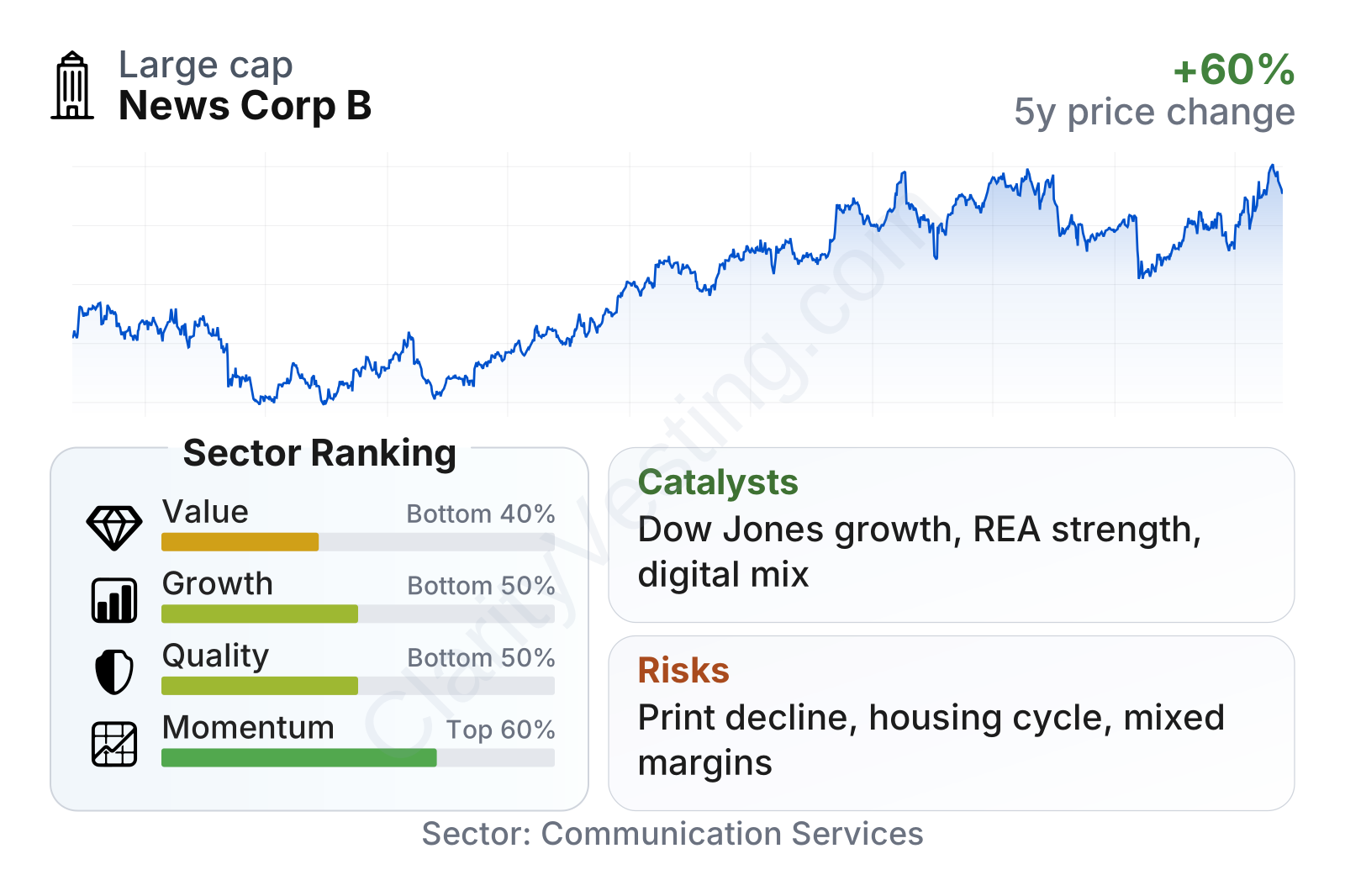
News Corp is a large but not mega-cap media and information company, with a share price that has risen strongly over the last three years despite some pullback over the past year. The latest factor picture is mixed. Growth and quality rank in the lower half of the sector, but momentum ranks in the upper half, showing that market performance has still been relatively resilient over a longer period.
Valuation looks less attractive on simple earnings and cash flow measures. The earnings multiple is well above the sector median, while free cash flow yield is notably lower than the typical peer. On the positive side, leverage is conservative: debt relative to equity and net debt relative to EBIT both sit below sector norms, which gives the company more flexibility than many media peers.
Growth
News Corp operates in a mixed industry backdrop. Traditional print news is a mature or declining area in many markets, but several of the company’s key assets are tied to healthier long-term themes: digital subscriptions, professional information services, and online real estate marketplaces. That makes the company more relevant to current media trends than its legacy image might suggest.
Its strategy for future growth is reasonably coherent. Dow Jones continues to build recurring revenue through consumer and enterprise subscriptions, licensing, and professional data products. REA Group remains one of the strongest digital property platforms in Australia, and Move gives News Corp exposure to the large U.S. housing listings market through Realtor.com. HarperCollins adds a different kind of durable content business, where popular intellectual property can be monetized across formats over time.
Recent revenue trends have improved meaningfully. After a period of declines through 2023 and part of 2024, year-over-year growth turned positive again and accelerated into 2026, reaching a low-double-digit pace most recently. That rebound suggests the company is benefiting from a healthier operating mix and easier comparisons, rather than remaining stuck in a flat legacy-media pattern.
Cash generation remains an important part of the long-term picture. Free cash flow has been positive and substantial, even though it has not moved in a straight line and has come down from prior highs. That inconsistency limits how aggressive the growth case can be, but the business still demonstrates an ability to convert earnings into real cash over time.
A notable recent opportunity is News Corp’s continued emphasis on higher-value subscription and digital products, especially at Dow Jones. The company has also highlighted product development around data, licensing, and digital tools, which could gradually improve revenue quality. In digital real estate, any sustained recovery in housing activity could act as an external tailwind, particularly for listing and advertising volumes.
Risks
This article is for informational purposes only and does not constitute financial advice. Some content is AI-generated. See Disclaimer


