Stock Analysis · Navitas Semiconductor Corp (NVTS)
Overview
Navitas Semiconductor Corp designs and sells power semiconductors used to convert and manage electricity more efficiently. In simple terms, its chips help electronic devices waste less energy, charge faster, run cooler, and become smaller. The company is best known for using newer semiconductor materials instead of traditional silicon, especially gallium nitride, usually called GaN, and silicon carbide, usually called SiC.
Its products are used in several end markets, including mobile fast chargers, consumer electronics, data centers, solar and energy storage systems, electric vehicles, and industrial power equipment. The long-term theme behind the business is clear: as the world electrifies, power conversion becomes more important, and efficiency standards become stricter.
Based on recent company filings, Navitas reports revenue mainly by product technology rather than by end market. The broad revenue mix can be summarized as follows:
- Gallium nitride power ICs and related solutions: approximately 55% to 65% of revenue in recent periods. This category includes fast-charging, consumer, appliance, and some data-center applications, and it has historically been the company’s original core business.
- Silicon carbide products: approximately 35% to 45% of revenue in recent periods. This category is tied more closely to higher-power uses such as EV, solar, storage, and industrial systems, and has become strategically important after the GeneSiC acquisition.
Geographically, revenue is diversified across Asia, Europe, and North America, with Asia remaining an important manufacturing and electronics demand center. The customer base includes both direct customers and sales through distribution channels, which is typical for a semiconductor company of this size.
The business model is also relatively asset-light compared with integrated chip manufacturers. Navitas focuses on design, process know-how, system integration, and customer qualification, while relying on external manufacturing partners for wafer fabrication, assembly, and testing. That can support scalability, but it also means execution depends heavily on partner capacity, product yields, and customer adoption cycles.
The revenue base expanded sharply through 2024 from a much smaller starting point, but spending on research, development, and commercialization has remained high relative to sales. That helps explain why the company has built meaningful technological reach before reaching sustained profitability.
Key Figures
| Metric | Value | Sector ⓘ |
|---|---|---|
| Date | Sep 12, 2026 | |
| Context | ||
| Sector | Technology | |
| Industry | Semiconductors | |
| Market Cap ⓘ | $2.91B | |
| Beta ⓘ | 3.88 | |
Value (Cheapness) | ||
| P/E Ratio ⓘ | N/A | 29.51 |
| FCF Yield ⓘ | -2.33% | 4.25% |
| EBIT / EV ⓘ | -4.50% | 2.85% |
| PEG ⓘ | N/A | |
Growth (Business expansion) | ||
| Revenue Growth ⓘ | -27.30% | 15.40% |
| RPS Growth (5Y CAGR) ⓘ | -22.08% | 8.56% |
| EPS Growth (5Y CAGR) ⓘ | -21.52% | -11.88% |
| Margin Growth (5Y Trend) ⓘ | N/A | 0.46% |
| FCF Growth (5Y CAGR) ⓘ | N/A | 9.80% |
Quality (Business durability) | ||
| ROIC (Latest) ⓘ | -17.07% | 9.44% |
| ROIC (5Y Median) ⓘ | -20.93% | 8.30% |
| Net Debt / EBIT (Latest) ⓘ | N/A | 0.54 |
| Net Debt / EBIT (5Y Median) ⓘ | N/A | 0.44 |
| Operating Margin (Latest) ⓘ | -304.93% | 9.58% |
| Operating Margin (5Y Median) ⓘ | -184.34% | 8.25% |
| Debt to Equity (Latest) ⓘ | 0.64% | 33.33% |
| Profit Margin (Latest) ⓘ | N/A | 7.14% |
| Free Cash Flow (Latest) ⓘ | -$67.85M | |
Momentum (Price trend) | ||
| 3Y Return ⓘ | +43.94% | +45.48% |
| 12M Return (excl. last month) ⓘ | +100.14% | +23.48% |
| 6M Return ⓘ | +16.53% | +20.93% |
| Price vs. 200-Day MA ⓘ | -10.46% | +7.43% |
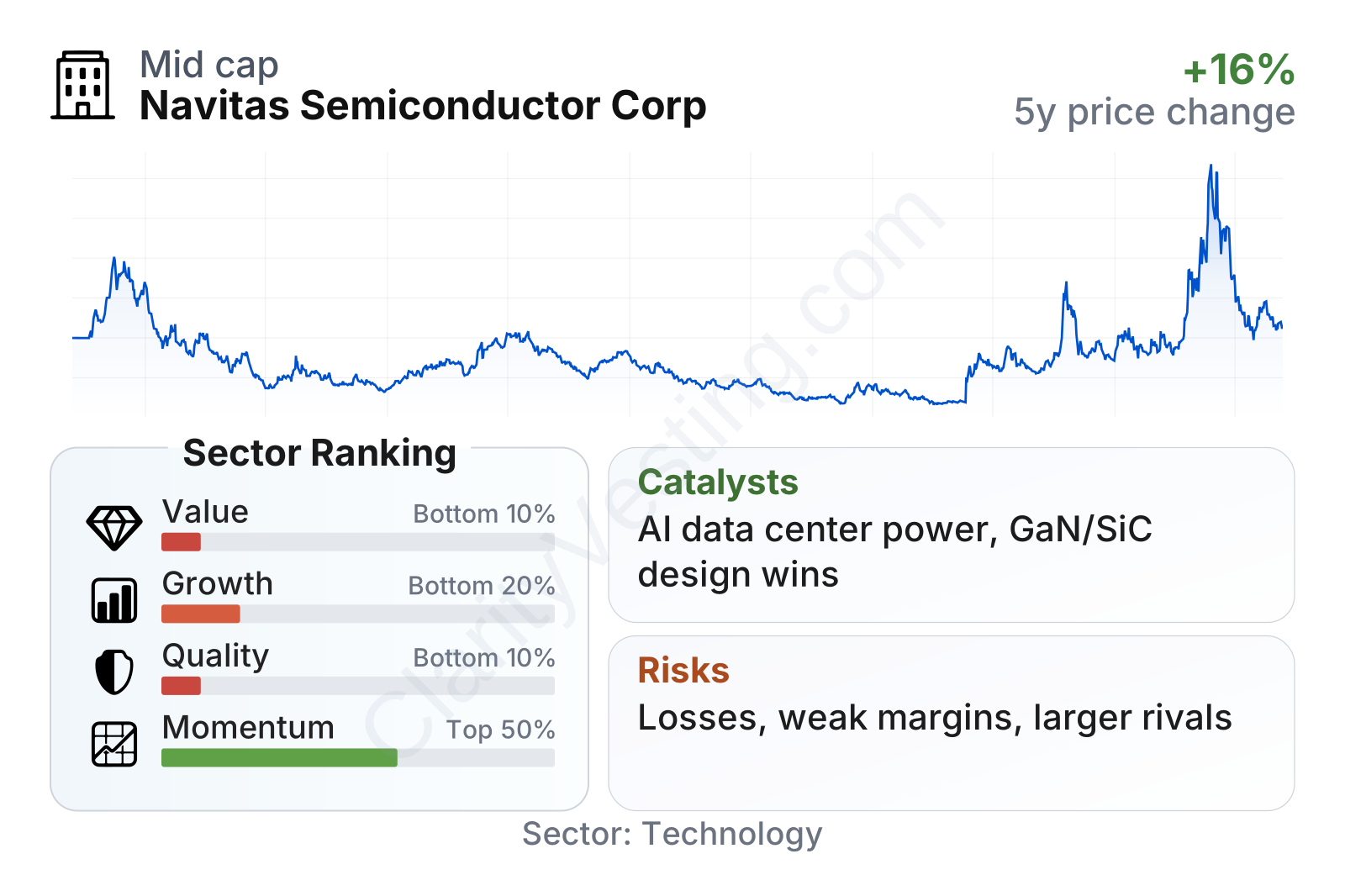
Navitas remains a small-cap semiconductor company with unusually high share-price volatility, reflected in a beta well above the sector norm. The factor picture is mixed but clear: momentum has improved strongly over the past year, while value, quality, and growth metrics still rank near the bottom of the semiconductor group. In practice, that means the market has recently become more optimistic, but the underlying financial profile is still weak compared with established peers.
The stock’s path since listing has also been uneven. After a prolonged decline, the shares rebounded sharply into 2026. That kind of move often signals rising expectations around future demand rather than proof that the business model has already matured.
Growth
Navitas operates in a part of the semiconductor market with strong structural tailwinds. Power electronics sits at the center of several long-term trends: electrification of vehicles, growth in renewable energy and battery storage, rising power demand in AI data centers, and tighter energy-efficiency rules across consumer and industrial products. These are attractive markets because better power chips can deliver measurable customer benefits such as lower energy loss, smaller system size, and faster charging.
The company’s strategy is coherent for that environment. Rather than competing broadly across all semiconductors, it is focused on next-generation power devices where GaN and SiC can outperform traditional silicon in certain applications. GaN is especially attractive in lower- to mid-power, high-frequency uses like fast chargers and compact power supplies. SiC is more relevant in higher-voltage and higher-power uses such as solar inverters, EV systems, and industrial energy infrastructure. Having both platforms gives Navitas a wider product map and a better chance of selling into multiple growth markets.
That said, the recent revenue trend has been weak. After very strong growth during 2023 and early 2024, sales turned negative on a year-over-year basis and remained under pressure through 2025 and into 2026. The latest decline of roughly 27% year over year is well below the semiconductor sector median, showing that the company is still working through a difficult demand and customer-concentration phase rather than enjoying smooth expansion.
Recent company updates still point to several meaningful commercial opportunities. Navitas has continued to highlight design wins and platform progress in AI data center power, EV charging, solar, energy storage, and high-efficiency power supplies. These matter because qualification cycles in power semiconductors are often long; once a product is designed into a system, it can produce revenue over multiple years. The strongest potential catalyst is broad adoption in data-center and AI-related power architecture, where efficiency, power density, and thermal performance are becoming more valuable as racks consume more electricity.
Another visible catalyst is the push for higher-voltage fast charging and onboard power conversion in electric mobility, along with industrial and energy customers looking for efficiency gains. The company has also pursued partnerships with major ecosystem players and reference designs that can shorten customer development time. For a smaller chip company, that is an important route to scale.
Cash generation remains the missing piece. Free cash flow has stayed negative for years, although the burn rate improved somewhat from the worst levels. That suggests Navitas is still in the investment and market-building phase. For long-term analysis, the key question is not whether the end markets are attractive—they are—but whether the company can convert technical relevance into durable, profitable volume.
Risks
This article is for informational purposes only and does not constitute financial advice. Some content is AI-generated. See Disclaimer


