Stock Analysis · Nova Ltd (NVMI)
Overview
Nova Ltd is a semiconductor equipment company focused on metrology and process control. In simple terms, it makes the tools chip manufacturers use to measure, inspect, and monitor wafers during production so defects can be caught early and yields can improve. Its customers are advanced logic, memory, and foundry manufacturers that need tighter control as chip structures become smaller, more complex, and more three-dimensional.
The company’s business is built around hardware systems, software, and related services. Based on company reporting, revenue is mainly generated from product sales, with service and support representing a smaller but recurring layer.
- Product revenue: approximately 85% to 90% of total revenue in recent years. This includes metrology platforms for dimensional, materials, and chemical analysis, as well as process control systems used in front-end semiconductor manufacturing.
- Service revenue: approximately 10% to 15% of total revenue. This includes maintenance, support, spare parts, and other customer service activity tied to the installed base of tools.
Within products, Nova is especially known for optical metrology and materials metrology, two areas that have become more important as chipmakers move to advanced nodes, gate-all-around structures, advanced packaging, and high-bandwidth memory. Geographically, the business is exposed to major semiconductor manufacturing regions in Asia, the United States, and Europe, although customer concentration can be meaningful because the industry itself is dominated by a limited number of very large chipmakers.
The business mix also shows a favorable economic pattern: revenue has expanded strongly over the last several years while gross profit, operating profit, and net income have risen faster than operating expenses. Research and development spending has also grown materially, which matters in a market where tool performance and accuracy are core competitive factors.
From 2021 through 2025, revenue more than doubled while profitability improved at the same time. That combination suggests Nova has been scaling without sacrificing margins, even while continuing to invest heavily in research and development.
Key Figures
| Metric | Value | Sector ⓘ |
|---|---|---|
| Date | Sep 12, 2026 | |
| Context | ||
| Sector | Technology | |
| Industry | Semiconductor Equipment & Materials | |
| Market Cap ⓘ | $11.83B | |
| Beta ⓘ | 1.75 | |
Value (Cheapness) | ||
| P/E Ratio ⓘ | 45.62 | 29.51 |
| FCF Yield ⓘ | 1.60% | 4.25% |
| EBIT / EV ⓘ | 2.68% | 2.85% |
| PEG ⓘ | 1.46 | |
Growth (Business expansion) | ||
| Revenue Growth ⓘ | 15.90% | 15.40% |
| RPS Growth (5Y CAGR) ⓘ | 17.77% | 8.56% |
| EPS Growth (5Y CAGR) ⓘ | -2.21% | -11.88% |
| Margin Growth (5Y Trend) ⓘ | 1.77% | 0.46% |
| FCF Growth (5Y CAGR) ⓘ | 14.35% | 9.80% |
Quality (Business durability) | ||
| ROIC (Latest) ⓘ | 23.93% | 9.44% |
| ROIC (5Y Median) ⓘ | 24.05% | 8.30% |
| Net Debt / EBIT (Latest) ⓘ | 2.22 | 0.54 |
| Net Debt / EBIT (5Y Median) ⓘ | 0.84 | 0.44 |
| Operating Margin (Latest) ⓘ | 32.68% | 9.58% |
| Operating Margin (5Y Median) ⓘ | 29.04% | 8.25% |
| Debt to Equity (Latest) ⓘ | 54.84% | 33.33% |
| Profit Margin (Latest) ⓘ | 28.84% | 7.14% |
| Free Cash Flow (Latest) ⓘ | $189.75M | |
Momentum (Price trend) | ||
| 3Y Return ⓘ | +217.57% | +45.48% |
| 12M Return (excl. last month) ⓘ | +49.50% | +23.48% |
| 6M Return ⓘ | -11.50% | +20.93% |
| Price vs. 200-Day MA ⓘ | -15.43% | +7.43% |
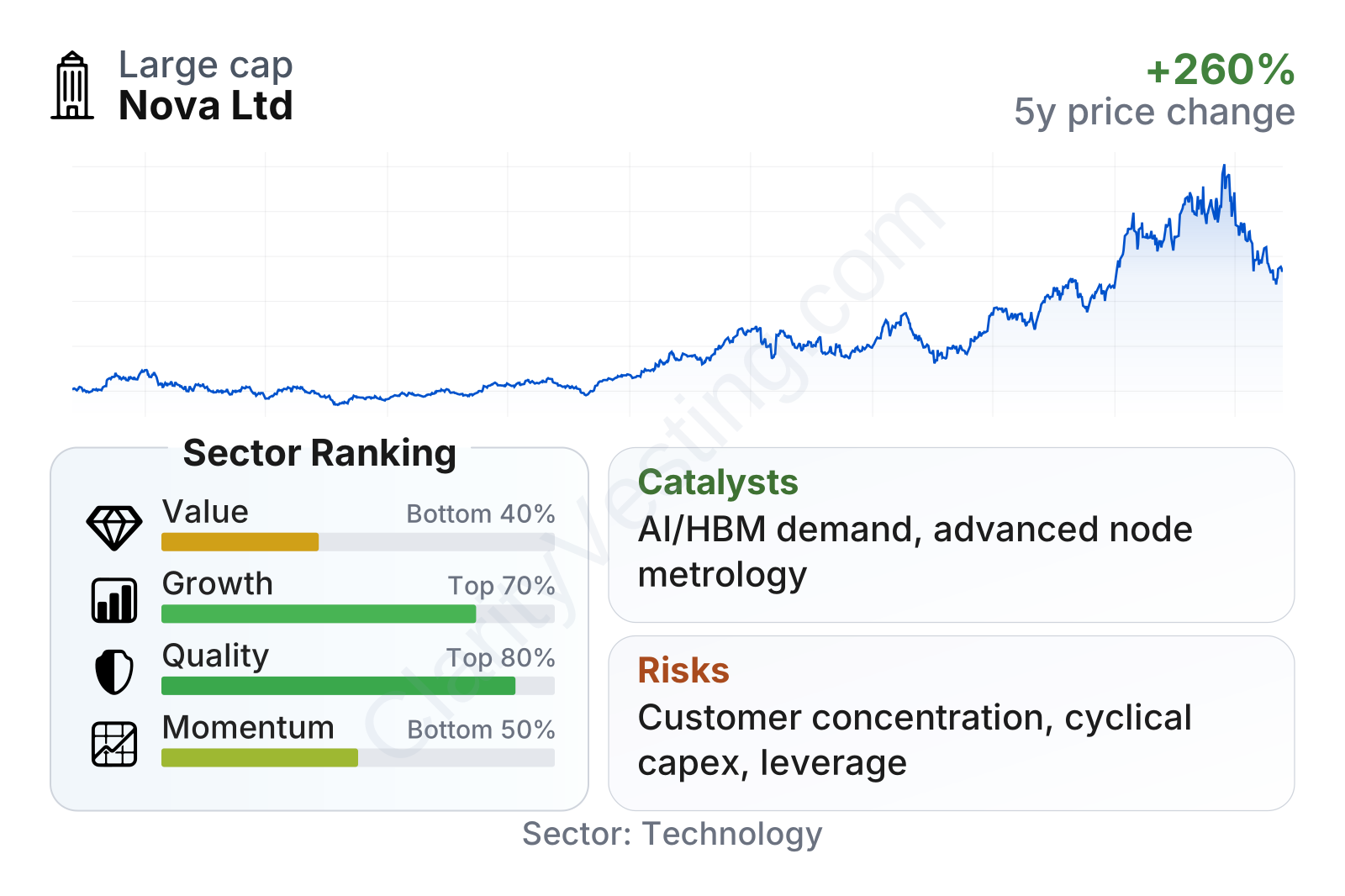
Nova sits in the larger mid-cap range, and the stock has shown high volatility, with a beta well above 1. The factor profile is unusual in a positive way on operations but more demanding on price: growth ranks above much of the sector, quality is especially strong, and momentum has been good over longer periods even after a weaker recent stretch. The weaker area is valuation, where the shares trade at noticeably richer earnings and cash flow multiples than the sector median.
The long-term share-price trend has been powerful, but the path has not been smooth. After a sharp climb over the past three years, the stock also experienced sizable pullbacks along the way, which is typical for semiconductor equipment names tied to cyclical spending plans.
Growth
Nova operates in a structurally growing part of the semiconductor industry. As chips become more advanced, manufacturers need more measurement steps, tighter process control, and better analytics. That creates a tailwind for metrology and inspection suppliers because complexity rises even when wafer volumes do not. In other words, a more difficult manufacturing process can increase demand for Nova’s tools even before total industry capacity expands.
The company’s strategy appears aligned with that trend. It has been broadening from traditional optical metrology into adjacent areas such as materials metrology and chemical analysis, which can deepen its role inside customer production lines. That matters because chipmakers increasingly want integrated control across more steps of fabrication rather than isolated measurements. A broader portfolio can also raise revenue per customer and make the relationship stickier over time.
Revenue growth has been cyclical, which is normal for the industry, but the pattern is still encouraging. After a downturn in 2023, growth reaccelerated strongly through 2024 and 2025 before moderating into 2026. Even with that slowdown, current year-over-year growth remains positive and near the sector median, while the five-year revenue-per-share growth rate is comfortably ahead of many peers.
Cash generation also supports the growth case. Free cash flow has risen meaningfully over the last several years, with only a modest pullback most recently after a very strong prior level. That suggests the company is not relying only on accounting profits; it is also turning a meaningful share of earnings into cash that can support development, acquisitions, and balance-sheet flexibility.
Several industry catalysts could remain important. Advanced logic transitions, high-bandwidth memory demand tied to AI infrastructure, and increasingly complex packaging all require more process control. Nova has also emphasized software, analytics, and integrated solutions, which could help it capture a larger slice of customer spending per manufacturing step. Recent company communications have pointed to continued demand related to advanced nodes and materials characterization, reinforcing the idea that its addressable market is expanding rather than standing still.
Risks
This article is for informational purposes only and does not constitute financial advice. Some content is AI-generated. See Disclaimer


