Stock Analysis · NVIDIA Corporation (NVDA)
Overview
NVIDIA designs computing chips and the software that makes those chips useful. The company is best known for graphics processing units, or GPUs, which were originally popular in video games but are now central to artificial intelligence, high-performance computing, data centers, robotics, and some automotive systems. Over time, NVIDIA has expanded from being mainly a chip designer into a broader computing platform company, combining semiconductors, networking equipment, and software tools such as CUDA that help developers build AI applications.
Its business is now heavily led by data center demand, especially for AI training and AI inference. In its most recent fiscal year ended January 26, 2026, revenue reached about $215.9 billion, far above prior years. Based on company reporting, the revenue mix is approximately:
- Data Center: about 91% — AI accelerators, GPU computing platforms, networking products from InfiniBand and Ethernet, and related systems used by cloud providers, enterprises, and research customers.
- Gaming: about 5% — GeForce GPUs, gaming laptops, and related consumer graphics products.
- Professional Visualization: about 2% — workstation graphics and software for designers, engineers, and 3D content creation.
- Automotive and Robotics: about 1% — hardware and software for autonomous driving, advanced driver assistance, and embedded computing platforms.
- OEM and Other: below 1% — legacy and miscellaneous products.
This mix matters because it shows how dramatically NVIDIA has become tied to AI infrastructure spending. It also helps explain the company’s unusually high profitability: revenue has risen much faster than operating costs, while research spending has continued to increase in absolute dollars. Over the last several years, gross profit, operating income, and net income all expanded much faster than expenses, showing very strong operating leverage.
The business model has become more efficient as scale increased. Revenue rose from roughly $26.9 billion in fiscal 2022 to about $215.9 billion in fiscal 2026, while operating expenses grew much more slowly. Research and development remains large in dollar terms, but it now represents a smaller share of revenue than before because sales have expanded so quickly.
Key Figures
| Metric | Value | Sector ⓘ |
|---|---|---|
| Date | Sep 12, 2026 | |
| Context | ||
| Sector | Technology | |
| Industry | Semiconductors | |
| Market Cap ⓘ | $5.27T | |
| Beta ⓘ | 2.22 | |
Value (Cheapness) | ||
| P/E Ratio ⓘ | 27.63 | 29.51 |
| FCF Yield ⓘ | 2.41% | 4.25% |
| EBIT / EV ⓘ | 4.38% | 2.85% |
| PEG ⓘ | 0.55 | |
Growth (Business expansion) | ||
| Revenue Growth ⓘ | 105.90% | 15.40% |
| RPS Growth (5Y CAGR) ⓘ | 69.72% | 8.56% |
| EPS Growth (5Y CAGR) ⓘ | 104.91% | -11.88% |
| Margin Growth (5Y Trend) ⓘ | 27.81% | 0.46% |
| FCF Growth (5Y CAGR) ⓘ | 85.69% | 9.80% |
Quality (Business durability) | ||
| ROIC (Latest) ⓘ | 101.70% | 9.44% |
| ROIC (5Y Median) ⓘ | 94.24% | 8.30% |
| Net Debt / EBIT (Latest) ⓘ | 0.07 | 0.54 |
| Net Debt / EBIT (5Y Median) ⓘ | 0.11 | 0.44 |
| Operating Margin (Latest) ⓘ | 75.91% | 9.58% |
| Operating Margin (5Y Median) ⓘ | 55.93% | 8.25% |
| Debt to Equity (Latest) ⓘ | 16.97% | 33.33% |
| Profit Margin (Latest) ⓘ | 63.66% | 7.14% |
| Free Cash Flow (Latest) ⓘ | $127.01B | |
Momentum (Price trend) | ||
| 3Y Return ⓘ | +387.95% | +45.48% |
| 12M Return (excl. last month) ⓘ | +22.51% | +23.48% |
| 6M Return ⓘ | +19.47% | +20.93% |
| Price vs. 200-Day MA ⓘ | +10.75% | +7.43% |
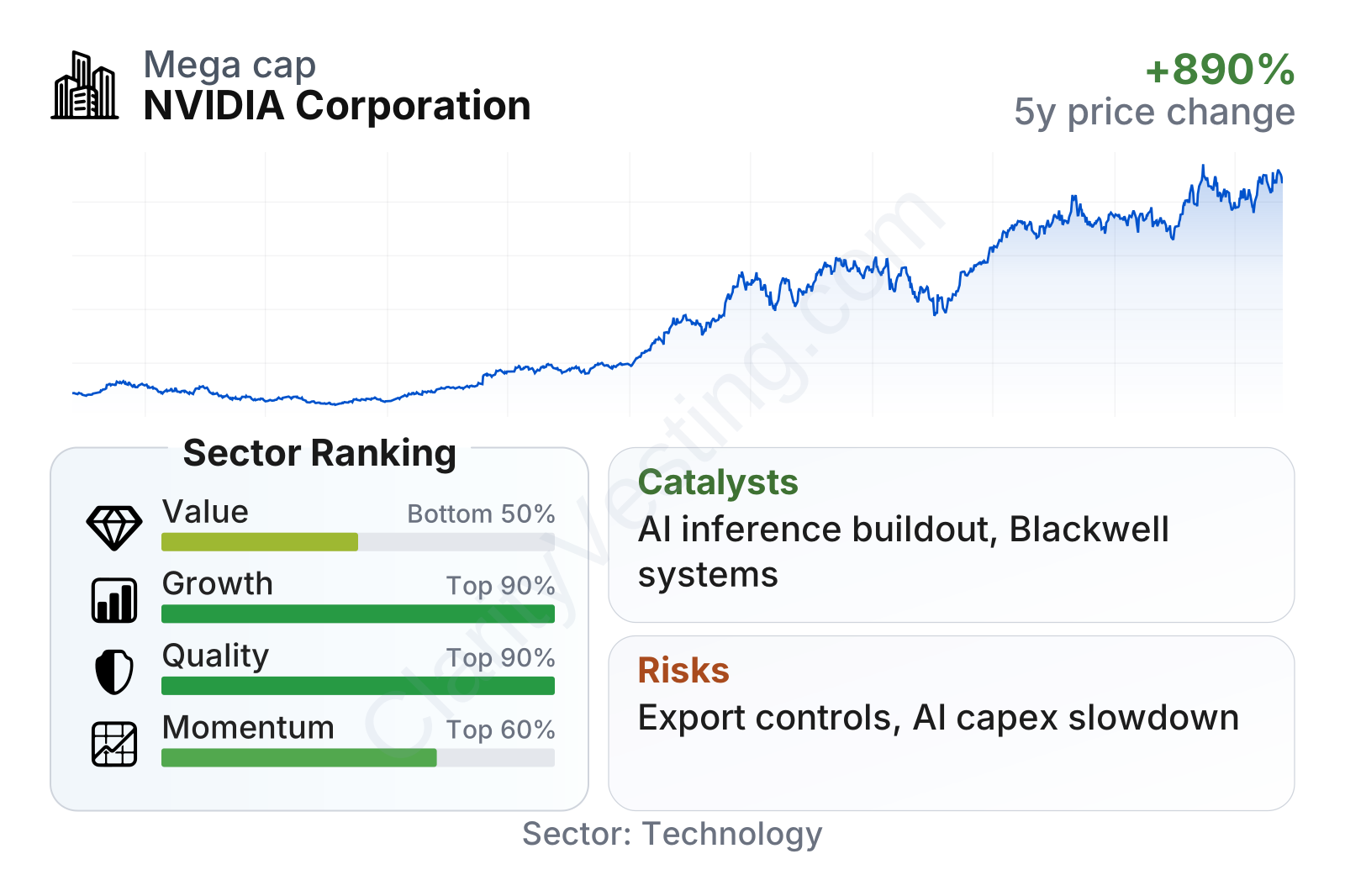
NVIDIA is one of the largest companies in the market, and its share price has been very volatile despite a strong long-term rise. The metrics point to an unusual combination: growth and quality rank near the top of the semiconductor sector, while value looks less compelling on cash-flow yield measures. Profitability, returns on capital, and balance-sheet strength stand well above typical sector levels, which helps explain why the market continues to assign the company a premium profile even after earnings have grown into part of that valuation.
Growth
NVIDIA operates in one of the most attractive areas of technology: accelerated computing and artificial intelligence infrastructure. Demand is being driven by cloud providers, large enterprises, governments, and AI developers that need enormous computing power for training models and then running them at scale. This is not only a hardware trend. NVIDIA’s position is reinforced by software, networking, developer tools, and a broad ecosystem that makes its platforms easier to adopt and harder to replace.
The company’s strategy is coherent for future growth because it addresses the full AI stack. Instead of selling only chips, NVIDIA packages GPUs, interconnects, systems, and software into an integrated platform. That approach can support higher pricing, deepen customer dependence, and expand the company’s reach into newer workloads such as inference, enterprise AI, industrial digital twins, sovereign AI infrastructure, and robotics.
Revenue growth has been extraordinary. After a weaker period in 2022 and early 2023, NVIDIA moved into a surge that reached triple-digit year-over-year growth at several points. Growth has naturally become harder to sustain at the same pace because the revenue base is now much larger, but the latest readings still indicate expansion far above normal semiconductor industry levels.
Cash generation has followed the same direction. Free cash flow climbed from single-digit billions a few years ago to well above $90 billion on a trailing basis by early 2026, reflecting both rising sales and exceptional margins. This gives NVIDIA significant flexibility to fund research, secure supply, repurchase stock, and invest in new platforms without straining the balance sheet.
A major catalyst remains the shift from AI training to AI inference at scale. Training large models created the initial wave of demand, but running AI applications for millions of users can create a second, more durable layer of spending. NVIDIA has also continued introducing new architectures and complete rack-scale systems, which can increase revenue per customer deployment. Recent company communications have highlighted continuing hyperscale and enterprise demand, as well as expanding interest from countries and corporations building their own AI infrastructure.
Risks
This article is for informational purposes only and does not constitute financial advice. Some content is AI-generated. See Disclaimer


