Stock Analysis · Nutanix Inc (NTNX)
Overview
Nutanix is an infrastructure software company. In simple terms, it helps businesses run data centers, private clouds, and hybrid multi-cloud environments with software that is designed to make computing, storage, networking, and management work together more easily. Its platform is often used by enterprises that want a cloud-like experience inside their own facilities or across a mix of on-premise systems and public cloud services.
The company’s core offering is the Nutanix Cloud Platform, which includes software for hyperconverged infrastructure, virtualization, cloud management, database and application operations, and disaster recovery. Nutanix has increasingly positioned itself as a subscription software business rather than a hardware-linked product vendor, which matters because recurring software revenue is usually more predictable than one-time product sales.
Revenue is now overwhelmingly subscription-based. Based on recent annual reporting, the business mix is approximately as follows:
- Subscription revenue: about 93% to 95% of total revenue. This includes term-based software subscriptions, SaaS offerings, support attached to subscriptions, and cloud platform products sold under recurring contracts.
- Professional services: about 5% to 7% of total revenue. This includes deployment, consulting, training, and implementation work that helps customers adopt and operate Nutanix software.
Within the business, another important indicator is annual recurring revenue, which reflects the value of contracted subscription revenue expected to repeat over a year. That measure has become a central operating focus as Nutanix continues moving customers toward multi-year recurring contracts.
The company serves a broad enterprise customer base, including large corporations, government organizations, healthcare providers, and universities. It sells through both direct sales and channel partners, and strategic alliances with major hardware and cloud providers remain important to distribution and adoption.
The financial flow over the last few years shows a clear shift: revenue has risen steadily, gross profit has expanded, operating income moved from negative to positive, and interest expense has fallen sharply. The most recent net income figure is unusually strong because of a large tax-related benefit, so operating profit and cash generation are more useful than bottom-line profit alone for judging the underlying business trend.
Key Figures
| Metric | Value | Sector ⓘ |
|---|---|---|
| Date | Sep 12, 2026 | |
| Context | ||
| Sector | Technology | |
| Industry | Software - Infrastructure | |
| Market Cap ⓘ | $17.68B | |
| Beta ⓘ | 0.62 | |
Value (Cheapness) | ||
| P/E Ratio ⓘ | 12.65 | 29.51 |
| FCF Yield ⓘ | 4.75% | 4.25% |
| EBIT / EV ⓘ | 1.91% | 2.85% |
| PEG ⓘ | 1.37 | |
Growth (Business expansion) | ||
| Revenue Growth ⓘ | 15.90% | 15.40% |
| RPS Growth (5Y CAGR) ⓘ | 7.99% | 8.56% |
| EPS Growth (5Y CAGR) ⓘ | N/A | -11.88% |
| Margin Growth (5Y Trend) ⓘ | 57.04% | 0.46% |
| FCF Growth (5Y CAGR) ⓘ | 159.69% | 9.80% |
Quality (Business durability) | ||
| ROIC (Latest) ⓘ | 43.67% | 9.44% |
| ROIC (5Y Median) ⓘ | 30.11% | 8.30% |
| Net Debt / EBIT (Latest) ⓘ | 2.25 | 0.54 |
| Net Debt / EBIT (5Y Median) ⓘ | 2.25 | 0.44 |
| Operating Margin (Latest) ⓘ | 11.56% | 9.58% |
| Operating Margin (5Y Median) ⓘ | 3.17% | 8.25% |
| Debt to Equity (Latest) ⓘ | 216.17% | 33.33% |
| Profit Margin (Latest) ⓘ | 52.81% | 7.14% |
| Free Cash Flow (Latest) ⓘ | $840.67M | |
Momentum (Price trend) | ||
| 3Y Return ⓘ | +82.02% | +45.48% |
| 12M Return (excl. last month) ⓘ | -6.78% | +23.48% |
| 6M Return ⓘ | +68.46% | +20.93% |
| Price vs. 200-Day MA ⓘ | +34.61% | +7.43% |
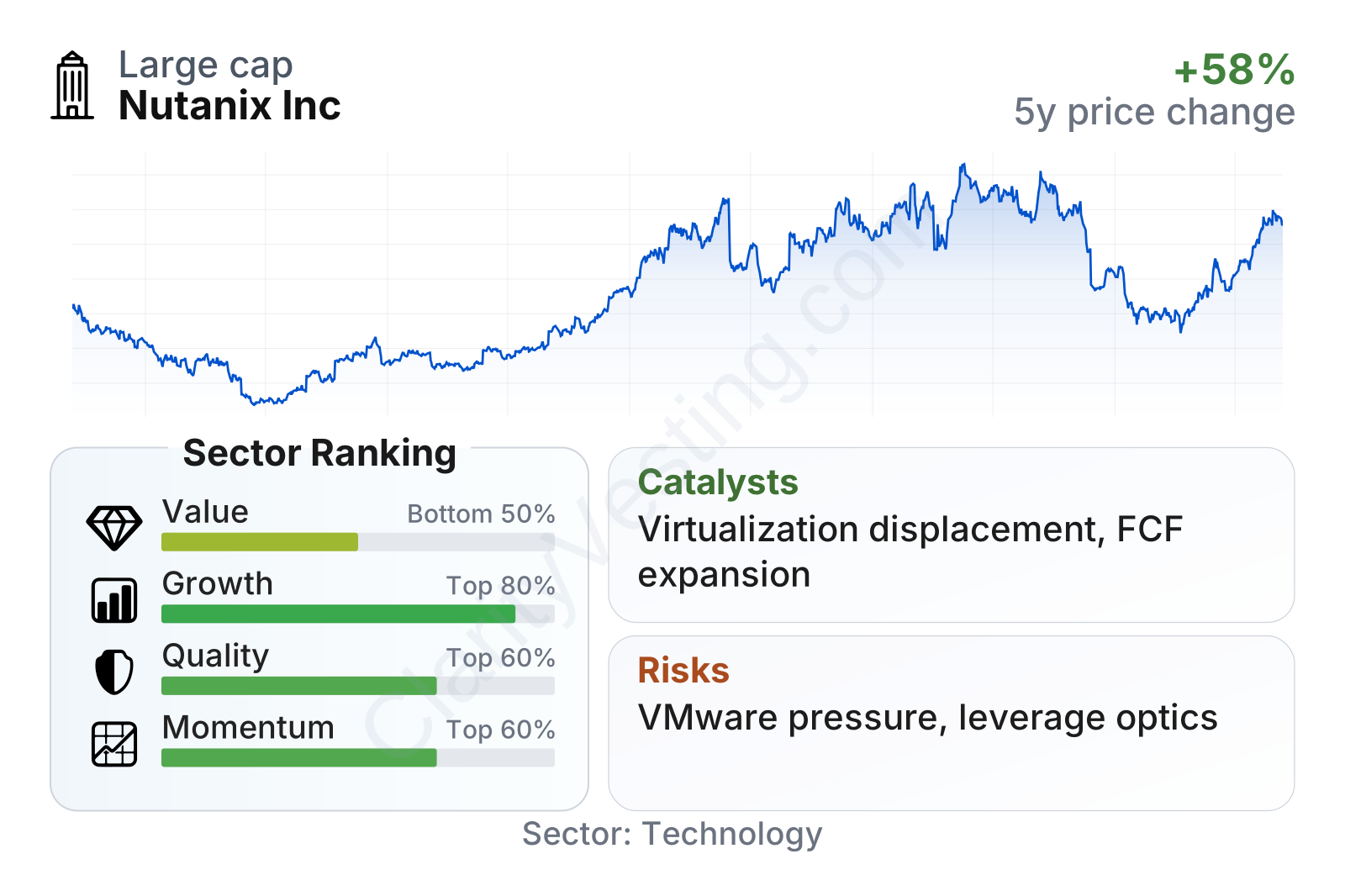
Nutanix is now a mid-to-large infrastructure software company with a stock that has been volatile but has performed strongly over the last three years despite a major pullback after late 2025. In the latest factor snapshot, growth ranks in the top 80% of its sector and quality in the top 60%, reflecting solid execution, improving margins, and strong cash generation. Value metrics look mixed: the earnings multiple is below the sector median, but enterprise-value-based profitability measures are less favorable. The balance sheet remains an area to watch because leverage measures are well above the sector median.
Growth
Nutanix operates in a part of technology that still has room to expand. Many companies are trying to modernize old data center systems, manage applications across multiple environments, and keep more control over where data and workloads run. That is favorable for vendors that offer private cloud and hybrid cloud software. Nutanix sits in that lane rather than competing only as a pure public cloud provider.
Its strategy also looks coherent. The company has spent years moving from hardware-tied deals and perpetual licenses toward recurring subscriptions. That transition can temporarily distort traditional accounting comparisons, but over time it usually creates more stable revenue, better visibility, and stronger free cash flow if customer retention remains healthy.
Revenue growth has generally stayed around the low-teens to low-20s range, with only one clear dip several years ago. More recently, growth slowed toward about 10% before reaccelerating back toward the mid-teens. That pattern suggests Nutanix is no longer an early hypergrowth company, but it is still expanding at a respectable rate for enterprise infrastructure software.
One of the strongest parts of the growth profile is cash generation. Free cash flow has improved from negative territory a few years ago to well over $700 million on a trailing basis, with a five-year compound growth rate far above the sector median. That matters because it shows the subscription model is not only lifting reported revenue quality, but also turning into real cash that can support product investment, debt management, and operating flexibility.
A major catalyst for future expansion is the company’s push beyond core hyperconverged infrastructure into a broader platform approach. Nutanix has been promoting its own virtualization layer and management tools as alternatives for customers reassessing incumbent platforms. Changes in the virtualization market have created an opening for enterprises that want to reduce dependence on traditional vendors, and Nutanix has been trying to capture that migration demand.
Another growth support is partnerships. Nutanix has worked with large server makers, cloud providers, and channel partners to make adoption easier in enterprise environments. That can help the company reach customers that prefer integrated, lower-risk deployments rather than building cloud infrastructure from scratch.
Recent company communications have also emphasized AI-ready infrastructure, cloud-native application support, and cross-environment management. Those themes are important because many organizations want to run newer workloads without fully abandoning existing on-premise investments. Nutanix’s value proposition becomes stronger if it can remain the software layer that simplifies that mix.
Risks
This article is for informational purposes only and does not constitute financial advice. Some content is AI-generated. See Disclaimer