Stock Analysis · NetScout Systems Inc (NTCT)
Overview
NetScout Systems is a network performance, cybersecurity, and service assurance company. In simple terms, its software and hardware help enterprises, telecom operators, cloud providers, and public-sector organizations keep digital networks running smoothly, detect outages, measure application performance, and respond to cyberattacks such as distributed denial-of-service, or DDoS, attacks. The company is especially known for deep network visibility: it captures and analyzes traffic moving across complex networks so customers can understand what is happening in real time.
The business is organized around one main reporting segment, but its revenue is commonly described through product and customer mix disclosures in company filings. Based on recent annual reporting, the main revenue sources are approximately:
- Service assurance and observability solutions: about 70% to 75% of revenue. This includes tools used by telecom carriers, enterprises, and government customers to monitor network health, application performance, and user experience.
- Cybersecurity solutions: about 25% to 30% of revenue. This mainly includes DDoS protection and threat intelligence offerings, notably under the Arbor brand.
- Recurring support and maintenance: a meaningful share inside both categories. NetScout sells a mix of software, appliances, and related maintenance contracts, so a notable portion of sales repeats after the initial deployment, even though the company does not present its business as a pure subscription software model.
Customer concentration also matters. A substantial part of revenue comes from service providers and large enterprises with complex network environments. That gives NetScout exposure to mission-critical infrastructure spending, but it also means sales cycles can be long and linked to capital spending plans at large customers.
The company’s operating profile is that of a mature infrastructure software and systems vendor: high gross margins, steady cash generation, and slower long-term expansion than faster-growing cloud software peers. Its role is less about consumer-facing technology and more about being an essential behind-the-scenes supplier for digital resilience.
The financial flow over the last several years shows a business with consistently strong gross profit, but with earnings that became distorted in fiscal 2024 and fiscal 2025 before recovering in fiscal 2026. Research and development remains a significant cost base, which fits a company that must keep pace with increasingly complex networks and security threats.
Key Figures
| Metric | Value | Sector ⓘ |
|---|---|---|
| Date | Sep 12, 2026 | |
| Context | ||
| Sector | Technology | |
| Industry | Software - Infrastructure | |
| Market Cap ⓘ | $2.72B | |
| Beta ⓘ | 0.69 | |
Value (Cheapness) | ||
| P/E Ratio ⓘ | 22.69 | 29.51 |
| FCF Yield ⓘ | 9.48% | 4.25% |
| EBIT / EV ⓘ | 6.67% | 2.85% |
| PEG ⓘ | 1.64 | |
Growth (Business expansion) | ||
| Revenue Growth ⓘ | 12.70% | 15.40% |
| RPS Growth (5Y CAGR) ⓘ | 1.26% | 8.56% |
| EPS Growth (5Y CAGR) ⓘ | -44.67% | -11.88% |
| Margin Growth (5Y Trend) ⓘ | 8.03% | 0.46% |
| FCF Growth (5Y CAGR) ⓘ | -0.02% | 9.80% |
Quality (Business durability) | ||
| ROIC (Latest) ⓘ | 7.49% | 9.44% |
| ROIC (5Y Median) ⓘ | 1.79% | 8.30% |
| Net Debt / EBIT (Latest) ⓘ | -3.62 | 0.54 |
| Net Debt / EBIT (5Y Median) ⓘ | -3.28 | 0.44 |
| Operating Margin (Latest) ⓘ | 16.03% | 9.58% |
| Operating Margin (5Y Median) ⓘ | 5.95% | 8.25% |
| Debt to Equity (Latest) ⓘ | 2.40% | 33.33% |
| Profit Margin (Latest) ⓘ | 13.71% | 7.14% |
| Free Cash Flow (Latest) ⓘ | $258.08M | |
Momentum (Price trend) | ||
| 3Y Return ⓘ | +37.02% | +45.48% |
| 12M Return (excl. last month) ⓘ | +74.58% | +23.48% |
| 6M Return ⓘ | +26.58% | +20.93% |
| Price vs. 200-Day MA ⓘ | +11.06% | +7.43% |
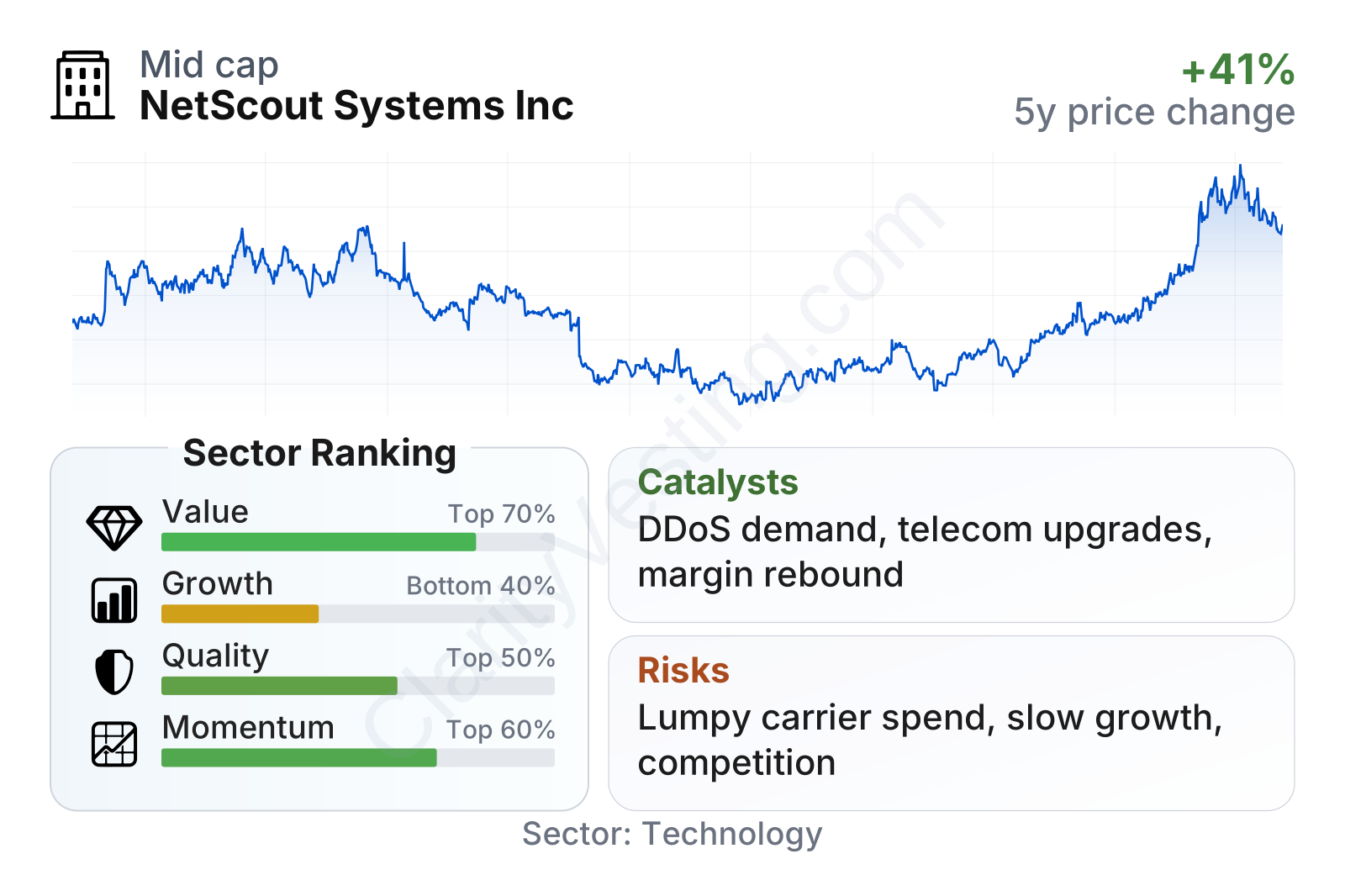
NetScout sits in the mid-cap range and its share-price volatility has been lower than the broader market, as reflected by a beta below 1. The current factor picture is mixed but understandable for a mature infrastructure name: value metrics look favorable relative to much of the technology sector, quality is supported by strong margins and a very conservative balance sheet, while growth ranks weaker because revenue and earnings expansion over multi-year periods have been inconsistent. Momentum has improved sharply over the last year, suggesting the market has been reacting positively to the earnings recovery and stronger recent execution.
Growth
NetScout operates in markets that should remain relevant for years. Network complexity is still increasing as enterprises use more cloud services, telecom operators upgrade infrastructure, and cyberattacks become more frequent and more expensive. That creates a durable need for network observability, performance management, and DDoS defense. These are not fashionable categories in the same way as artificial intelligence software, but they are foundational and often tied to uptime, compliance, and customer experience.
The company’s strategy makes sense in that context. NetScout focuses on deep packet-level visibility and on customers that run large, highly demanding environments. That positioning can be harder to replace than lighter monitoring tools, because telecom carriers, governments, and large enterprises often need very detailed traffic intelligence. The trade-off is that this is not usually a hyper-growth business; it is more dependent on large deployments, refresh cycles, and security-driven demand.
Revenue growth has been uneven over the past several years, including some negative periods, which reinforces the idea that NetScout is not on a straight-line expansion path. Still, the latest year-over-year trend has turned positive again, and that matters because it suggests the company may be moving out of a weaker stretch marked by customer caution and unusual accounting impacts.
Cash generation has recovered more convincingly than reported earnings over the last few years. Free cash flow fell sharply at one point, then rebounded back toward prior highs. That is an important sign for a long-term business assessment because it suggests the underlying operations remained more resilient than headline net income alone might have implied.
A practical catalyst is the continued rise in DDoS attacks and the need for always-on digital infrastructure. NetScout’s Arbor security franchise is positioned to benefit when enterprises, service providers, and governments increase investment in traffic visibility and attack mitigation. Another catalyst is telecom modernization: operators upgrading networks and managing heavier data loads need tools that can diagnose problems across increasingly complex architectures.
Recent company communications have also pointed to improved profitability and operational discipline after a difficult period. That does not guarantee sustained growth, but it does indicate that NetScout has recently regained financial footing rather than simply relying on cost cuts to mask weakness.
Risks
This article is for informational purposes only and does not constitute financial advice. Some content is AI-generated. See Disclaimer


