Stock Analysis · Insight Enterprises Inc (NSIT)
Overview
Insight Enterprises is a technology solutions provider that helps businesses buy, manage, and modernize their IT environments. In simple terms, it sits between major technology vendors and corporate customers, but it is more than a basic reseller. The company combines hardware and software distribution with consulting, cloud, cybersecurity, data, AI, device lifecycle, and managed services. Its customers range from large enterprises to public sector organizations and mid-sized businesses.
Revenue is mainly generated by selling technology products, while a smaller but strategically important portion comes from services and software-related solutions. Based on recent company reporting, the business mix is approximately:
- Hardware: about 70% to 75% of revenue. This includes client devices, infrastructure, networking equipment, peripherals, and other physical IT products.
- Software: about 15% to 20% of revenue. This includes software licenses, subscriptions, cloud-related software, and vendor programs.
- Services: about 10% to 15% of revenue. This includes consulting, implementation, managed services, cloud enablement, cybersecurity support, and device lifecycle services.
That mix matters because hardware typically produces very large sales volumes but thinner margins, while software and services usually carry better profitability and create stickier customer relationships. Over the last several years, Insight has been trying to move further toward these higher-value offerings even as product sales remain the foundation of the business.
The company also reports results geographically, with the United States as the core market and smaller contributions from Europe, the Middle East and Africa, and Asia-Pacific. Its scale is meaningful, but it is not the dominant player in global IT distribution. The business is best understood as a large, established technology partner operating in a competitive, low-margin part of the market while trying to build a more differentiated solutions layer on top.
The long-term pattern shows a business with declining revenue since the post-pandemic peak, but a somewhat more resilient gross profit base. That suggests the mix has been shifting gradually toward categories with better economics, even though rising operating costs and interest expense have recently put pressure on net earnings.
Key Figures
| Metric | Value | Sector ⓘ |
|---|---|---|
| Date | Sep 12, 2026 | |
| Context | ||
| Sector | Technology | |
| Industry | Electronics & Computer Distribution | |
| Market Cap ⓘ | $4.57B | |
| Beta ⓘ | 1.10 | |
Value (Cheapness) | ||
| P/E Ratio ⓘ | 23.09 | 29.51 |
| FCF Yield ⓘ | 9.25% | 4.25% |
| EBIT / EV ⓘ | 6.79% | 2.85% |
| PEG ⓘ | 0.99 | |
Growth (Business expansion) | ||
| Revenue Growth ⓘ | 14.70% | 15.40% |
| RPS Growth (5Y CAGR) ⓘ | -0.10% | 8.56% |
| EPS Growth (5Y CAGR) ⓘ | -9.40% | -11.88% |
| Margin Growth (5Y Trend) ⓘ | 0.27% | 0.46% |
| FCF Growth (5Y CAGR) ⓘ | 25.77% | 9.80% |
Quality (Business durability) | ||
| ROIC (Latest) ⓘ | 7.55% | 9.44% |
| ROIC (5Y Median) ⓘ | 12.60% | 8.30% |
| Net Debt / EBIT (Latest) ⓘ | 3.69 | 0.54 |
| Net Debt / EBIT (5Y Median) ⓘ | 2.04 | 0.44 |
| Operating Margin (Latest) ⓘ | 4.22% | 9.58% |
| Operating Margin (5Y Median) ⓘ | 4.03% | 8.25% |
| Debt to Equity (Latest) ⓘ | 108.52% | 33.33% |
| Profit Margin (Latest) ⓘ | 2.45% | 7.14% |
| Free Cash Flow (Latest) ⓘ | $422.96M | |
Momentum (Price trend) | ||
| 3Y Return ⓘ | +9.95% | +45.48% |
| 12M Return (excl. last month) ⓘ | +20.35% | +23.48% |
| 6M Return ⓘ | +102.41% | +20.93% |
| Price vs. 200-Day MA ⓘ | +66.88% | +7.43% |
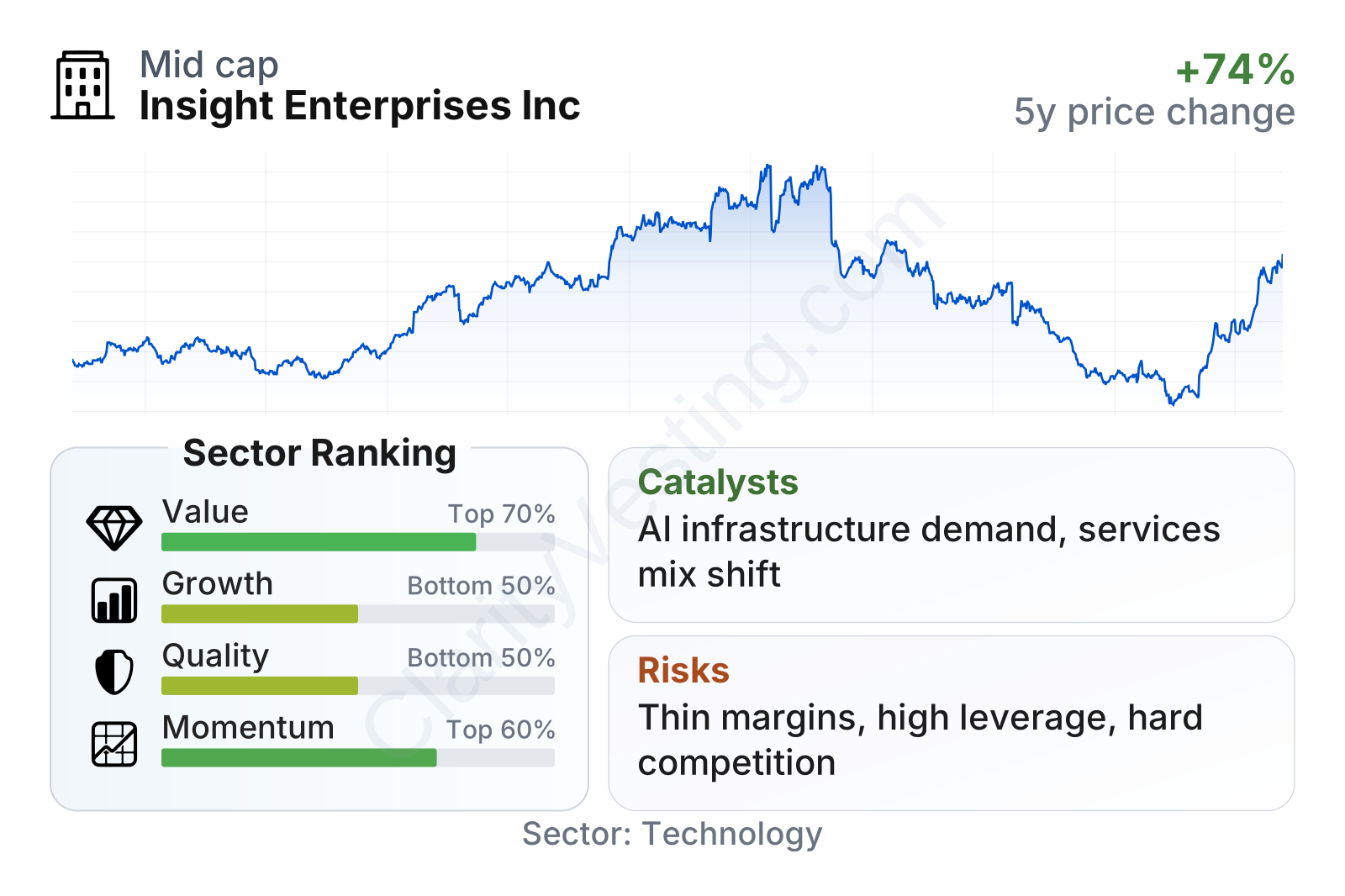
Insight is a mid-sized technology company with share-price volatility close to the broader market. The overall profile is mixed. On valuation, the company screens cheaper than the typical technology stock on earnings and cash-flow-based measures. Free cash flow generation also looks solid relative to its size. On the other hand, growth and profitability are not standout areas versus the sector, and leverage is materially higher than the typical peer. Recent market momentum has improved sharply after a weak period, but the longer three-year share-price record has lagged much of the technology sector.
Growth
Insight operates in a sector with durable long-term demand. Companies continue to spend on cloud infrastructure, cybersecurity, AI-ready systems, digital workplace tools, data platforms, and IT lifecycle management. Those are attractive themes because they are not tied to a single product cycle. Even so, Insight’s position in that demand chain is important: a meaningful share of its business still depends on customer hardware budgets, which can fluctuate with economic conditions and corporate refresh cycles.
The company’s strategy for future expansion is sensible. Management has spent years pushing the business beyond transactional product resale and toward integrated solutions and services. That includes cloud, cybersecurity, digital transformation, edge and data center work, and managed offerings. If executed well, this can improve margin quality over time because services and software are generally more profitable and less commoditized than hardware fulfillment.
Revenue growth has been uneven. After strong expansion during the pandemic-driven spending wave, sales turned negative for several quarters as hardware demand cooled and customers became more selective. More recently, growth has improved again, including a clear rebound in the latest year-over-year trend. That is encouraging, but it does not yet erase the longer pattern of choppy top-line performance.
Cash generation has been one of the stronger parts of the picture, even though it has not moved in a straight line. Free cash flow swung from negative territory in 2022 to very strong levels in 2023 and 2024, then cooled before recovering again. For a distributor and solutions provider, that matters because working capital can move sharply with inventory, receivables, and customer payment timing. The ability to keep producing meaningful cash through a cycle supports business flexibility.
A notable catalyst is the broader enterprise move toward AI infrastructure and workplace modernization. Insight is not an AI model developer, but it can benefit as customers need servers, PCs, networking, cloud architecture, software environments, and services to deploy AI in practical business settings. Another potential tailwind is the continued consolidation of IT purchasing: many organizations prefer a partner that can combine procurement, integration, and ongoing support rather than manage many vendors separately. Insight’s vendor relationships and services portfolio fit that trend.
Recent company updates have also emphasized acquisitions and capability-building in higher-value service areas. These deals are usually small relative to the total company, but they can strengthen technical expertise, deepen customer access, and gradually improve the business mix over time.
Risks
This article is for informational purposes only and does not constitute financial advice. Some content is AI-generated. See Disclaimer


