Stock Analysis · ServiceNow Inc (NOW)
Overview
ServiceNow is a cloud software company that helps large organizations manage digital workflows. In simple terms, its platform is used to organize and automate internal business processes such as IT support, employee requests, customer service, operations, and industry-specific tasks. Instead of relying on emails, spreadsheets, and disconnected tools, customers use ServiceNow to route work through a single system with built-in automation, analytics, and increasingly, artificial intelligence.
The company sells subscription software, so most of its business comes from recurring contracts rather than one-time product sales. That makes revenue more predictable than in many traditional software businesses. Based on recent company disclosures, revenue is overwhelmingly subscription-based, with a much smaller professional services and other component.
- Subscription revenue: about 96% of total revenue. This includes access to the Now Platform and the company’s main workflow products across IT, customer, employee, creator, operations, and newer AI-enabled offerings.
- Professional services and other: about 4% of total revenue. This includes implementation help, training, and related support activities tied to customer deployments.
Within subscription revenue, ServiceNow does not always break out exact percentages for every product family in a way that stays stable across reporting periods, but its largest business has historically been Technology Workflows, especially IT Service Management and related IT operations products. The company has also been expanding in Customer and Industry Workflows and Employee Workflows, while its Creator Workflows tools support low-code app building and automation on the same platform. The broader pattern matters more than exact category shares: ServiceNow is steadily widening from an IT tool into an enterprise-wide workflow and automation platform.
The economics of the business are attractive. Revenue has grown quickly for several years, gross profit remains very high because cloud software is relatively inexpensive to deliver once built, and free cash flow has scaled strongly. The financial flow also shows a business becoming larger while still investing heavily in research and development, which is typical for a software company trying to strengthen its platform advantage.
Over the last several years, revenue, gross profit, operating income, and net income all moved materially higher. Research and development spending also increased significantly, showing that ServiceNow is not simply harvesting profits; it is still reinvesting to expand products, especially around automation and AI.
Key Figures
| Metric | Value | Sector ⓘ |
|---|---|---|
| Date | Sep 12, 2026 | |
| Context | ||
| Sector | Technology | |
| Industry | Software - Application | |
| Market Cap ⓘ | $135.61B | |
| Beta ⓘ | 0.97 | |
Value (Cheapness) | ||
| P/E Ratio ⓘ | 81.98 | 29.51 |
| FCF Yield ⓘ | 3.38% | 4.25% |
| EBIT / EV ⓘ | 1.74% | 2.85% |
| PEG ⓘ | 0.94 | |
Growth (Business expansion) | ||
| Revenue Growth ⓘ | 24.00% | 15.40% |
| RPS Growth (5Y CAGR) ⓘ | 21.58% | 8.56% |
| EPS Growth (5Y CAGR) ⓘ | -4.80% | -11.88% |
| Margin Growth (5Y Trend) ⓘ | 12.33% | 0.46% |
| FCF Growth (5Y CAGR) ⓘ | 26.41% | 9.80% |
Quality (Business durability) | ||
| ROIC (Latest) ⓘ | 11.37% | 9.44% |
| ROIC (5Y Median) ⓘ | 14.29% | 8.30% |
| Net Debt / EBIT (Latest) ⓘ | 2.46 | 0.54 |
| Net Debt / EBIT (5Y Median) ⓘ | 0.51 | 0.44 |
| Operating Margin (Latest) ⓘ | 16.41% | 9.58% |
| Operating Margin (5Y Median) ⓘ | 8.49% | 8.25% |
| Debt to Equity (Latest) ⓘ | 67.54% | 33.33% |
| Profit Margin (Latest) ⓘ | 11.34% | 7.14% |
| Free Cash Flow (Latest) ⓘ | $4.58B | |
Momentum (Price trend) | ||
| 3Y Return ⓘ | +12.53% | +45.48% |
| 12M Return (excl. last month) ⓘ | -26.80% | +23.48% |
| 6M Return ⓘ | +17.31% | +20.93% |
| Price vs. 200-Day MA ⓘ | +12.33% | +7.43% |
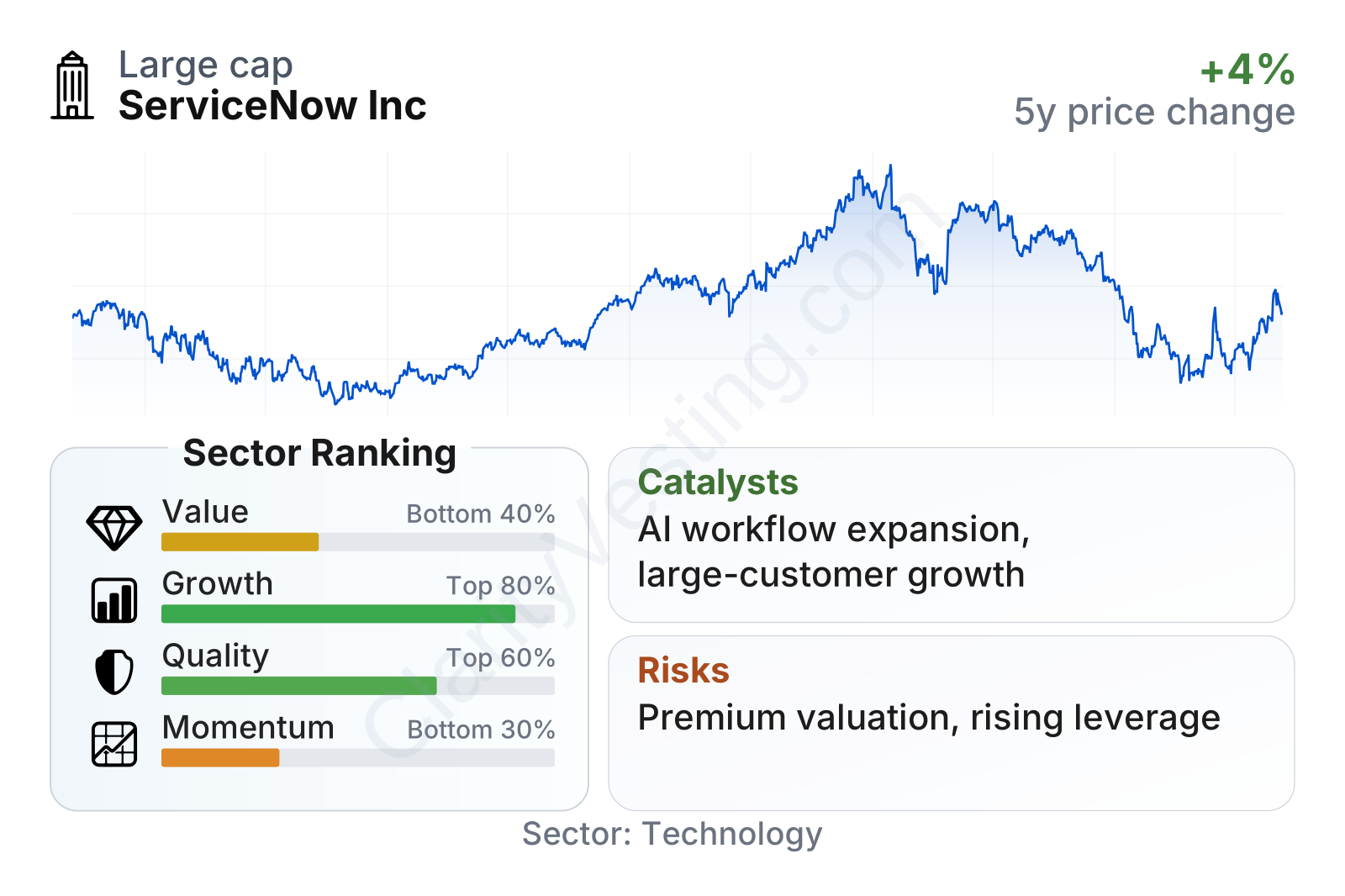
ServiceNow combines strong business quality and strong growth with weaker near-term share-price momentum. Growth metrics sit well above the sector median, helped by revenue expansion around 24% and a five-year free cash flow growth rate far ahead of many software peers. Profitability is also solid, with operating and profit margins above sector norms. The weaker area is valuation, where the earnings multiple remains elevated versus the sector, even after a large pullback in the share price. That combination usually points to a company with durable fundamentals but high expectations still embedded in the stock.
The stock-price history highlights this tension clearly. ServiceNow delivered a powerful multi-year climb, but recent trading has been much weaker, with the shares well below their earlier highs. That drop has reduced some valuation pressure, though it has not turned the company into an obviously cheap software name on traditional earnings measures.
Growth
ServiceNow operates in a part of software that still has a long runway: enterprise digital transformation. Large companies continue to replace manual processes with workflow software, integrate departments on common platforms, and use AI to handle repetitive tasks faster. This is not a niche trend. It touches IT operations, employee support, customer service, compliance, procurement, and industry-specific work. As a result, ServiceNow’s addressable market is broader than its origins in IT service management might suggest.
The company’s strategy for future growth is coherent. Rather than selling many unrelated tools, it promotes one platform that can serve multiple departments. That matters because software buyers increasingly prefer fewer vendors, cleaner data flows, and easier automation across teams. A customer that starts with IT can later add HR, customer care, security operations, app development, or AI agents on the same system. This cross-sell path is one of ServiceNow’s most important growth engines.
Revenue growth has remained remarkably resilient, staying around the low-20% to mid-20% range through multiple periods. That consistency is notable for a company already operating at large scale. It suggests demand is not coming from a short-lived product cycle, but from deeper adoption of the platform across enterprise customers.
Artificial intelligence is the most visible catalyst today. ServiceNow has been embedding generative AI, AI assistants, and agentic workflow capabilities into its platform so customers can automate more work with less human intervention. In practice, that can mean faster IT ticket resolution, automated employee support, smarter customer-service routing, and workflow creation with less manual coding. Because ServiceNow already sits at the center of many enterprise processes, AI can be sold as an enhancement to existing workflows rather than a completely separate system.
Another growth support is the company’s strong free cash flow generation. That gives management room to invest in product development, partnerships, data center capacity, and sales expansion without depending heavily on external financing.
Free cash flow has risen sharply over the last several years, moving from under $2 billion to well above $4 billion on a trailing basis. That is an important signal for long-term analysis because it shows the business is converting growth into real cash, not just accounting profits.
Recent company updates have also pointed to continued expansion in large-customer relationships and in newer products tied to AI and workflow automation. Strategic partnerships with major cloud and enterprise software providers help ServiceNow reach bigger clients and fit more naturally into existing corporate technology stacks. For a platform business, those ecosystem ties can meaningfully extend growth.
Risks
This article is for informational purposes only and does not constitute financial advice. Some content is AI-generated. See Disclaimer