Stock Analysis · Novanta Inc (NOVT)
Overview
Novanta Inc. is a technology company that supplies specialized components and subsystems used inside advanced machines. Its products are not usually consumer-facing. Instead, they are built into equipment used in medical and life sciences, manufacturing, and automation applications. The company focuses on areas where precision, reliability, and motion control matter, such as lasers, imaging, motion systems, robotics, and surgical technologies.
Novanta reports its business in three operating segments. Based on the latest annual filing for 2025, revenue is distributed approximately as follows:
- Precision Medicine and Manufacturing: about 45% of revenue. This segment includes photonics, beam delivery, vision, and precision motion technologies used in medical equipment and advanced industrial systems.
- Medical Solutions: about 30% of revenue. This area includes components and subsystems used in minimally invasive surgery, diagnostics, and other medical device applications.
- Robotics and Automation: about 25% of revenue. This segment includes motion control, encoders, drives, and related technologies used in robotics, warehouse automation, and industrial automation.
That mix matters for long-term analysis because Novanta is not dependent on a single product line. It sells a portfolio of enabling technologies to equipment makers, which can create recurring demand as customers redesign or upgrade their own systems. At the same time, the business depends heavily on capital spending cycles in medical technology and industrial automation.
The financial flow over the last several years shows a business that expanded revenue from roughly $700 million in 2021 to about $980 million in 2025, but with pressure on profitability more recently. Gross profit grew in absolute dollars, yet operating income and net income did not keep pace as selling costs, research spending, and other operating expenses increased.
Key Figures
| Metric | Value | Sector ⓘ |
|---|---|---|
| Date | Sep 12, 2026 | |
| Context | ||
| Sector | Technology | |
| Industry | Scientific & Technical Instruments | |
| Market Cap ⓘ | $5.44B | |
| Beta ⓘ | 1.68 | |
Value (Cheapness) | ||
| P/E Ratio ⓘ | 91.08 | 29.51 |
| FCF Yield ⓘ | 2.10% | 4.25% |
| EBIT / EV ⓘ | 1.81% | 2.85% |
| PEG ⓘ | 2.11 | |
Growth (Business expansion) | ||
| Revenue Growth ⓘ | 10.30% | 15.40% |
| RPS Growth (5Y CAGR) ⓘ | 7.84% | 8.56% |
| EPS Growth (5Y CAGR) ⓘ | -15.55% | -11.88% |
| Margin Growth (5Y Trend) ⓘ | -2.32% | 0.46% |
| FCF Growth (5Y CAGR) ⓘ | -9.58% | 9.80% |
Quality (Business durability) | ||
| ROIC (Latest) ⓘ | 4.76% | 9.44% |
| ROIC (5Y Median) ⓘ | 9.20% | 8.30% |
| Net Debt / EBIT (Latest) ⓘ | -1.13 | 0.54 |
| Net Debt / EBIT (5Y Median) ⓘ | 2.87 | 0.44 |
| Operating Margin (Latest) ⓘ | 8.68% | 9.58% |
| Operating Margin (5Y Median) ⓘ | 12.48% | 8.25% |
| Debt to Equity (Latest) ⓘ | 17.50% | 33.33% |
| Profit Margin (Latest) ⓘ | 6.00% | 7.14% |
| Free Cash Flow (Latest) ⓘ | $114.28M | |
Momentum (Price trend) | ||
| 3Y Return ⓘ | -6.46% | +45.48% |
| 12M Return (excl. last month) ⓘ | +37.83% | +23.48% |
| 6M Return ⓘ | +22.60% | +20.93% |
| Price vs. 200-Day MA ⓘ | +5.82% | +7.43% |
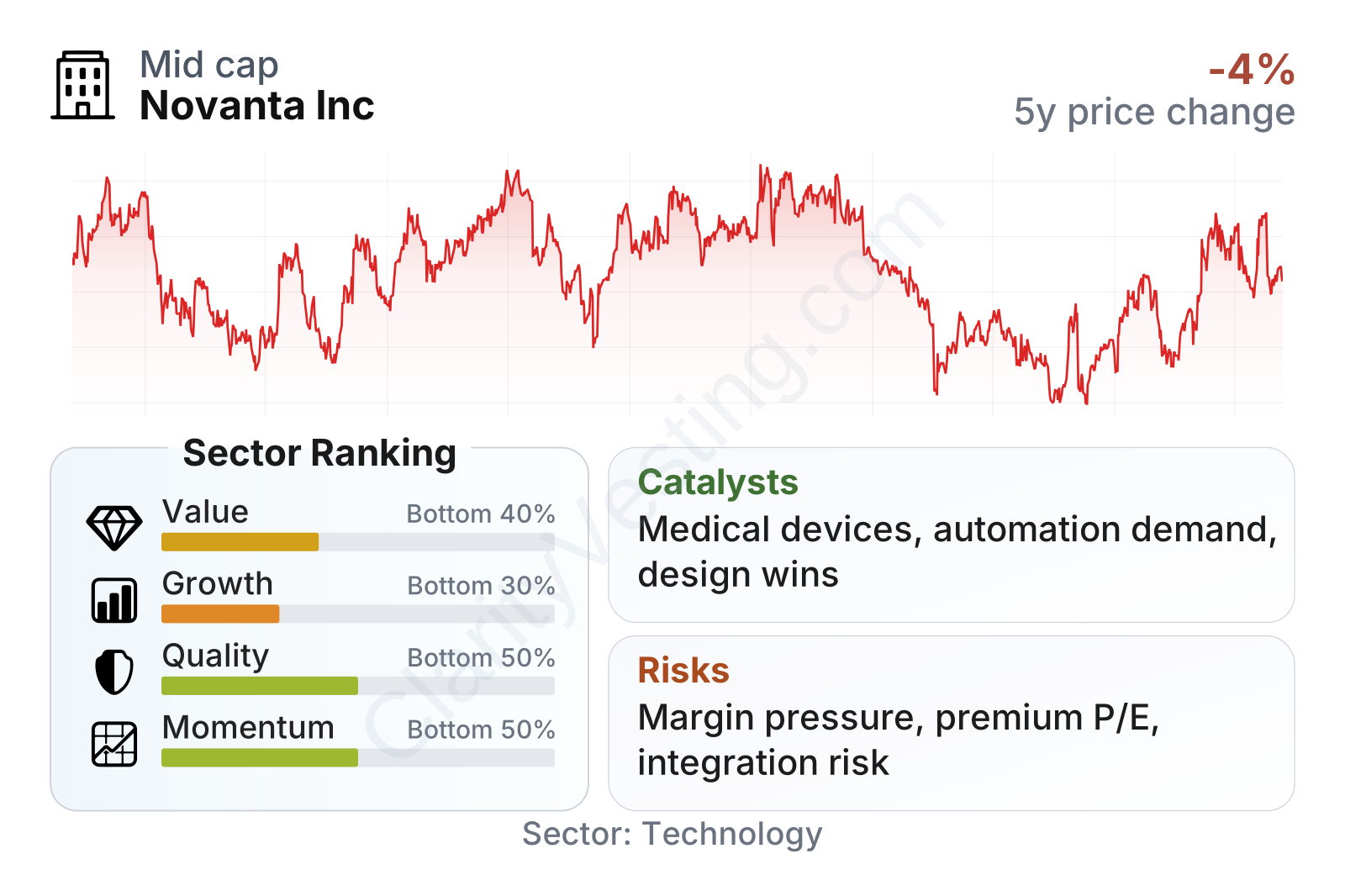
Novanta is a mid-sized technology and industrial instrumentation company with a market value around $6 billion and a stock that has been more volatile than the broader market, as shown by its beta above 1.5. The factor summary points to a mixed profile. Balance-sheet strength stands out, with net cash on a trailing basis and debt to equity down to about 17%, clearly below the sector median. However, value, growth, and quality rankings are mostly in the lower half of the sector. The main reason is that current earnings, margins, and cash-flow efficiency do not fully match the stock’s premium valuation.
The stock history also shows that Novanta has not moved in a straight line. Shares were strong in 2024, weakened materially through much of 2025, and then recovered in early 2026. That pattern fits a company whose market rating is sensitive to changes in growth expectations and margin trends.
Growth
Novanta operates in markets that have credible long-term growth drivers. Medical technology continues to benefit from greater use of minimally invasive procedures, higher adoption of imaging and diagnostics, and ongoing demand for automation inside healthcare equipment. Industrial automation and robotics also remain structural themes as manufacturers seek higher productivity, better precision, and more flexible production systems. These are attractive sectors, but they can still move through shorter business cycles that affect order timing.
Novanta’s strategy is coherent for that environment. The company has built a portfolio of niche technologies that are often difficult to replace once they are designed into a customer’s equipment. It also combines internal product development with acquisitions to deepen its capabilities and broaden customer relationships. This approach can support long-term expansion if integration is done well and end markets remain healthy.
Revenue growth has clearly slowed from the very strong pace seen in 2021 and 2022. After a softer period in 2023, growth improved again and has recently returned to around 10% year over year. That is a constructive sign, although it still sits below the sector median. In other words, the company is growing again, but not fast enough to remove all concerns around execution and valuation.
Cash generation adds another layer to the picture. Free cash flow improved strongly from 2022 through 2025, showing the business can convert earnings into cash when operations are running well. More recently, trailing free cash flow has dropped sharply from prior highs, which suggests either working-capital pressure, increased investment needs, or weaker operating conversion. For a company priced at a premium multiple, that recent softening matters.
A meaningful catalyst is Novanta’s exposure to higher-value medical and automation applications where customers care more about precision and reliability than about the lowest component price. Another important catalyst is new product content inside customer platforms, especially in surgical, vision, and motion applications. If demand in medical equipment and automation improves at the same time that Novanta keeps gaining design wins, revenue growth could strengthen without requiring a major change in the company’s business model.
Recent company communications in 2026 have also emphasized continued demand tied to medical and advanced manufacturing applications, along with ongoing portfolio shaping. That does not eliminate cyclical risk, but it supports the case that management is still aiming at markets with durable multi-year demand drivers rather than purely short-cycle industrial niches.
Risks
This article is for informational purposes only and does not constitute financial advice. Some content is AI-generated. See Disclaimer


