Stock Analysis · Nextnav Acquisition Corp (NN)
Overview
NextNav is a positioning, navigation, and timing company focused on services that work where traditional GPS can struggle, especially indoors and in dense urban areas. Its main offering is a terrestrial system designed to improve location accuracy and timing resilience for applications such as public safety, telecom infrastructure, critical infrastructure, connected devices, and next-generation location services. In simple terms, the company is trying to build a backup and enhancement layer for GPS rather than compete as a general software platform.
Based on company filings, NextNav is still in an early commercial stage. Revenue remains small relative to its operating costs, which means the business is still more about developing and proving the platform than harvesting mature recurring cash flow. Public disclosures indicate revenue is primarily tied to contracts, services, and technology-related arrangements connected to its positioning and timing platform, but the company does not provide a detailed segment breakdown with stable percentages in the same way a large diversified business would.
The available revenue picture can therefore be summarized this way:
- Positioning, navigation, and timing-related commercial revenue: the clear primary source of revenue. This includes services and arrangements linked to NextNav’s technology platform, spectrum assets, and related deployments.
- Other revenue sources: limited and not disclosed in enough detail to assign reliable percentages.
What stands out most is not the mix itself, but the gap between revenue and spending. The business has generated only a few million dollars annually in revenue while continuing to fund research, operating expenses, and network development at a much higher level. That makes NextNav less like a mature infrastructure software company and more like a specialized technology platform still trying to convert strategic assets into meaningful commercial scale.
The long-term pattern shows revenue improving from very low levels earlier in the decade, but costs have remained well above sales. Research and development spending has stayed meaningful, and selling, general, and administrative expense has also remained high, which helps explain why losses have persisted even as the company continues building out its platform.
Key Figures
| Metric | Value | Sector ⓘ |
|---|---|---|
| Date | Sep 12, 2026 | |
| Context | ||
| Sector | Technology | |
| Industry | Software - Infrastructure | |
| Market Cap ⓘ | $2.50B | |
| Beta ⓘ | 1.13 | |
Value (Cheapness) | ||
| P/E Ratio ⓘ | N/A | 29.51 |
| FCF Yield ⓘ | -2.14% | 4.25% |
| EBIT / EV ⓘ | -4.43% | 2.85% |
| PEG ⓘ | N/A | |
Growth (Business expansion) | ||
| Revenue Growth ⓘ | -4.30% | 15.40% |
| RPS Growth (5Y CAGR) ⓘ | 45.06% | 8.56% |
| EPS Growth (5Y CAGR) ⓘ | -20.11% | -11.88% |
| Margin Growth (5Y Trend) ⓘ | N/A | 0.46% |
| FCF Growth (5Y CAGR) ⓘ | N/A | 9.80% |
Quality (Business durability) | ||
| ROIC (Latest) ⓘ | -36.17% | 9.44% |
| ROIC (5Y Median) ⓘ | -56.26% | 8.30% |
| Net Debt / EBIT (Latest) ⓘ | N/A | 0.54 |
| Net Debt / EBIT (5Y Median) ⓘ | N/A | 0.44 |
| Operating Margin (Latest) ⓘ | -2660.02% | 9.58% |
| Operating Margin (5Y Median) ⓘ | -1756.86% | 8.25% |
| Debt to Equity (Latest) ⓘ | 3.94% | 33.33% |
| Profit Margin (Latest) ⓘ | N/A | 7.14% |
| Free Cash Flow (Latest) ⓘ | -$53.47M | |
Momentum (Price trend) | ||
| 3Y Return ⓘ | +199.41% | +45.48% |
| 12M Return (excl. last month) ⓘ | +30.55% | +23.48% |
| 6M Return ⓘ | -10.39% | +20.93% |
| Price vs. 200-Day MA ⓘ | -10.51% | +7.43% |
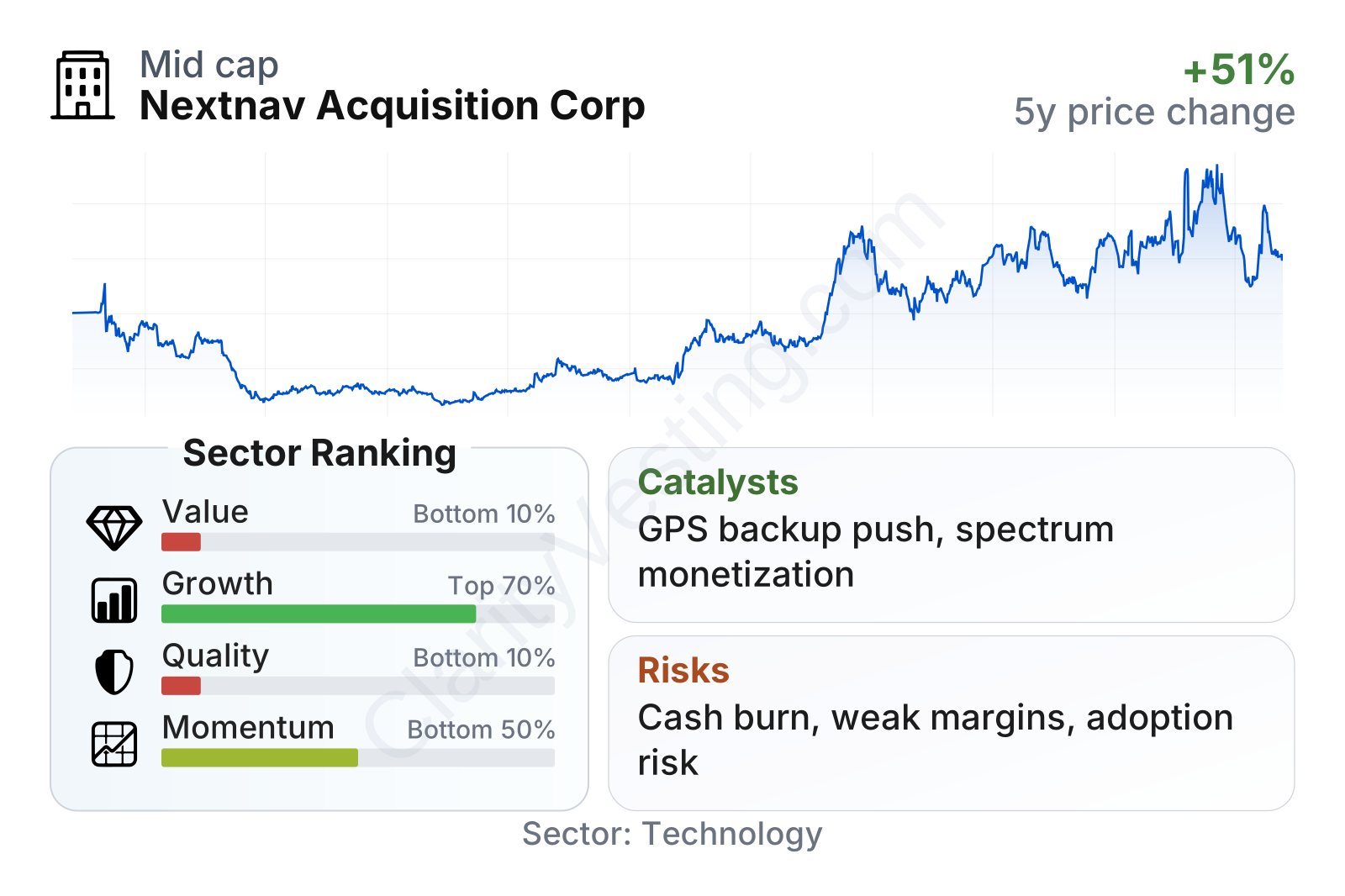
NextNav sits in a difficult middle ground. Its market value places it in the mid-cap range, but its operating profile still resembles an early-stage company. On the positive side, long-term revenue per share growth has been strong and the stock’s multi-year price performance has been far above the sector median. On the weaker side, profitability, returns on capital, and cash generation rank near the bottom of the sector, while traditional value measures are not very useful because earnings remain negative.
The share price history also shows how event-driven the stock can be. After a sharp decline in 2021 through 2023, the stock recovered strongly in 2024 and continued climbing into 2026. That kind of rebound often reflects rising expectations around strategic assets or policy-related opportunities, but it also means market sentiment can move faster than the underlying business results.
Growth
NextNav operates in a sector with real long-term demand drivers. Location technology, resilient timing, spectrum-enabled networks, and public safety communications are all areas with structural relevance. As more systems depend on precise timing and positioning, the need for alternatives or complements to satellite-based GPS becomes easier to understand. That broad theme supports the company’s strategic logic.
The strategy also makes sense on paper. Instead of trying to outspend much larger technology companies across many markets, NextNav is focused on a narrower problem: reliable positioning and timing in places where satellite signals can be weak or vulnerable. If that problem becomes more important for emergency response, telecom networks, or national infrastructure, a specialized provider could gain strategic value disproportionate to its current revenue base.
Recent revenue growth has been volatile rather than steady. The company posted some very strong year-over-year jumps in earlier periods, but more recent quarters show contraction, including a small decline in the latest reading versus the prior year. That suggests commercialization is still uneven. The long-term trajectory is better than the latest quarter alone would imply, but the business has not yet shown the kind of consistent scaling usually associated with a proven growth company.
Cash flow is the main constraint on the growth case. Free cash flow has remained negative for years and recently trended deeper into the red, moving from roughly the low-$40 million range of annual cash burn to closer to the high-$40 million range. That means growth still depends heavily on external funding, asset monetization, or future commercial wins large enough to change the economics of the business.
A major recent catalyst is the company’s push around spectrum and timing infrastructure. NextNav has argued that its assets can support a terrestrial complement to GPS and has positioned itself around national timing resilience and 5G-related infrastructure opportunities. If regulators, carriers, or government agencies move more decisively toward backup timing systems, NextNav could benefit because it already has a defined technical and spectrum position in this niche. That is the clearest reason the stock has attracted attention despite weak current earnings.
Risks
This article is for informational purposes only and does not constitute financial advice. Some content is AI-generated. See Disclaimer


