Stock Analysis · Nike Inc (NKE)
Overview
Nike is one of the world’s largest sportswear companies. It designs, markets, and sells athletic footwear, apparel, and equipment under the Nike, Jordan, and Converse brands. Its products are aimed at a wide range of consumers, from professional athletes to everyday buyers looking for sports-inspired fashion. The company relies on a global brand, product innovation, sponsorships, and a large distribution network that includes wholesale partners, company-owned stores, and digital channels.
Revenue is still heavily driven by footwear, with apparel and equipment making up smaller portions. Based on Nike’s recent annual reporting, the business mix is approximately the following:
- Footwear: about two-thirds of revenue, roughly 65% to 70%
- Apparel: about one-quarter of revenue, roughly 25% to 30%
- Equipment: a small share, roughly 3% to 4%
- Other brands and business lines: mainly Converse and licensing, a modest contribution
Geographically, Nike is also broad-based. North America remains the largest market, followed by Europe, the Middle East and Africa, Greater China, and Asia Pacific and Latin America. That matters for long-term analysis because it gives the company multiple growth levers, but it also exposes Nike to shifts in consumer demand, foreign exchange, and regional competition.
The business model is attractive in principle: Nike does not need to own most of the factories that make its products, so its value comes more from brand strength, design, marketing, and distribution than from heavy industrial assets. That structure has historically supported strong profitability and cash generation, even if recent performance has become more uneven.
The multi-year picture shows a company that expanded revenue strongly through 2024, then gave back a meaningful part of that progress in 2025, with only a limited stabilization in 2026. Gross profit has held up better than revenue, but net income has fallen much more sharply than sales, showing that margin pressure and operating discipline have become central issues.
Key Figures
| Metric | Value | Sector ⓘ |
|---|---|---|
| Date | Sep 12, 2026 | |
| Context | ||
| Sector | Consumer Cyclical | |
| Industry | Footwear & Accessories | |
| Market Cap ⓘ | $54.59B | |
| Beta ⓘ | 1.11 | |
Value (Cheapness) | ||
| P/E Ratio ⓘ | 17.52 | 17.10 |
| FCF Yield ⓘ | 4.00% | 8.53% |
| EBIT / EV ⓘ | 6.92% | 6.46% |
| PEG ⓘ | 1.42 | |
Growth (Business expansion) | ||
| Revenue Growth ⓘ | -1.10% | 5.75% |
| RPS Growth (5Y CAGR) ⓘ | 1.92% | 9.14% |
| EPS Growth (5Y CAGR) ⓘ | -19.61% | -18.21% |
| Margin Growth (5Y Trend) ⓘ | -6.68% | -0.23% |
| FCF Growth (5Y CAGR) ⓘ | -16.21% | 4.91% |
Quality (Business durability) | ||
| ROIC (Latest) ⓘ | 14.04% | 12.61% |
| ROIC (5Y Median) ⓘ | 36.70% | 10.72% |
| Net Debt / EBIT (Latest) ⓘ | 0.89 | 2.10 |
| Net Debt / EBIT (5Y Median) ⓘ | 0.73 | 2.32 |
| Operating Margin (Latest) ⓘ | 8.41% | 9.25% |
| Operating Margin (5Y Median) ⓘ | 12.66% | 9.64% |
| Debt to Equity (Latest) ⓘ | 74.22% | 75.78% |
| Profit Margin (Latest) ⓘ | 6.70% | 5.33% |
| Free Cash Flow (Latest) ⓘ | $2.18B | |
Momentum (Price trend) | ||
| 3Y Return ⓘ | -59.02% | +14.53% |
| 12M Return (excl. last month) ⓘ | -44.42% | +3.08% |
| 6M Return ⓘ | -30.68% | +0.55% |
| Price vs. 200-Day MA ⓘ | -26.31% | -0.54% |
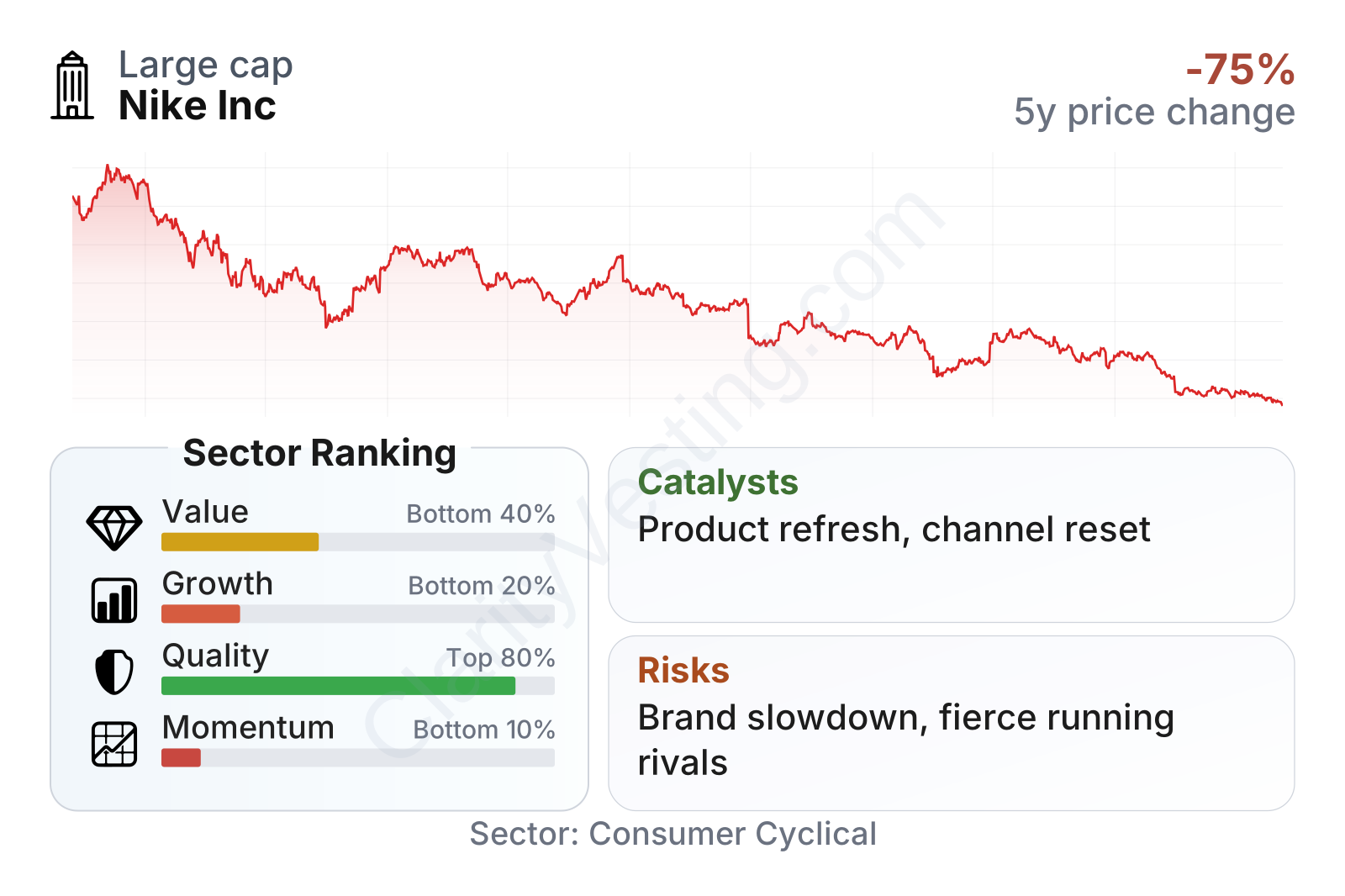
Nike remains a very large company, with a market value around $63 billion, but the profile in the latest metrics is mixed. Quality is still decent relative to much of the sector, helped by a strong long-term record of returns on capital and manageable leverage. However, growth and momentum rank weakly, reflecting shrinking sales over the last year, weaker margin trends, and a stock that has significantly underperformed the broader consumer discretionary peer group. On valuation measures, the shares do not screen as clearly cheap relative to the sector, especially considering the recent slowdown and lower free cash flow yield.
Growth
The athletic footwear and sportswear industry remains attractive over the long run. It benefits from several durable trends: health and wellness spending, the blending of sportswear with everyday fashion, direct-to-consumer digital retail, and continued demand for premium global brands. Nike is clearly operating in a sector that can still grow over time, but the important question is whether it can regain momentum faster than rivals.
Nike’s current strategy still makes sense on paper. The company has been working to sharpen product innovation, improve its digital and direct relationship with consumers, rebalance its wholesale presence, and refresh key franchises. For a brand like Nike, future growth does not depend only on expanding the total market; it also depends on staying culturally relevant and creating enough new products to avoid overreliance on older silhouettes.
Recent revenue growth has been weak. After a stronger rebound period earlier in the cycle, year-over-year growth turned negative and remained soft into the latest reading. That suggests Nike is still in a reset phase rather than a clean recovery. For a company of this size, low or negative top-line growth is not automatically alarming, but it becomes more serious when it lasts long enough to pressure margins and brand perception.
Cash generation tells a similar story. Nike has historically produced strong free cash flow, which is one reason the business has long been viewed as financially resilient. But trailing free cash flow has dropped sharply from earlier levels, indicating that the recent operating slowdown has had a real financial impact. Even so, the company is still cash generative, which gives management room to invest in product development, marketing, and supply chain improvements.
A meaningful catalyst is product renewal. Nike has acknowledged the need to improve its pipeline and restore energy in performance categories such as running, training, and women’s sportswear, while also supporting major lifestyle franchises. Another catalyst is the company’s effort to rebuild a healthier balance between direct sales and wholesale partners. In recent years, Nike leaned heavily into direct-to-consumer, but broad distribution remains important for reach, convenience, and visibility. A better channel mix could support both sales recovery and inventory discipline.
Recent company updates have also pointed to restructuring efforts, operational simplification, and a greater focus on execution. That does not create growth by itself, but it can help Nike recover earnings power if demand stabilizes and new product launches improve sell-through. For long-term analysis, the main opportunity is not a new business line; it is the possibility that a globally dominant brand returns to more normal growth and margin levels after a difficult stretch.
Risks
This article is for informational purposes only and does not constitute financial advice. Some content is AI-generated. See Disclaimer


