Stock Analysis · Nice Ltd (NICE)
Overview
Nice Ltd is a software company focused on customer engagement, contact center operations, and financial crime prevention. In simple terms, it helps large organizations manage customer interactions across phone, chat, email, social channels, and automated self-service tools, while also providing software used to detect fraud, support compliance work, and improve operational efficiency. The company has increasingly shifted toward cloud-based subscriptions, which usually means more recurring revenue and deeper customer integration over time.
Its business is organized mainly around two broad activities: customer experience software and financial crime/compliance solutions. Based on recent company reporting, customer experience has become the clear growth engine and the largest contributor to revenue, while the financial crime and compliance activity remains a meaningful second pillar.
Main sources of revenue can be summarized approximately as follows:
- Customer Experience (CX): about 70% to 75% of revenue. This includes cloud contact center software, AI-powered customer service tools, workforce engagement, digital self-service, analytics, and related services. The flagship platform is widely centered on CXone and adjacent cloud applications.
- Financial Crime & Compliance: about 25% to 30% of revenue. This segment includes anti-money laundering, fraud detection, case management, compliance monitoring, and public safety-related analytics used mainly by banks, financial institutions, and regulated organizations.
- By revenue model, cloud and recurring software now represent the majority of the business, while professional services and other one-time or lower-margin activities make up a smaller share.
The business mix is attractive for long-term analysis because it combines mission-critical software, recurring contracts, and exposure to two structural technology needs: better customer service automation and stronger fraud prevention.
The operating picture has also improved over the last several years. Revenue has expanded steadily, gross profit has risen with it, and net income has grown faster than sales. Research and development spending remains meaningful, but profitability has still moved higher, which suggests scale benefits rather than growth bought at the expense of margins.
The progression of revenue, gross profit, and net income points to a company that has been converting growth into stronger earnings, with financing costs falling sharply along the way. That combination matters because it suggests the cloud transition is not only lifting sales quality, but also helping the business become more efficient.
Key Figures
| Metric | Value | Sector ⓘ |
|---|---|---|
| Date | Sep 19, 2026 | |
| Context | ||
| Sector | Technology | |
| Industry | Software - Application | |
| Market Cap ⓘ | $6.17B | |
| Beta ⓘ | 0.05 | |
Value (Cheapness) | ||
| P/E Ratio ⓘ | 15.37 | 29.79 |
| FCF Yield ⓘ | 9.83% | 4.26% |
| EBIT / EV ⓘ | 10.93% | 2.82% |
| PEG ⓘ | 0.70 | |
Growth (Business expansion) | ||
| Revenue Growth ⓘ | 7.60% | 15.60% |
| RPS Growth (5Y CAGR) ⓘ | 12.81% | 8.58% |
| EPS Growth (5Y CAGR) ⓘ | -13.50% | -11.79% |
| Margin Growth (5Y Trend) ⓘ | 10.56% | 0.44% |
| FCF Growth (5Y CAGR) ⓘ | 15.54% | 9.80% |
Quality (Business durability) | ||
| ROIC (Latest) ⓘ | 11.25% | 9.48% |
| ROIC (5Y Median) ⓘ | 8.84% | 8.32% |
| Net Debt / EBIT (Latest) ⓘ | -0.37 | 0.54 |
| Net Debt / EBIT (5Y Median) ⓘ | 0.59 | 0.44 |
| Operating Margin (Latest) ⓘ | 20.14% | 9.58% |
| Operating Margin (5Y Median) ⓘ | 19.41% | 8.25% |
| Debt to Equity (Latest) ⓘ | 2.34% | 35.18% |
| Profit Margin (Latest) ⓘ | 13.86% | 7.16% |
| Free Cash Flow (Latest) ⓘ | $606.22M | |
Momentum (Price trend) | ||
| 3Y Return ⓘ | -40.96% | +45.90% |
| 12M Return (excl. last month) ⓘ | -26.85% | +19.52% |
| 6M Return ⓘ | -12.09% | +18.03% |
| Price vs. 200-Day MA ⓘ | +0.41% | +5.69% |
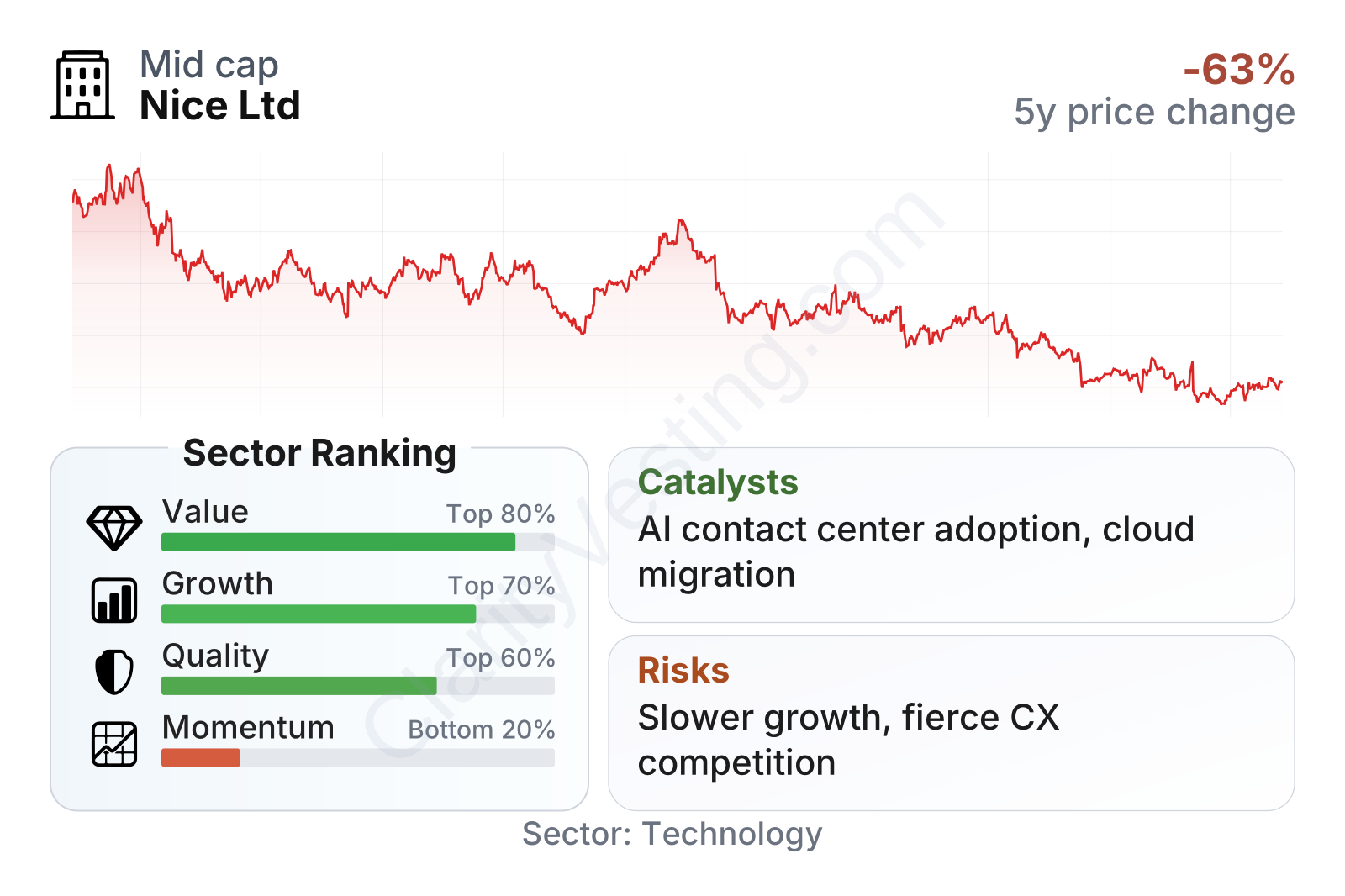
Nice stands out more for business quality and cash generation than for recent market momentum. Profitability is clearly above the software sector median, free cash flow generation is strong, and leverage is very low. Growth is still positive, although the most recent year-over-year revenue increase is below the sector median, which helps explain why the shares have lagged despite healthy fundamentals.
Growth
Nice operates in segments that are still supported by durable long-term demand. Companies continue to move customer service workloads to the cloud, add automation and AI to reduce service costs, and unify fragmented communication channels. At the same time, financial institutions and regulated organizations face rising fraud complexity and heavier compliance requirements. Those are not temporary trends, which gives Nice a favorable industry backdrop.
The company’s strategy also makes sense for future expansion. Its focus on cloud subscriptions, AI-enabled workflows, and platform breadth gives customers reasons to consolidate spending with one vendor instead of stitching together separate tools. That can support both new customer wins and additional sales into the existing base. In software, that combination is important because it tends to improve retention and raise revenue per customer over time.
Revenue growth has cooled from the very strong pace seen a few years ago, but it remains positive. The pattern suggests Nice is moving from a faster expansion phase into a more mature one, where consistency and margin discipline matter more. That is not necessarily negative, especially when the company is still improving profitability and operating efficiency.
Cash generation is one of the more important positives. Free cash flow has grown strongly over the last several years, even if the latest trailing figure sits below the prior peak. The broader trend still indicates a business capable of funding product development, acquisitions, and balance sheet improvement without relying heavily on outside capital.
A meaningful catalyst is the wider enterprise adoption of AI in contact centers. Nice has been embedding AI into customer service, agent assistance, workflow automation, and self-service tools. As more enterprises look for measurable productivity gains rather than experimental AI projects, vendors with existing customer relationships and operational software already in place could have an advantage. Nice fits that profile.
Another opportunity is continued migration from older on-premise contact center systems toward cloud platforms. This transition has been underway for years, but it is not complete. Nice remains well positioned to benefit as enterprises modernize systems that are expensive to maintain and harder to integrate with digital channels and automation tools.
Risks
This article is for informational purposes only and does not constitute financial advice. Some content is AI-generated. See Disclaimer