Stock Analysis · Netflix Inc (NFLX)
Overview
Netflix is a global entertainment company built around subscription video streaming. Its service gives members access to movies, series, documentaries, animation, live programming in selected cases, and mobile games tied to the Netflix ecosystem. The core idea is simple: people pay a monthly fee to watch content on demand across TVs, phones, tablets, and computers.
The business is much more geographically diversified than many media companies. Netflix reports revenue by region rather than by product line, which reflects how the company is managed. In practice, most revenue still comes from the same core activity: paid streaming memberships. Advertising has become a newer contribution through the lower-priced ad-supported plan, but it is not disclosed as a separate line in the financial statements.
Main sources of revenue can be summarized as follows:
- Streaming subscriptions: approximately 90% to 95% of revenue. This includes monthly membership fees across Standard, Premium, and lower-priced plans in more than 190 countries.
- Advertising: likely less than 10% of revenue at this stage. This comes from the ad-supported tier launched to widen the addressable market and improve monetization of lower-price plans. Netflix has indicated strong growth in this area, but it does not separately report the exact share.
- Other revenue: very limited. This includes items such as consumer products or experiences, but these remain immaterial relative to the main subscription business.
Regionally, Netflix’s revenue base is broad, with the largest contribution typically coming from the United States and Canada, followed by Europe, the Middle East and Africa, then Latin America, and Asia-Pacific. That geographic spread helps reduce dependence on any single country, while also giving the company room to raise prices and expand advertising in different markets over time.
The business model has also become more efficient. Over the last several years, revenue has climbed from roughly $30 billion to more than $45 billion, while operating income and net income have grown even faster. That suggests Netflix is no longer just a scale-building platform; it is increasingly converting scale into profit and cash generation.
The financial flow shows a clear improvement in earnings power. Revenue has risen steadily, but gross profit and operating income have expanded even faster, meaning a larger portion of each sales dollar is reaching the bottom line than a few years ago.
Key Figures
| Metric | Value | Sector ⓘ |
|---|---|---|
| Date | Sep 12, 2026 | |
| Context | ||
| Sector | Communication Services | |
| Industry | Entertainment | |
| Market Cap ⓘ | $322.29B | |
| Beta ⓘ | 1.53 | |
Value (Cheapness) | ||
| P/E Ratio ⓘ | 23.89 | 18.61 |
| FCF Yield ⓘ | 3.41% | 13.68% |
| EBIT / EV ⓘ | 5.28% | 4.54% |
| PEG ⓘ | 1.41 | |
Growth (Business expansion) | ||
| Revenue Growth ⓘ | 13.40% | 5.40% |
| RPS Growth (5Y CAGR) ⓘ | 12.55% | 4.62% |
| EPS Growth (5Y CAGR) ⓘ | 22.80% | -18.01% |
| Margin Growth (5Y Trend) ⓘ | 7.63% | 1.10% |
| FCF Growth (5Y CAGR) ⓘ | N/A | 5.88% |
Quality (Business durability) | ||
| ROIC (Latest) ⓘ | 33.87% | 8.38% |
| ROIC (5Y Median) ⓘ | 21.42% | 8.32% |
| Net Debt / EBIT (Latest) ⓘ | 0.30 | 1.99 |
| Net Debt / EBIT (5Y Median) ⓘ | 1.42 | 2.94 |
| Operating Margin (Latest) ⓘ | 36.06% | 14.89% |
| Operating Margin (5Y Median) ⓘ | 22.24% | 12.96% |
| Debt to Equity (Latest) ⓘ | 47.46% | 59.59% |
| Profit Margin (Latest) ⓘ | 28.22% | 8.77% |
| Free Cash Flow (Latest) ⓘ | $10.99B | |
Momentum (Price trend) | ||
| 3Y Return ⓘ | +78.06% | +46.64% |
| 12M Return (excl. last month) ⓘ | -39.43% | +2.16% |
| 6M Return ⓘ | -17.93% | +5.05% |
| Price vs. 200-Day MA ⓘ | -10.25% | +2.88% |
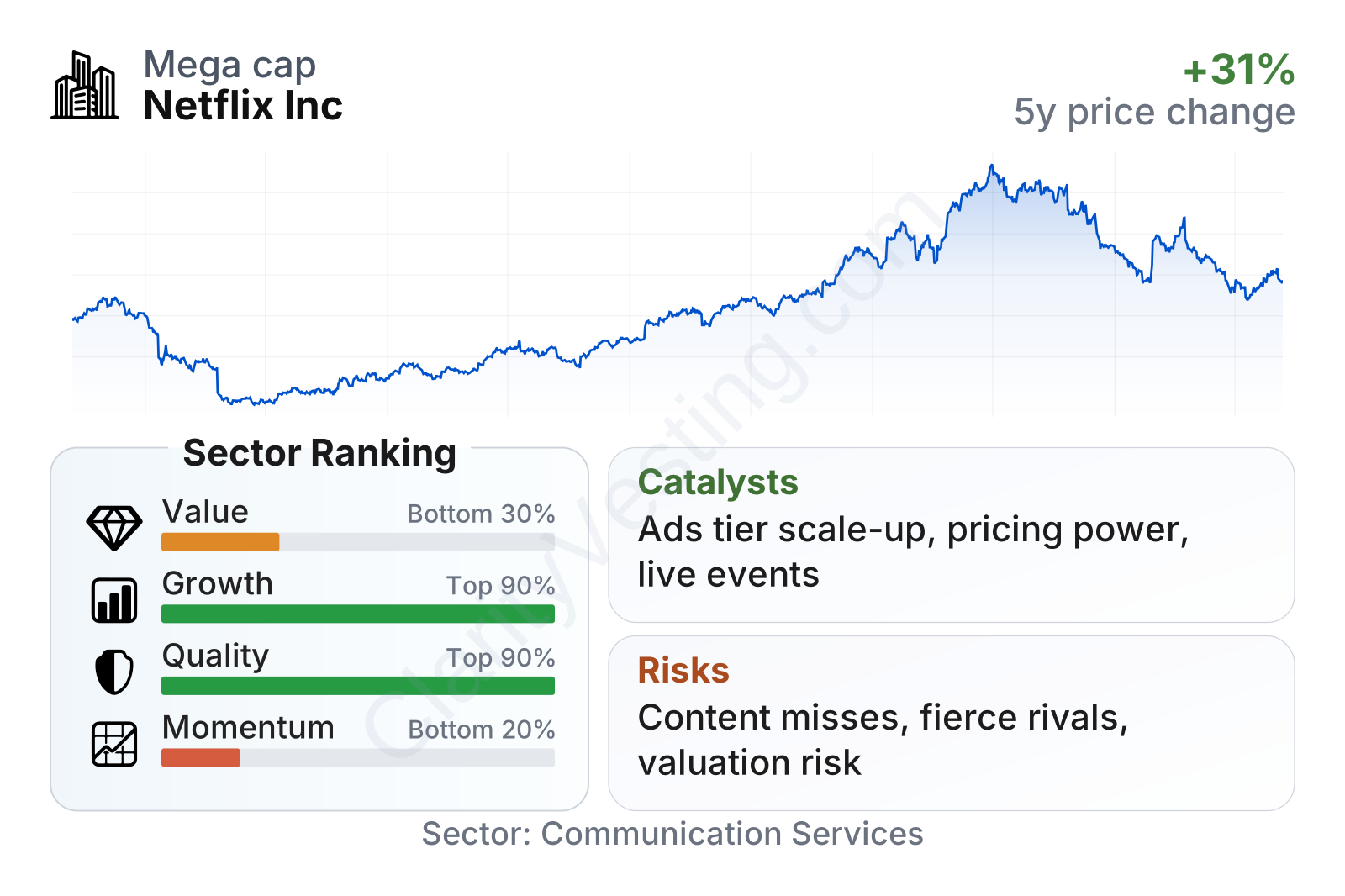
Netflix stands out for business quality and growth. Profitability, return on invested capital, and balance-sheet discipline all rank near the top of its sector, while revenue and earnings growth have also been well above typical entertainment peers. The weaker area is valuation, which still looks richer than the sector median, and recent price momentum has been softer despite strong long-term share performance.
With a market value in the very large-cap range and a beta above 1.5, the stock has historically shown that it can move more sharply than the broader market. That fits the company’s profile: a large, profitable platform, but one whose share price can still react strongly to subscriber trends, margins, and changes in sentiment around growth.
Growth
Netflix operates in a sector that still has room to grow over the long run. Traditional linear television continues to lose attention share, while streaming remains the main destination for on-demand viewing. That does not mean the industry is easy; it is highly competitive. Still, the structural shift from cable bundles to internet-delivered entertainment remains favorable for large global platforms with strong brands and deep content libraries.
Netflix’s strategy for the next phase of growth is more balanced than it was a few years ago. Earlier, the market focused heavily on subscriber additions alone. Now the company is pushing several levers at once: account sharing enforcement, price optimization, ad-supported memberships, broader content variety, and more engagement through live events and games. That mix makes sense because it reduces reliance on any single growth driver.
Revenue growth slowed sharply in 2022, then recovered and returned to a low-teens to high-teens range. Even after that rebound, recent growth remains grounded enough to look sustainable rather than purely promotional. Compared with the sector median, Netflix has remained comfortably ahead.
Free cash flow is one of the biggest changes in the Netflix investment case. A few years ago, the company was often judged on future profit potential while cash spending on content remained heavy. Now it is generating very large positive free cash flow, reaching roughly $11 billion on a trailing basis. That gives Netflix more flexibility for content investment, debt management, and shareholder returns without changing the core business model.
A major catalyst is advertising. Netflix has spent years proving consumers will pay directly for the service, and it is now adding an advertising layer on top of that audience. If ad-supported plans keep scaling, Netflix can potentially reach lower-income households, improve retention through cheaper options, and generate more revenue per hour viewed. Management has also been building its own advertising technology stack, which can improve control over pricing and targeting over time.
Another growth support is pricing power. Netflix has repeatedly shown that customers will tolerate higher monthly prices when the content lineup and user experience remain strong. Price increases do carry churn risk, but a company does not usually maintain this kind of flexibility unless its service has become a habitual part of household entertainment spending.
Recent company updates have also highlighted continued expansion in advertising capabilities, stronger monetization after paid sharing measures, and an ongoing push into live programming such as sports-related events and entertainment specials. These are meaningful because they can deepen engagement and create moments that are harder to replicate with a static library alone.
Risks
This article is for informational purposes only and does not constitute financial advice. Some content is AI-generated. See Disclaimer


