Stock Analysis · Cloudflare Inc (NET)
Overview
Cloudflare is a software infrastructure company that helps websites, applications, networks, and corporate systems run faster, stay available, and remain protected from cyberattacks. Its platform sits between users and customer systems, allowing it to filter malicious traffic, speed up content delivery, secure internet-facing applications, connect employees to internal tools, and support developers building software closer to end users through its global network.
The business has expanded well beyond its early focus on content delivery and DDoS protection. Today, Cloudflare positions itself as a broad connectivity and security platform. Its network spans hundreds of cities globally, and that scale matters because the same infrastructure can support multiple services at once: application security, zero-trust access, performance optimization, developer tools, and network services. That shared platform is a key part of the company’s economic model.
Cloudflare does not provide a detailed revenue split by product line in its primary filings, so precise percentages are not publicly disclosed. Based on company disclosures about its platform structure and sales focus, revenue can be understood through the following main categories, ordered by business importance rather than exact reported percentages:
- Security solutions — protection against DDoS attacks, web application threats, bots, API abuse, and identity-based access risks. This also includes zero-trust offerings used to secure employees, devices, and applications.
- Performance services — content delivery, caching, traffic routing, image and video optimization, and tools that improve website and application speed and reliability.
- Network services — products such as secure connectivity, WAN replacement capabilities, DNS, and tools that help enterprises modernize traditional network infrastructure.
- Developer platform and related services — edge compute, serverless functions, storage, databases, AI-related inference and developer tooling delivered on Cloudflare’s network.
Another useful way to view the business is by customer type. Cloudflare serves self-serve users, small and medium-sized businesses, and large enterprises, but enterprise customers account for a growing share of revenue. Larger customers typically adopt more products over time, which can raise contract sizes and improve retention.
The financial flow also shows a business with strong gross profit expansion: revenue has climbed from roughly $0.7 billion in 2021 to more than $2.1 billion in 2025, while gross profit has remained a large share of sales. The main pressure point has been operating expenses, especially research and development and sales-related spending, which explains why accounting profits have remained negative even as scale improved.
Key Figures
| Metric | Value | Sector ⓘ |
|---|---|---|
| Date | Sep 12, 2026 | |
| Context | ||
| Sector | Technology | |
| Industry | Software - Infrastructure | |
| Market Cap ⓘ | $109.15B | |
| Beta ⓘ | 1.66 | |
Value (Cheapness) | ||
| P/E Ratio ⓘ | N/A | 29.51 |
| FCF Yield ⓘ | 0.35% | 4.25% |
| EBIT / EV ⓘ | -0.17% | 2.85% |
| PEG ⓘ | 2.38 | |
Growth (Business expansion) | ||
| Revenue Growth ⓘ | 35.90% | 15.40% |
| RPS Growth (5Y CAGR) ⓘ | 31.17% | 8.56% |
| EPS Growth (5Y CAGR) ⓘ | N/A | -11.88% |
| Margin Growth (5Y Trend) ⓘ | N/A | 0.46% |
| FCF Growth (5Y CAGR) ⓘ | N/A | 9.80% |
Quality (Business durability) | ||
| ROIC (Latest) ⓘ | -3.21% | 9.44% |
| ROIC (5Y Median) ⓘ | -7.05% | 8.30% |
| Net Debt / EBIT (Latest) ⓘ | N/A | 0.54 |
| Net Debt / EBIT (5Y Median) ⓘ | N/A | 0.44 |
| Operating Margin (Latest) ⓘ | -7.43% | 9.58% |
| Operating Margin (5Y Median) ⓘ | -14.30% | 8.25% |
| Debt to Equity (Latest) ⓘ | 217.86% | 33.33% |
| Profit Margin (Latest) ⓘ | -8.21% | 7.14% |
| Free Cash Flow (Latest) ⓘ | $378.63M | |
Momentum (Price trend) | ||
| 3Y Return ⓘ | +372.82% | +45.48% |
| 12M Return (excl. last month) ⓘ | +53.93% | +23.48% |
| 6M Return ⓘ | +44.51% | +20.93% |
| Price vs. 200-Day MA ⓘ | +36.49% | +7.43% |
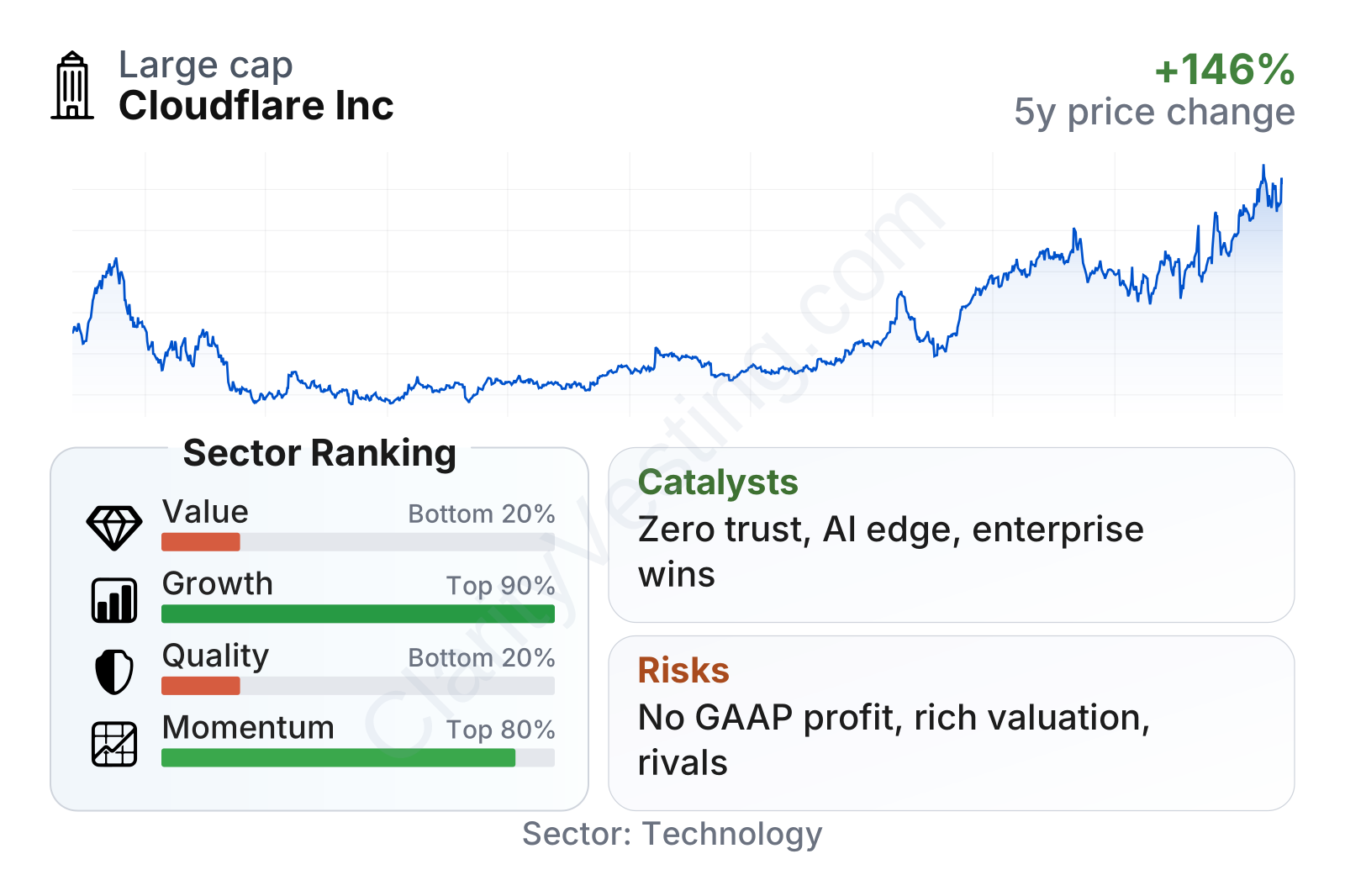
Cloudflare is now a very large software infrastructure company, but its financial profile remains unusual compared with much of the sector. Growth ranks near the top of its peer group, and share-price momentum has also been very strong. At the same time, value and quality measures remain weak versus the sector median because profitability is still negative and the stock trades on demanding expectations. The picture is therefore one of a business that the market rewards for expansion and strategic relevance, not for current earnings strength.
Growth
Cloudflare operates in markets with durable long-term demand. Cybersecurity spending continues to benefit from the rise in online threats, the spread of cloud applications, hybrid work, API-based software, and the need to secure users and data outside traditional corporate perimeters. At the same time, internet performance, network modernization, and edge computing remain active areas of enterprise investment. This gives Cloudflare exposure to several expanding segments instead of relying on a single narrow niche.
The company’s strategy is coherent for future growth because many of its services are built on one global network rather than on separate products stitched together through acquisitions. That can make it easier to cross-sell customers from one use case to another. A client that starts with application protection can later adopt zero-trust access, network connectivity, developer tools, or AI-related services. This platform approach is one reason the company often highlights large customers adopting multiple products.
Revenue growth has slowed from the extraordinary pace seen in 2021 and 2022, which is normal for a larger business, but the recent trend still stands out. Year-over-year growth has remained around the low-to-mid 30% range lately, well above the sector median near 16%. Over a five-year period, revenue per share growth has also been far stronger than typical software infrastructure peers. In other words, Cloudflare is no longer in hypergrowth, but it is still expanding at a pace that many mature software companies do not reach.
Cash generation is another important part of the growth case. Free cash flow has moved from negative territory in 2022 to clearly positive levels more recently, reaching roughly the mid-hundreds of millions of dollars on a trailing basis. That matters because it shows the company can invest aggressively while still producing cash, even if accounting profits remain negative. The gap between cash generation and net income is not unusual for software businesses, but it does require attention because stock-based compensation and other non-cash items can materially affect the comparison.
One of the strongest catalysts is Cloudflare’s role in helping enterprises replace older network and security architectures with cloud-based alternatives. Its zero-trust offerings, secure application access, network services, and developer platform all fit that shift. A second catalyst is artificial intelligence infrastructure at the network edge. Cloudflare has been pushing products that help route, secure, and run AI workloads closer to users, which could create additional demand if enterprises want lower latency and more distributed deployment options.
Recent company communications have continued to emphasize large customer growth, deeper product adoption, and progress in enterprise-oriented offerings. For a long-term view, the most significant opportunity is not one single product launch but the possibility that Cloudflare becomes a broader core layer of internet security, application delivery, and edge computing for enterprises.
Risks
This article is for informational purposes only and does not constitute financial advice. Some content is AI-generated. See Disclaimer


